1. About Dark and Bright Cave — Key Facts at a Glance
| Detail |
Information |
| Vietnamese name |
Hang Tối (Dark Cave) + Hang Sáng (Bright Cave) |
| Also known as |
Dark and Light Cave · Hang Sang Toi |
| Location |
Lan Ha Bay, at the border of Lan Ha Bay and Halong Bay, near Cat Ba Island |
| Cave type |
Sea caves — formed by tidal/seawater erosion at water level |
| Geological age |
Approximately 10,000 years (seawater intrusion) |
| Bright Cave (Hang Sáng) |
~70–100 m long · naturally sunlit · always accessible · shorter passage |
| Dark Cave (Hang Tối) |
~100 m long · near-total darkness · tide-dependent access |
| Hidden lagoon |
Approximately 1 km wide · fully enclosed by limestone cliffs |
| Access method |
Kayak or bamboo boat only — cruise ships and motorized boats cannot enter |
| Wildlife |
Monkeys · birds · colorful fish · squirrels · bats |
| 2026 access note |
Regulations on Dark Cave access vary with tidal conditions — always confirm with cruise operator |
2. Location & How to Get There
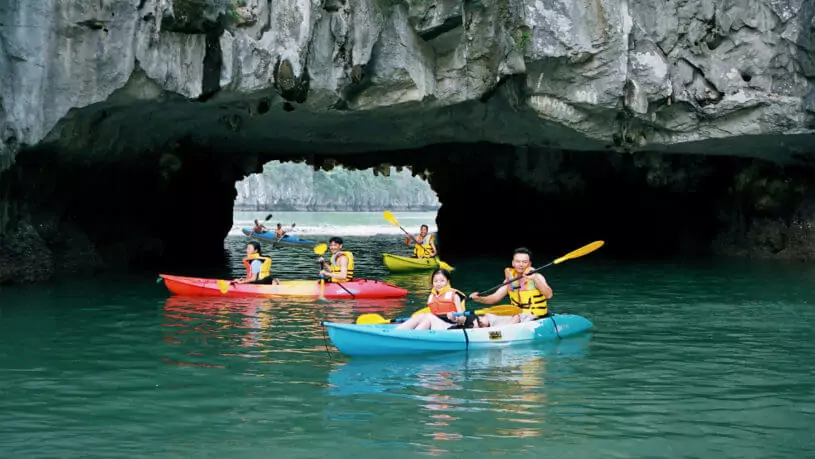 Kayaking through Dark and Bright Cave’s narrow water-level tunnel — from near-total darkness into a sunlit hidden lagoon — is the defining kayaking experience in Lan Ha Bay.
Dark and Bright Cave is located in Lan Ha Bay, at the boundary between Lan Ha Bay and the broader Halong Bay region — close to the southern edge of Cat Ba National Park, Hai Phong Province. The cave system is near Cat Ba Island and is considered a highlight of the Lan Ha Bay circuit rather than the main Halong Bay routes, meaning it is served by Lan Ha Bay cruise operators departing from Tuan Chau Port (Halong City) or Cat Ba Island.
Because the cave is administered under Hai Phong Province rather than Quang Ninh Province (where central Halong Bay lies), cruise ships with a Halong Bay operating license only may not automatically be permitted to stop here — it is important to choose a cruise operator who specifically includes Dark and Bright Cave in their Lan Ha Bay itinerary. The cave is typically a 1.5–2 hour boat journey from Tuan Chau Port and is combined with Ba Trai Dao Islets, the Ao Ech Area, or Viet Hai Village on most overnight itineraries.
3. Geology: How the Caves Were Formed
Dark and Bright Cave belongs to a relatively rare category in the Halong Bay region: sea caves, formed not by the rainwater dissolution process that carved the limestone interior of Sung Sot, Thien Cung, and most of the bay’s famous caves, but by the direct action of seawater erosion at water level. According to geological studies of the region, this cave system formed approximately 10,000 years ago during a period when rising sea levels following the last Ice Age caused seawater to intrude into fractures and weaknesses in the base of the limestone karst formation.
Over millennia, tidal action, wave energy, and the chemical corrosion of saltwater gradually widened these initial fractures into the low, narrow tunnels that exist today — tunnels whose ceilings sit just above the waterline at low tide, and below it at high tide. This is what makes Dark and Bright Cave unlike Halong Bay’s walk-through caves: the water is not the floor to be avoided, it is the road to be traveled. Ancient fossil evidence of freshwater snails and other marine organisms can be found embedded in the cave walls, confirming that this area was once fully submerged beneath the ocean at an earlier geological period.
4. The Kayaking Experience: Dark to Light
The experience of visiting Dark and Bright Cave follows a consistent, memorable arc from approach to arrival — from open water to darkness to dazzling light.
The Approach
From the cruise ship anchored in the bay, visitors board a kayak (self-paddled) or a bamboo boat (rowed by a local guide). The journey across the open water takes approximately 10–15 minutes, approaching the base of a limestone cliff formation where a low, arch-shaped gap in the rock — barely wide enough for a kayak or small boat — marks the entrance to the cave system. There are no stairs, no paved paths, no entrance gates. The only ticket is a paddle, and the only approach is low on the water.
The Bright Cave (Hang Sáng) — Gateway of Light
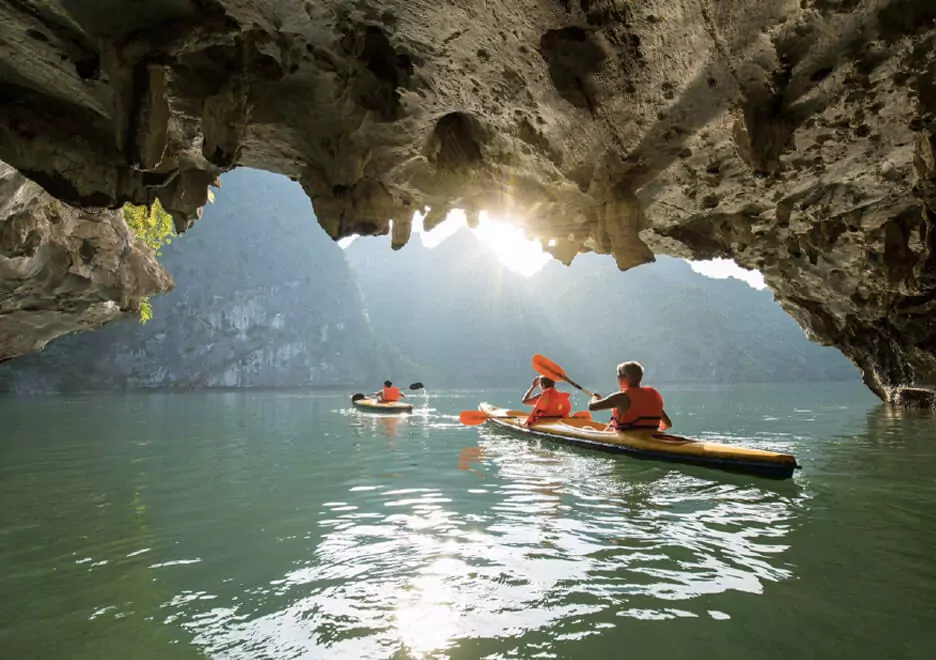 Beams of natural light filter through cracks in the Bright Cave’s limestone ceiling, creating shifting light patterns on the emerald water — an effect visitors consistently describe as “a natural cathedral.”
The Bright Cave is typically explored first — a passage of approximately 70–100 meters through which natural sunlight filters from above through cracks and openings in the limestone ceiling. The effect is extraordinary: beams of light cut through the dim interior, reflecting off the emerald water below, illuminating the cave walls with patterns that shift as the boat moves forward. The passage is relatively wide and always accessible by kayak or bamboo boat regardless of tide level. Paddling through this cave feels, as multiple sources have described, like entering a natural cathedral — the light, the silence, and the enclosed water creating an atmosphere unlike any indoor tourist cave.
The Dark Cave (Hang Tối) — Adventure in Darkness
The Dark Cave is the longer, more dramatic of the two passages — approximately 100 meters through which very little or no natural light penetrates. Visitors who enter the Dark Cave (subject to tidal conditions — see Section 6) paddle in near-total darkness, guided by the sound of the water, the echo of their own paddles, and any torchlight they carry. At certain points the ceiling is low enough that kayakers must duck, and at the narrowest sections the cave walls close in close enough to touch with both hands. The experience is thrilling, meditative, and genuinely adventurous in a way that no other attraction in the Lan Ha Bay region can match.
Two ways to experience the caves: Kayaking (self-paddled) — the most popular and immersive option; gives full control over pace and freedom to pause for photos or simply to absorb the experience. Bamboo boat (rowed by a local guide) — the relaxed alternative; you remain dry and hands-free, carried through both tunnels by a local rower with the confidence of someone who has made this journey hundreds of times. Both options emerge into the same hidden lagoon beyond.
5. The Hidden Lagoon & Wildlife
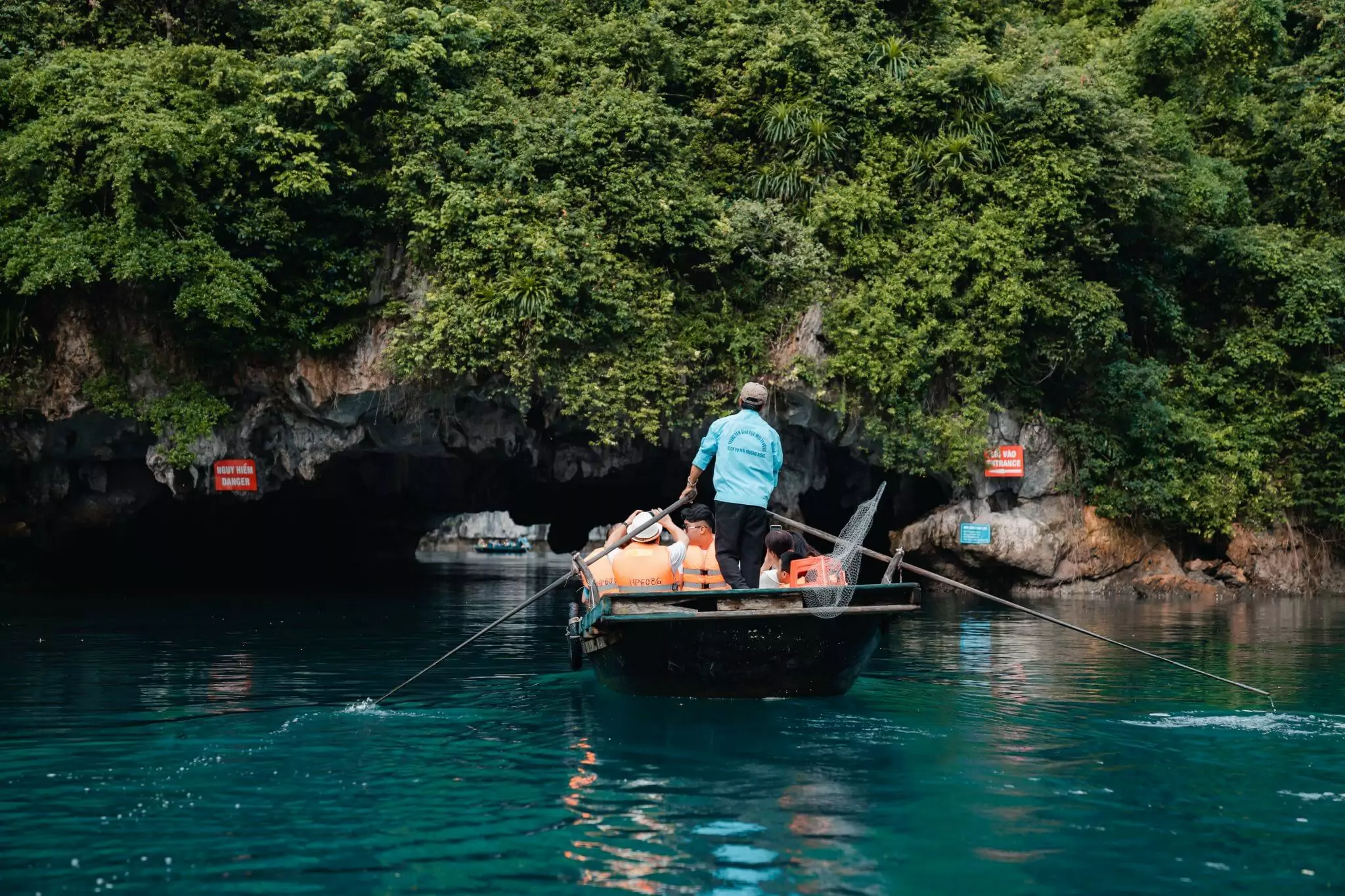 The hidden lagoon of Dark and Bright Cave — approximately 1 km wide, fully enclosed by sheer limestone cliffs — is one of the most extraordinary natural spaces in Lan Ha Bay.
Emerging from the cave tunnels — whether from the Bright Cave’s sunlit passage or the Dark Cave’s near-blackout tunnel — into the hidden lagoon is the defining moment of the entire experience. The lagoon is approximately 1 kilometer wide, completely enclosed on all sides by sheer limestone cliffs that rise dramatically from the waterline to heights of 20–30 meters and above. There are no gaps, no exits to the open bay visible from the water’s surface. The effect is total enclosure: a secret amphitheater of stone, sky, and still water, completely cut off from the world outside.
The lagoon’s water is mirror-calm — protected from wind and waves by the surrounding cliffs — and clear enough to see fish moving below the surface. The silence inside is striking: the sound of the paddle moving through the water, birds calling from the cliff tops, and the occasional crash of a monkey moving through the trees above are the primary sounds in a space that otherwise holds the quality of a natural anechoic chamber.
Wildlife in the Lagoon
The cliffs and forested slopes surrounding the lagoon form part of the buffer zone of Cat Ba National Park, and the wildlife visible here reflects that protected ecosystem:
- Monkeys: A troop of macaque or Golden-headed Langur monkeys inhabits the cliff faces around the lagoon, frequently visible climbing the rock or moving through the canopy. In 2026, “quiet zones” have been established to protect these primates from disturbance by engine noise — another reason why the kayak-only access rule is ecologically as well as aesthetically important.
- Colorful fish: Schools of tropical fish are visible through the clear water, especially near the cave walls where light filters down.
- Squirrels and birds: Squirrels occasionally dart across the cliff ledges; seabirds and raptors call from the cliff tops.
- Bats: The cave ceilings, particularly in the Dark Cave, host roosting bats visible as eyes adjust to the darkness.
- Jellyfish: On certain days, translucent jellyfish drift through the lagoon’s still water.
⚠️ Wildlife etiquette: Do not feed or approach the monkeys. Do not disturb roosting bats by shining torches directly at them. Do not collect any marine life or shells from the water. The lagoon and surrounding area form part of Cat Ba’s protected ecosystem — even small disturbances accumulate when multiplied across hundreds of daily visitors.
6. Access Rules & Tidal Conditions 2026
Dark and Bright Cave has important access rules that vary by tide level and evolve with updated management guidelines. Travelers should always confirm current conditions with their cruise operator before the visit.
| Cave |
Access Level |
Conditions |
| Bright Cave (Hang Sáng) |
Always open |
Accessible by kayak or bamboo boat at all tide levels; the more naturally lit, shorter passage |
| Dark Cave (Hang Tối) |
Tide-dependent |
Accessible only at low or medium tide — at high tide the ceiling may be at or below water level, making entry dangerous or impossible |
| Swimming in the lagoon |
Operator-dependent |
Some cruise operators permit a brief swim in the lagoon; others do not — always ask in advance |
| Night kayaking |
Available with select operators |
The Ao Ech area near Dark and Bright Cave is the premier spot for bioluminescent plankton night kayaking |
Important 2026 note on Dark Cave access: Access regulations for Dark and Bright Cave — particularly entry into the longer, darker tunnel — have been subject to management-level revisions in recent years by the Lan Ha Bay and Cat Ba authorities, reflecting both safety concerns (visitors getting caught at high tide) and environmental protection goals. Before booking, confirm with your cruise operator that both the Bright Cave passage and, if desired, the Dark Cave tunnel are explicitly included in your itinerary and approved for your visit date.
7. How to Visit Dark and Bright Cave in 2026
Dark and Bright Cave is accessible exclusively via Lan Ha Bay overnight cruise itineraries — it is not served by standard day tours from Halong City (which operate primarily on Halong Bay’s central zone) and requires a cruise operator licensed for Lan Ha Bay.
| Cruise Type |
Duration |
Dark & Bright Cave Included? |
| Day cruise |
6–8 hours |
Possible with Lan Ha Bay day cruise from Cat Ba or Tuan Chau — confirm itinerary |
| Overnight 2D1N |
2 days, 1 night |
Commonly included — this is the most popular option |
| Extended 3D2N |
3 days, 2 nights |
Included with more time in the lagoon and nearby Ao Ech area |
- From Hanoi: ~2.5–3 hours by road to Tuan Chau Port (Ha Long City), then cruise departs into Lan Ha Bay
- From Cat Ba Island: Join a half-day or full-day boat tour from Beo Harbor — the cave is closer to Cat Ba than to Tuan Chau
- Kayak rental: Usually included in cruise packages; if not, ask about rental rates on board
→ Browse Lan Ha Bay cruises including Dark and Bright Cave →
8. Best Time to Visit Dark and Bright Cave
| Season |
Months |
Conditions |
Rating |
| Spring |
Mar – May |
Calm water, clear skies, ideal tide windows — best overall for kayaking |
⭐⭐⭐⭐⭐ Best overall |
| Autumn |
Sep – Nov |
Clear skies return after summer rain, comfortable temperatures |
⭐⭐⭐⭐⭐ Excellent |
| Summer |
Jun – Aug |
Warmest water; bioluminescent plankton at its peak for night kayaking; higher typhoon risk |
⭐⭐⭐⭐ Good with caution |
| Winter |
Dec – Feb |
Cool, sometimes misty — adds atmosphere but can be chilly for kayaking |
⭐⭐⭐ Atmospheric |
Best time of day: Early morning (7:30–9:00 AM) — light filters into the Bright Cave most beautifully, the lagoon is calmest, and crowds from day-tripper groups have not yet arrived. Many experienced cruise operators schedule the Dark and Bright Cave stop for early morning to maximize these advantages.
Bioluminescent plankton: Night kayaking in the Ao Ech area near Dark and Bright Cave is best in June–August on moonless nights — one of the most magical experiences in all of Lan Ha Bay.
9. Practical Tips Before You Go
- Bring a headlamp or small torch if you plan to enter the Dark Cave tunnel — there is no artificial lighting and near-total darkness requires some light to paddle safely.
- Wear quick-dry clothing — kayaking through the narrow cave passages will almost certainly result in some splashing, and the low ceiling may force you to lie back in the kayak.
- Waterproof your phone and camera — a waterproof case or dry bag is essential, especially for the Dark Cave passage.
- Life jackets are mandatory — provided by your cruise operator. Do not enter the caves without one.
- Paddle in pairs (2026 rule). Solo kayaking is now prohibited at Dark and Bright Cave by the Lan Ha Bay management board — always paddle with at least one other person.
- Follow tidal guidance from your guide. Dark Cave entry during high tide is genuinely dangerous — never attempt to enter without a guide’s confirmation that conditions are safe.
- No noise in the lagoon. The quiet zones established in 2026 mean that loud voices, music, or engine noise from motorized boats are prohibited near the lagoon — this is actively enforced to protect the wildlife.
- Budget 45–60 minutes for the full experience: kayaking out from the cruise ship, through both cave passages, time in the lagoon, and return.
10. Dark and Bright Cave — Frequently Asked Questions
The questions we get asked most often by travelers planning to visit Dark and Bright Cave in Lan Ha Bay.
Last updated: June 2026 | Information verified against multiple Lan Ha Bay tourism sources. Access rules for the Dark Cave (Hang Tối) are subject to change based on tidal conditions and Lan Ha Bay management regulations — always confirm current access rules with your cruise operator before your visit. Dimensions are approximate and vary between sources.


