By Jimmy, Halong Bay cruise specialist · Updated
Sung Sot Cave 2026: Inside Halong Bay’s Biggest Show Cave and How to Visit
Sung Sot Cave, also called Surprise Cave, is one of the largest and most visited caves in Halong Bay. It lies on Bo Hon Island about 14 km from Tuan Chau, covers roughly 10,000 m², and was recorded by French explorers in 1901 as the Grotte des Surprises. A lit path of several hundred metres leads through two vast chambers to a viewpoint over the bay. It is a fixed stop on route VHL2 and on most classic overnight cruises.
Status (checked October 2026): Sung Sot Cave is open daily on route VHL2, about 07:30–17:30 in summer and 07:30–17:00 in winter. It reopened on 10 September 2024, three days after Typhoon Yagi; trees outside lost branches but the cave itself was not reported damaged.
Sung Sot Cave at a Glance
| Location |
Bo Hon Island, core zone of Halong Bay, Quang Ninh |
| Distance |
About 14 km from Tuan Chau; about 11 km from Ha Long International Cruise Port |
| Size |
About 10,000 m²; ceiling up to about 30 m; entrance about 25 m above sea level |
| Route inside |
Paved, lit one-way path of several hundred metres (reported up to about 800 m) |
| Steps |
A stairway from the pier to the entrance plus steps inside; moderate |
| Known for |
Huge chambers, colour-lit formations, view over the Bo Hon anchorage |
| Discovered |
Recorded by the French in 1901 (Grotte des Surprises) |
| Visit time |
45–60 minutes |
| Ticket |
Part of the VHL2 sightseeing ticket (250,000 VND, Management Board 2025); included in our cruise prices |
| Nearby |
Ti Top Island, Luon Cave, Soi Sim Island |
| Find it |
Google Maps · TripAdvisor |
Is Sung Sot Cave worth it? Yes, especially on a first visit: the sheer size of the second chamber is the surprise. It is busy and lit with coloured lights, so travellers who want wild, unlit caves may prefer kayaking at Luon Cave or the quieter caves of Lan Ha Bay.
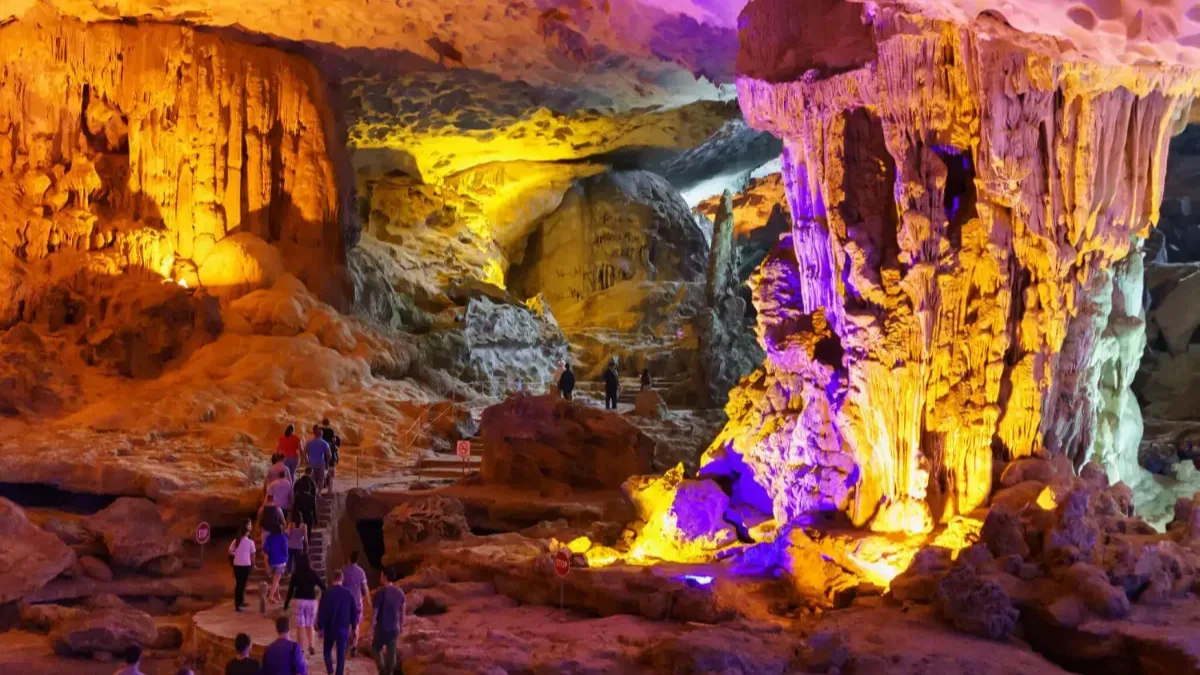 Stalactites hanging like chandeliers in the first chamber of Sung Sot Cave
What Makes Sung Sot Cave Special
Sheer scale
The Management Board describes Sung Sot Cave as the largest typical karst cave discovered in Halong Bay. The second chamber is so high and wide that guides compare it to a theatre or a castle hall.
An ancient, dry cave
Geologists class Sung Sot, like Thien Cung, as a remnant of an old phreatic cave formed when sea level and the water table were very different. Most of its formations are no longer actively growing, which keeps the path dry and easy.
A view at the exit
The path leaves the cave high on Bo Hon Island, above one of the bay’s busiest anchorages, with Ti Top Island across the water.
Easy to combine
Sung Sot, Ti Top and Luon Cave lie within a few kilometres of each other, so one route covers all three.
History, Name and Legend
French explorers recorded the cave in 1901 and named it the Grotte des Surprises. Sửng Sốt means astonished in Vietnamese. Guides explain the name in two ways: surprise at finding such a huge space inside a small island, and surprise at the shapes inside. Local legend also links the cave to Saint Giong, the boy-hero who drove out invaders; the round pools are said to be his horse’s hoofprints. See the official Management Board page and the Showcaves database for more background.
Dinners and parties inside Halong Bay’s caves, including Sung Sot, were stopped in 2016 to protect them.
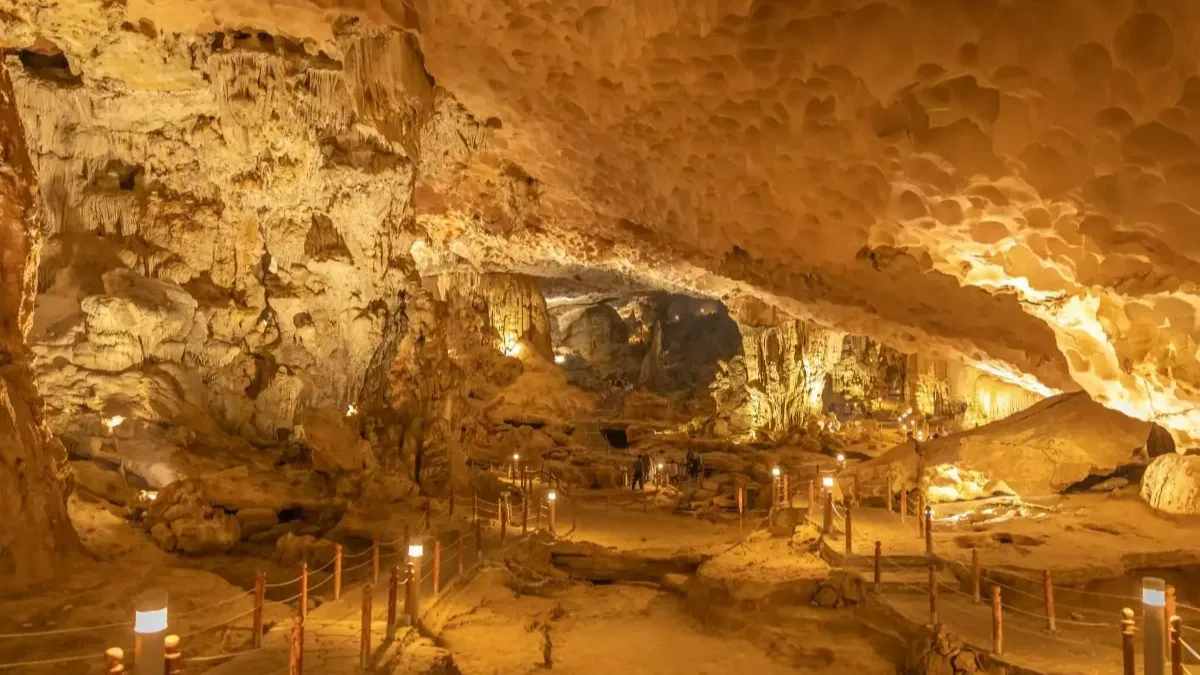 The vast second chamber of Sung Sot Cave
Inside Sung Sot Cave: Chamber by Chamber
1. The entrance and first chamber
After the stairway from the pier you enter a lower, wider chamber often called the waiting room, hung with stalactites like chandeliers. Guides point out shapes said to resemble animals.
2. The great hall
A short passage opens into the second chamber, the highlight. Its ceiling rises to around 30 m, natural light filters in from an opening, and the floor holds shallow pools.
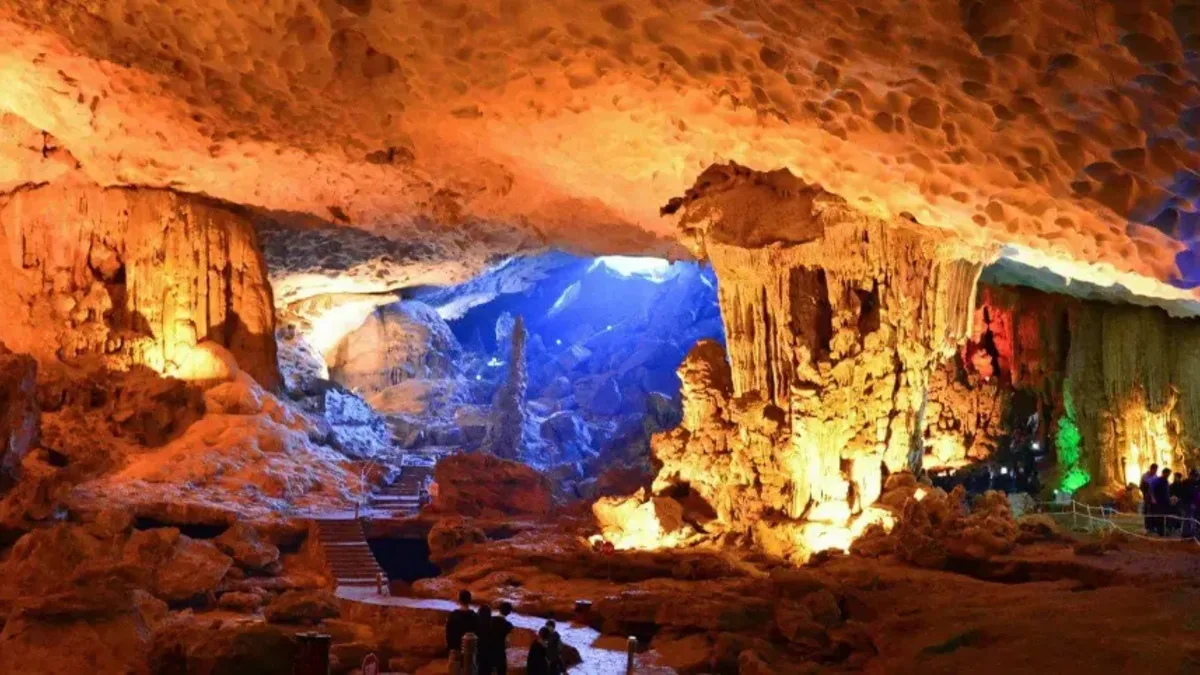 Rock formations and pools in the inner part of Sung Sot Cave
3. The famous formations
Guides name a turtle, a conical hat, an elephant, a banyan tree, a general’s horse and sword, and a large stalagmite lit in pink that locals treat as a fertility symbol. Part of the higher area is called the Royal Garden, with plants growing in the light shaft.
4. The exit viewpoint
The path climbs out to a terrace over the Bo Hon anchorage before the stairs down to the pier.
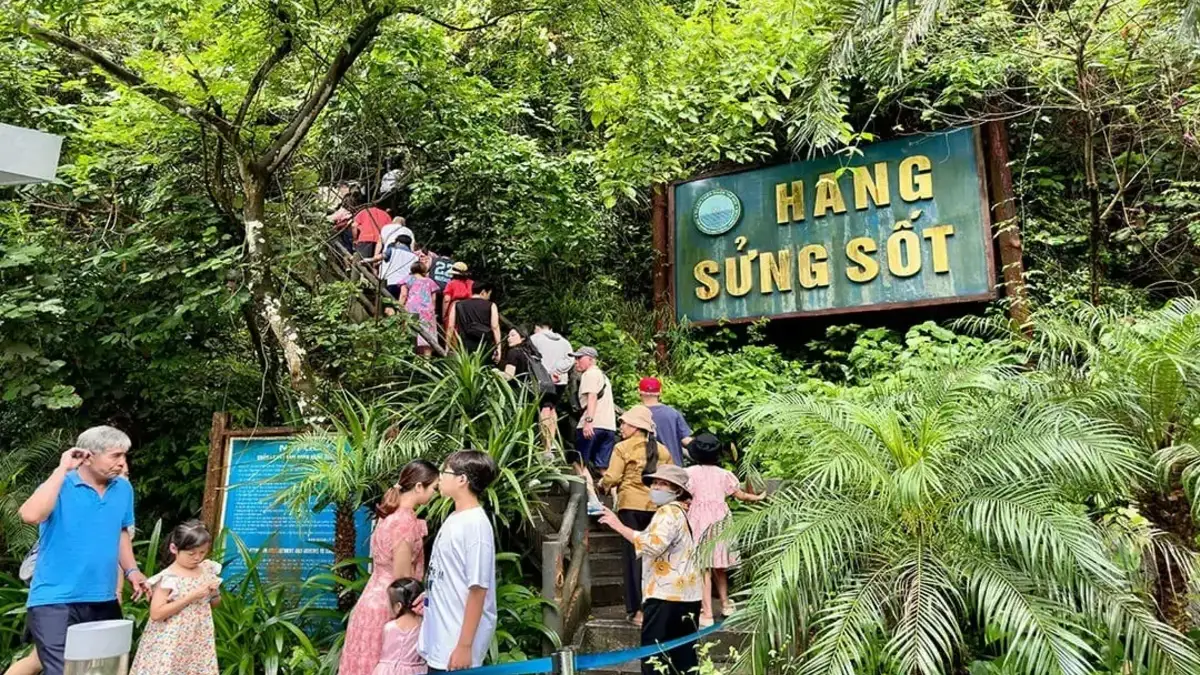 The stairway from the pier to the Sung Sot Cave entrance
Opening Hours, Tickets and Rules
| Item |
Details (checked October 2026) |
| Hours |
About 07:30–17:30 (summer) and 07:30–17:00 (winter) |
| Ticket |
Covered by the VHL2 route ticket (250,000 VND per adult per visit on the Management Board list, 2025); reduced or free for small children |
| Path |
Stairs from the pier, then a one-way lit loop with steps; not wheelchair accessible |
| Lighting |
Electric, multi-coloured |
| Rules |
Do not touch or break formations; no litter or single-use plastic; stay on the path |
How to Get to Sung Sot Cave
| Option |
How it works |
Notes |
| Halong Bay day cruise |
Route VHL2 boats from Tuan Chau or Ha Long International Cruise Port |
Usually with Ti Top and Luon Cave |
| Overnight cruise (classic route) |
Often Day 2 morning |
Earliest visits are the quietest |
| Public sightseeing boat |
Buy the VHL2 ticket inside the port terminal |
Shared or chartered boat |
Cruises in Lan Ha Bay visit Trung Trang Cave or Dark and Bright Cave instead; eastern-bay cruises visit Thien Canh Son Cave.
Best Time to Visit Sung Sot Cave
| Months |
Conditions |
Tip |
| October–December |
Cooler, less humid |
Most comfortable |
| January–April |
Cool outside, mild inside |
Good; mist on the bay |
| May–September |
Hot, humid, storm risk |
Go before 09:00 |
More in our best time to visit Halong Bay guide.
Sung Sot Cave vs Thien Cung Cave
|
Sung Sot Cave |
Thien Cung Cave |
| Route |
VHL2 (with Ti Top, Luon) |
VHL1 (with Dau Go) |
| Character |
Vast halls, bay view |
Dense, ornate formations |
| Size |
About 10,000 m² |
About 10,000 m² reported |
| Visited by |
Most overnight cruises |
Mainly short day boats |
Our view: On an overnight cruise you will almost certainly see Sung Sot Cave, and that is enough for most travellers. If you love caves, add Thien Cung Cave on a morning VHL1 boat.
How Sung Sot Cave Fits a Halong Bay Cruise
- Board in Ha Long and sail to the Bo Hon area
- Walk through Sung Sot Cave (about an hour)
- Kayak or row a bamboo boat at Luon Cave
- Climb or swim at Ti Top Island
Ships that include it: Catherine Cruise, Grand Pioneers Cruise I, Athena Luxury Cruise, Halong Phoenix Cruises and day boats such as Alova Premium Day Cruise.
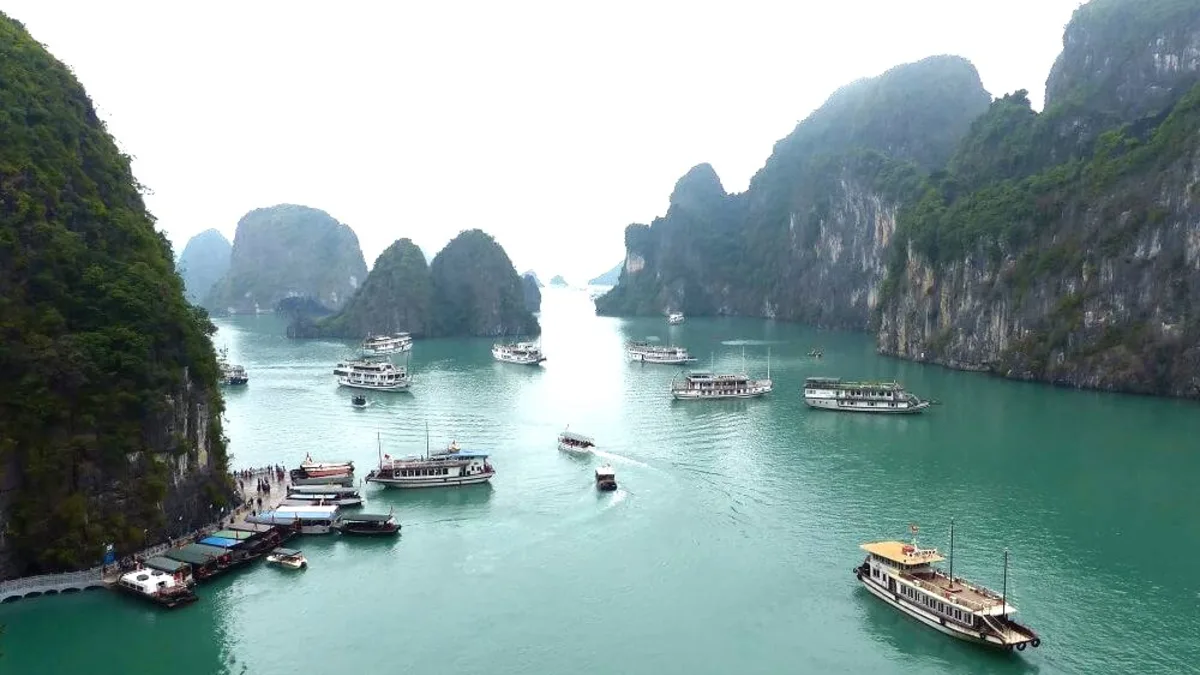 View over the Bo Hon anchorage from the Sung Sot Cave exit
Local Expert Tips for Sung Sot Cave
These tips come from more than a decade of arranging Halong Bay trips for international travellers; hours follow the Management Board’s schedule.
- Wear trainers; some steps are damp
- Carry water: the climb is warm in summer
- Stay with your guide; groups bunch up on the one-way path
- Phones in night mode handle the coloured lighting better than flash
- Travellers with limited mobility can wait at the pier and join at Luon Cave
Plan Your Visit
Compare our day cruises and luxury cruises that include Sung Sot Cave, or message us on WhatsApp +84 886 261 368. Best Price Guarantee included.
Frequently Asked Questions about Sung Sot Cave
1. Where is Sung Sot Cave?
Sung Sot Cave is on Bo Hon Island in the core of Halong Bay, about 14 km from Tuan Chau. See more Halong Bay attractions.
2. Why is it called Surprise Cave (Sung Sot Cave)?
Sửng Sốt means astonished; French explorers named it the Grotte des Surprises in 1901.
3. Who discovered Sung Sot Cave?
It was recorded by the French in 1901; local fishermen almost certainly knew it earlier.
4. How big is Sung Sot Cave?
About 10,000 m², with a ceiling up to about 30 m. Published lengths vary, so treat them as approximate.
5. How many steps are there at Sung Sot Cave?
A stairway climbs from the pier to the entrance about 25 m above sea level, with more steps inside; most visitors manage it easily.
6. How long does a Sung Sot Cave visit take?
About 45–60 minutes. Compare stop times in day cruise vs overnight cruise.
7. Is there a separate ticket for Sung Sot Cave?
No. It is part of the VHL2 ticket, included in our overnight cruise prices.
8. What are Sung Sot Cave opening hours?
About 07:30–17:30 in summer and 07:30–17:00 in winter.
9. Is Sung Sot Cave suitable for children and older travellers?
Yes for most, with care on the steps. Tell us about mobility needs via our contact page.
10. Is Sung Sot Cave open after Typhoon Yagi?
Yes. It reopened on 10 September 2024 and operates normally.
11. Which cruises visit Sung Sot Cave?
Most classic-route ships, such as Catherine Cruise.
12. Do Lan Ha Bay cruises visit Sung Sot Cave?
Usually not; they visit Trung Trang Cave or Dark and Bright Cave.
13. Is Sung Sot Cave crowded?
Yes at midday; overnight cruises often go early on Day 2. See our Halong Bay FAQs.
14. What is the pink rock in Sung Sot Cave?
A large stalagmite lit in pink that locals treat as a fertility symbol; guides always point it out.
15. Is Sung Sot Cave lit?
Yes, with electric coloured lighting along the path.
16. Sung Sot Cave or Thien Cung Cave: which is better?
Sung Sot is bigger and on overnight routes; Thien Cung Cave is more ornate and on VHL1.
17. What is near Sung Sot Cave?
Ti Top Island and Luon Cave, each a short boat ride away.
18. Is Sung Sot Cave hot inside?
It is mild but humid; the climb feels warm in summer. Plan with our best time to visit guide.
19. Can I visit Sung Sot Cave on a day trip from Hanoi?
Yes, on a VHL2 day cruise; about 12 hours door to door. Plan Sung Sot Cave into your trip with us.


