1. About Tung Sau Pearl Farm — Key Facts at a Glance
| Detail |
Information |
| Location |
Near Bo Hon Island, central Halong Bay, Quang Ninh Province, Vietnam |
| Distance from Tuan Chau |
Approximately 24 km from Tuan Chau Marina |
| Nearest major attraction |
Sung Sot Cave (approx. 30 min by kayak) · Luon Cave · Ti Top Island |
| Established |
1995 by Japanese company |
| Current owner |
Ha Long Pearl Joint Stock Company (acquired 2005) |
| Farm size |
30 hectares · 3,000+ saltwater oyster cages |
| Pearl types cultivated |
Akoya · Tahitian (South Sea black) · South Sea (white/gold) · Martensi |
| Cultivation period |
Approximately 2 years per pearl |
| Government recognition |
National 5-star OCOP products: Akoya, Tahitian, South Sea — 2020 |
| Key experience |
Live grafting demonstration · open your own oyster · pearl museum area · pearl shop |
| Entrance fee |
Approximately 30,000 VND/person (confirm current rate; usually included in cruise) |
| Access |
Halong Bay overnight cruise (Route 2) or private day boat from Tuan Chau |
2. Location & Setting
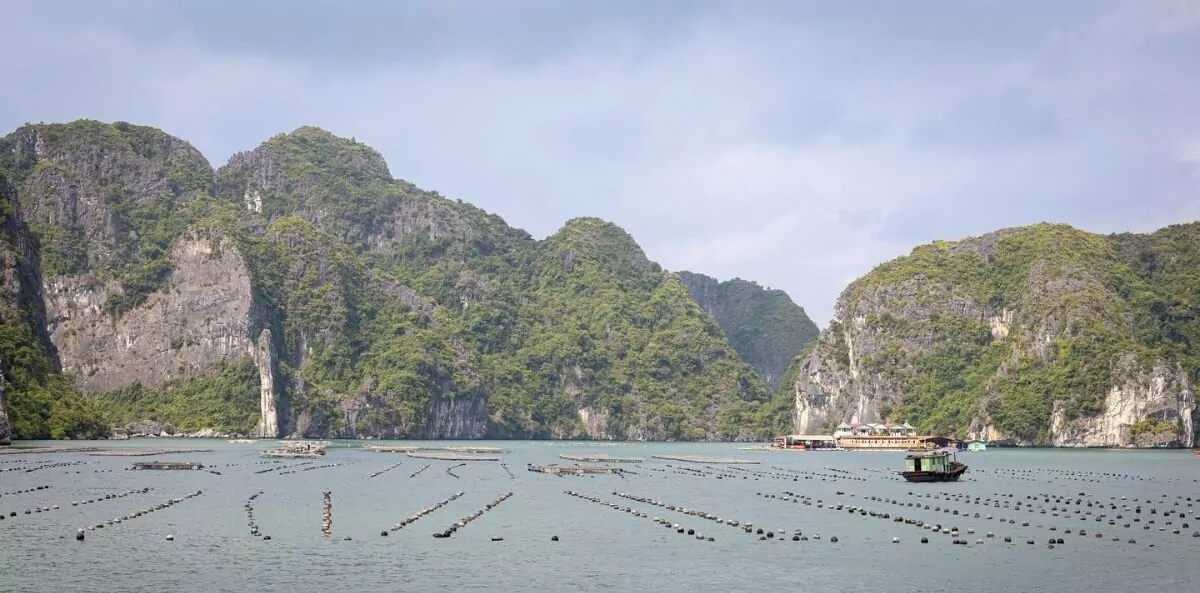 Tung Sau Pearl Farm’s 3,000+ oyster cages spread across 30 hectares of Halong Bay near Bo Hon Island — established 1995, now producing Vietnam’s only national 5-star OCOP-certified saltwater pearls.
Tung Sau Pearl Farm is anchored in a calm, sheltered lagoon near Bo Hon Island in the central section of Halong Bay — approximately 24 kilometers from Tuan Chau Marina. The choice of location was not accidental: this section of the bay provides the precise combination of water quality, temperature stability, salinity, and shelter from open-sea currents that saltwater pearl oysters require to produce gems of consistent, high quality.
The farm sits comfortably within the cluster of major Halong Bay attractions on Route 2 — just approximately 30 minutes by kayak from Sung Sot Cave, and easily combined with visits to Luon Cave, Ti Top Island, and Cua Van Fishing Village on a standard overnight cruise itinerary. Most luxury and mid-range cruises schedule Tung Sau as either a morning or afternoon stop, allowing 45 minutes to an hour on the farm — enough time for the full tour, grafting demonstration, and a browse of the pearl shop.
Unlike most commercial stops in the bay, Tung Sau offers a setting that is both industrial and beautiful: the orderly rows of white floating buoys across the emerald water, surrounded by towering limestone karsts, create a surprisingly photogenic scene that many visitors find more striking than they expected.
3. History: From Japan to Vietnam
The history of pearl farming at Tung Sau is inseparable from the broader story of Halong Bay’s emergence as a global pearl production centre. While Vietnamese fishermen had discovered natural pearls in the bay’s oysters as early as the 1960s — and the Vietnam Institute of Marine Products Research established the first experimental pearl facility in Halong Bay in 1965 — it was the arrival of Japanese expertise that transformed pearl farming here from artisanal curiosity into world-class industry.
In 1995, a Japanese company specialising in pearl cultivation technology selected the sheltered lagoon near Bo Hon Island as the site for a new facility, recognising Halong Bay’s exceptional natural water quality as ideal for the cultivation of Pinctada oysters. The Japanese team invested significantly in infrastructure, introduced advanced grafting techniques developed in Japan’s Akoya pearl industry, and trained local Vietnamese technicians to execute the delicate microsurgical process. The farm quickly became one of the most technically sophisticated pearl operations in Southeast Asia.
In 2005, the Japanese company sold the operation to Ha Long Pearl Joint Stock Company, a Vietnamese corporation that has continued to develop both the farm’s production capacity and its tourism infrastructure. Under Vietnamese management, Tung Sau was gradually transformed into an educational tourism destination alongside its commercial function — with guided tour platforms, demonstration areas, and eventually a pearl shop and exhibition space added to the original production facility.
The farm’s quality was formally recognised by the Vietnamese government in 2015, when its pearl products received OCOP (One Commune One Product) designation from Ha Long City. By 2020, three of Tung Sau’s pearl varieties — Akoya, Tahitian, and South Sea — had achieved the highest available recognition: national 5-star OCOP products, placing them among Vietnam’s most prestigious food and craft exports and benchmarking their quality explicitly against Japan’s strict international pearl standards.
4. How a Pearl Is Made: The Cultivation Process
Understanding how a cultured pearl is produced transforms a visit to Tung Sau from a simple sightseeing stop into one of the most intellectually satisfying experiences in all of Halong Bay. The process is a precise, patient marriage of biology, craftsmanship, and time — and visitors at Tung Sau see each stage of it in direct, unmediated form.
1
Breeding: Raising the Oyster Larvae
Expert cultivators select genetically superior parent oysters (Pinctada species — the same family used in Japan’s Akoya pearl industry) and extract sperm and eggs in a controlled environment. The fertilised larvae are nurtured with microscopic algae food in carefully monitored tanks until they develop into juvenile oysters, which are then transferred into protective underwater cages in the bay to begin their growth phase. This stage typically takes several months.
2
Cage Nurturing: Growth in the Bay
The young oysters are placed in specialised floating cages suspended at carefully calculated depths in the Tung Sau lagoon — close enough to the surface to receive adequate oxygen and planktonic food from the bay’s current, but protected from wave disturbance and predation. Skilled farmers monitor the oysters’ health, clean their cages regularly to prevent fouling, and adjust cage depth seasonally as water temperature changes. This nurturing phase continues until the oysters are large enough — typically 2 to 3 years old — to undergo grafting.
3
Grafting: The Surgical Moment
This is the most critical and most dramatic stage of the process — and the one visitors at Tung Sau watch live from just a few metres away. A skilled technician holds the oyster open with a small wedge, then uses fine microsurgical tools to make a tiny incision in the oyster’s mantle tissue. Into this incision, the technician inserts two things: a round nucleus (typically a polished sphere of freshwater mussel shell) and a tiny fragment of donor mantle tissue called a “seed.” The nucleus provides the physical template around which the pearl will form; the mantle tissue fragment, once healed around the nucleus, produces the nacre secretion that coats the nucleus and creates the pearl. The entire procedure takes approximately five minutes per oyster — but the precision required is extraordinary.
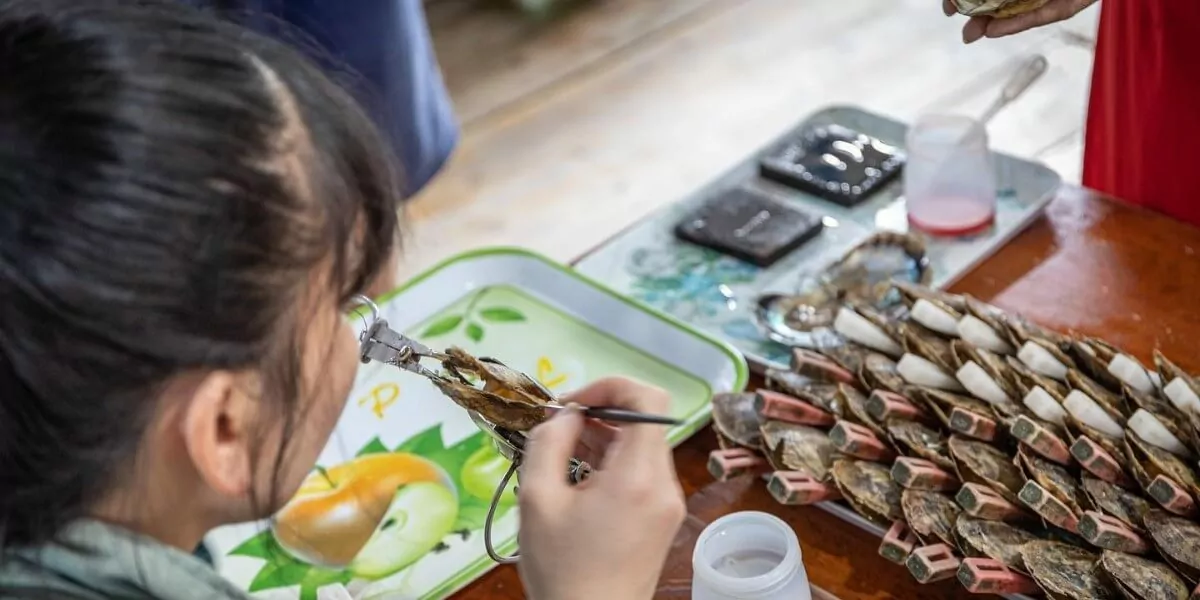 A skilled technician performs the live oyster grafting demonstration at Tung Sau — inserting a nucleus and mantle tissue fragment into a live Pinctada oyster with microsurgical precision. The pearl that forms around this nucleus will take approximately two years to harvest.
4
Harvest: Two Years of Nacre
After grafting, the oysters are returned to their cages and the farm waits. Over approximately two years, the oyster’s mantle tissue slowly deposits layer upon layer of nacre — a composite of calcium carbonate crystals and organic proteins — around the nucleus. It is this accumulation of thousands of microscopic nacre layers that creates a pearl’s characteristic lustre, depth, and iridescence. When the two years are complete, farmers carefully open each oyster shell, extract the pearl, sort it by size, shape, colour, and lustre quality, and begin the process of polishing and eventual jewellery production.
What makes Halong Bay pearls distinctive? Saltwater pearls from Halong Bay are prized internationally for three qualities: high purity nacre (produced in the bay’s exceptionally clean water), thick nacre layers (the two-year cultivation period allows substantial nacre deposition), and natural colour range — beyond the base colours of white, black, and gold, each Halong Bay pearl reflects multiple colour tones at different angles of light, a quality known as “orient” that is a marker of superior nacre quality. These characteristics led to their 5-star OCOP certification in 2020.
5. Pearl Types at Tung Sau
| Pearl Type |
Oyster Species |
Colour Range |
Characteristics |
| Akoya |
Pinctada fucata martensii |
White, cream, silver-rose |
Classic round shape; Japan’s traditional pearl; thick nacre; sharp lustre. Achieved national 5-star OCOP 2020. |
| Tahitian (Black) |
Pinctada margaritifera |
Black, grey, peacock green, aubergine |
Larger pearl (8-16mm typical); natural dark colour unique to black-lipped oyster; overtones of green, blue, purple. 5-star OCOP 2020. |
| South Sea (White/Gold) |
Pinctada maxima |
White, silver, gold, champagne |
Largest cultured saltwater pearl (10-20mm); thickest nacre; satiny lustre. Rarest and most valuable. 5-star OCOP 2020. |
| Martensi |
Pinctada martensii |
White, pink, silver |
Smaller pearl; very high lustre; used in classic strand jewellery. |
6. The Visitor Experience: What You Will See & Do
The Guided Farm Tour
Visitors arrive at Tung Sau by small transfer boat from their cruise ship and board the main floating platform, where a local guide leads the tour in Vietnamese and English. The tour follows the four stages of pearl cultivation in sequence — from the nursery cages visible in the water below the platform, to the grafting demonstration table, to the freshly harvested pearls laid out for sorting. Allow approximately 30 to 45 minutes for the complete guided tour.
The Live Grafting Demonstration
The undisputed highlight of the Tung Sau visit is watching a skilled technician perform the live oyster grafting procedure — the delicate microsurgical insertion of a nucleus and mantle tissue fragment into a live Pinctada oyster. The demonstration table is set up so that visitors can stand close and watch the technician’s hands in full detail. The five-minute procedure is mesmerisingly precise: the tiny tools, the careful holding open of the shell, the microscopic insertion — and the knowledge that what you are watching will, two years from now, produce a pearl — make this one of the most quietly astonishing demonstrations anywhere in Halong Bay.
Open Your Own Oyster
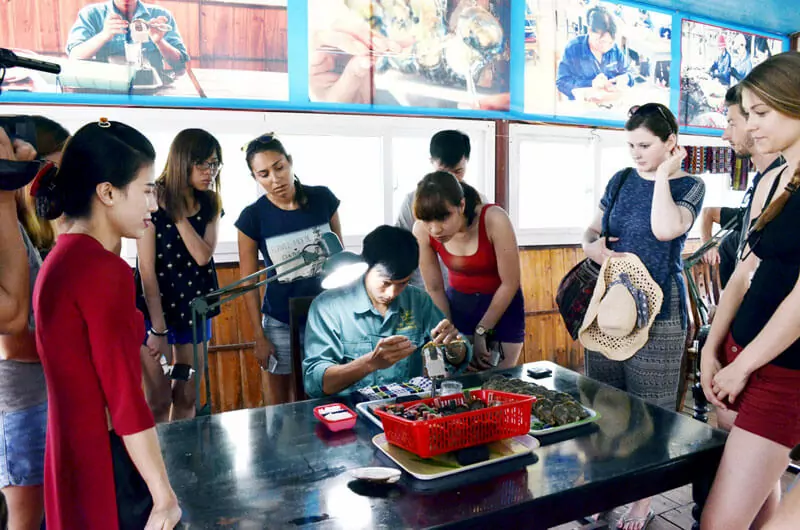 Visitors can open a live harvested oyster themselves at Tung Sau and keep the pearl they find inside — one of Halong Bay’s most memorable and personalised souvenir experiences.
One of Tung Sau’s most popular experiences is the opportunity to open a live oyster yourself and extract the pearl inside. This experience carries an additional fee (confirm current rate with your cruise operator — fees have ranged from approximately 500,000 to 850,000 VND per oyster), and the pearl you find is yours to keep. Oysters are selected from those ready for harvest, meaning the pearl inside is fully formed — but the size, shape, and colour is entirely a matter of chance. Finding an unusually round, large, or colourful pearl is genuinely exciting; and even an imperfect pearl extracted by your own hands from a living oyster carries a meaning that a purchased one from a jeweller’s counter simply cannot replicate.
Pearl Exhibition Area
Beyond the grafting demonstration, the farm features a display area showing pearls in various sizes, colours, and quality grades — an educational resource that allows visitors to understand the qualities pearl buyers and gemologists assess: lustre (the sharpness and depth of the reflection), nacre thickness, surface quality, shape (round being the rarest and most valuable), and colour overtones. After seeing the raw process on the farm platform and the quality spectrum in the exhibition, the pearl shop feels like a natural conclusion to the visit rather than a commercial afterthought.
7. The Pearl Shop: What to Buy & How to Buy Well
The on-site pearl shop at Tung Sau sells a full range of pearl jewellery and loose pearls produced at the farm — from single Akoya pearl pendants to South Sea pearl strands and Tahitian drop earrings. Prices range widely depending on pearl type, size, quality grade, and jewellery setting. Because the pearls are sold directly from the producer with no middleman, prices are generally more competitive than equivalent quality items in Hanoi or Ho Chi Minh City jewellery shops.
How to evaluate pearl quality before buying at Tung Sau:
- Lustre: Look for a sharp, mirror-like reflection of your finger on the pearl’s surface. A blurry, diffuse reflection indicates thin or poor-quality nacre.
- Surface: Minor surface blemishes (small spots or bumps) are normal in natural pearls. Avoid pearls with large cracks, pits, or peeling patches.
- Shape: Perfectly round pearls are rarest and most valuable. Near-round, oval, drop, and baroque shapes are progressively more common and affordable — and equally beautiful in the right setting.
- Colour & overtone: Hold the pearl in natural light and tilt it slowly. A high-quality pearl will show a secondary colour (rose, green, silver) overlaying the base colour as you move it — this is the “orient” effect, the hallmark of thick nacre.
- Authenticity: Tung Sau’s certified pearls carry quality documentation. If purchasing a significant piece, ask for a quality certificate.
8. How to Visit Tung Sau Pearl Farm in 2026
| Option |
Duration |
Notes |
| Overnight cruise 2D1N |
2 days, 1 night |
Most common — Tung Sau on Day 1 or Day 2; 45-min stop included on mid-range and luxury cruise itineraries |
| Extended cruise 3D2N |
3 days, 2 nights |
Longer stop possible; time for full tour + grafting demo + pearl shopping |
| Private day boat |
4 hours |
From Tuan Chau Marina; approx. 800,000-1,000,000 VND/private boat; entrance fee separate (~30,000 VND/person) |
Getting There
- From Hanoi: 2.5-3 hours by road to Tuan Chau Marina, Ha Long City
- Cruise journey from Tuan Chau: Approximately 1.5-2 hours to the Tung Sau area on Route 2
- Check itinerary: Not every Route 2 cruise includes Tung Sau — confirm explicitly with your operator before booking if this stop is a priority
-> Browse Halong Bay cruises that include Tung Sau Pearl Farm ->
9. Best Time to Visit Tung Sau Pearl Farm
| Season |
Months |
Conditions |
Rating |
| Dry season (best overall) |
Oct – April |
Clear skies, calm bay, comfortable temperatures; ideal for outdoor farm platform tour |
⭐⭐⭐⭐⭐ Best overall |
| Spring (ideal weather) |
March – May |
Light sunshine, cool breezes, pleasant for outdoor activities; increasingly popular with visitors |
⭐⭐⭐⭐⭐ Excellent |
| Autumn |
Sept – Nov |
Clear skies, mild temperatures, fewer domestic tourists; great light for pearl photography |
⭐⭐⭐⭐⭐ Excellent |
| Summer |
Jun – Aug |
Hot and humid; higher risk of rain and storms disrupting cruise schedules; farm still operates but comfort reduced |
⭐⭐⭐ Manageable |
Note on timing within the cruise: Tung Sau is most often visited in the morning (before 11 AM) or afternoon (after 2 PM) to allow the pearl demonstration team to prepare between cruise groups. Early morning visits offer the best soft light for photographing the oyster cages and pearl displays.
10. Practical Tips Before You Go
- Confirm Tung Sau is on your itinerary. Not every Halong Bay Route 2 cruise includes this stop — mid-range and luxury 3-day cruise itineraries are most likely to include it. Ask explicitly before booking.
- Budget for the open-oyster experience if interested — bring extra VND cash as the fee (currently in the range of 500,000-850,000 VND per oyster, confirm current rate) is typically not included in the cruise package.
- Bring VND cash for the pearl shop — not all on-site shops accept credit cards. ATM access is not available on the farm.
- Allow 45-60 minutes for a complete visit: guided tour (20-30 min), grafting demo (5-10 min), exhibition area and shop (15-20 min).
- Ask your guide questions. The technicians and guides at Tung Sau are knowledgeable — the grafting demonstration is far more interesting when you understand what you are looking at. Ask about nucleus sourcing, quality grading, and how to tell a genuine saltwater pearl from a freshwater or synthetic imitation.
- For pearl shopping: Compare prices with the quality evaluation tips in Section 7. Certificates of authenticity are available for significant purchases.
- Wear comfortable flat shoes — the floating farm platform can be uneven and slightly rocking.
11. Tung Sau Pearl Farm — Frequently Asked Questions
The questions we get asked most often by travelers planning to visit Tung Sau Pearl Farm in Halong Bay.
Tung Sau produces four types of cultured saltwater pearls: Akoya (classic white/cream/silver-rose; the traditional pearl of Japan’s Pinctada fucata martensii oyster); Tahitian (naturally dark — black, grey, peacock green, aubergine — from the Pinctada margaritifera black-lipped oyster); South Sea (the largest and rarest — white, silver, gold, champagne — from the Pinctada maxima oyster); and Martensi (smaller, high-lustre white/pink). In 2020, the Akoya, Tahitian, and South Sea varieties were awarded national 5-star OCOP status by the Vietnamese government.
Last updated: June 2026 | Information verified against multiple Halong Bay tourism sources including VietnamStory (Jan 2026), ParadiseVietnam, HalongBayCruises.com.vn, AzoTour, BestPrice Travel, and CruiseinHalongBay (April 2026). Entrance fees and open-oyster experience fees change periodically — confirm current rates with your cruise operator or directly with the farm. Pearl quality and OCOP certification status verified against Ha Long Pearl Joint Stock Company records.


