1. About Cap La Island — Key Facts at a Glance
| Detail |
Information |
| Location |
Cong Do island chain, Bai Tu Long Bay, Quang Ninh Province, Vietnam |
| Distance from Halong Port |
Approximately 18 km southeast of Halong International Port |
| Name meaning |
“Cap” = a pair; “La” = local La/Tra tree species — twin La-tree islands facing each other |
| Fishing village |
~80 households, ~200 residents; no grid electricity (generators only); fishing and aquaculture |
| Beach |
Pristine white sand; crystal-clear water; calm conditions ideal for kayaking and swimming |
| Cap La Cave |
150 m long, 4 chambers, 2 storeys, white stalactites, archaeological remains of ancient Vietnamese — not yet open to public visitors |
| Protected status |
Within Bai Tu Long National Park — Quang Ninh’s first and only ASEAN Heritage Park (15,783 hectares) |
| Cruise route |
Halong Bay Sightseeing Route 4 (Bai Tu Long Bay exploration) |
| Key activities |
Kayaking — swimming — fishing village visit — night squid fishing |
| Nearby attractions |
Thien Canh Son Cave — Vung Vieng Village — Cong Dam Area — Da Xep Nature Park |
| Access |
Bai Tu Long Bay overnight cruise (Route 4); not on standard Halong Bay Route 2 |
2. Location & Setting
Cap La Island is situated in the Cong Do island chain within Bai Tu Long Bay — approximately 18 kilometers southeast of Halong International Port and around 30 kilometers east of Halong Bay proper. This position places it firmly within Bai Tu Long Bay’s quieter, less-commercialised eastern waters — far beyond the reach of the standard Halong Bay cruise routes that serve Sung Sot Cave, Ti Top Island, and Cua Van Village.
The Cong Do area where Cap La sits is one of the most scenically concentrated sections of Bai Tu Long Bay — a tight cluster of limestone islands forming natural channels, sheltered coves, and small beaches that reward the relatively small number of Route 4 cruises that venture here. Cap La is typically visited in combination with Thien Canh Son Cave on Hon Co Island (one of Bai Tu Long Bay’s finest cave experiences), Vung Vieng Fishing Village (the bay’s most atmospheric floating community), and Cong Dam area — forming a complete and cohesive Bai Tu Long Bay overnight itinerary.
The island sits within Bai Tu Long National Park, a protected area of 15,783 hectares recognised as Quang Ninh Province’s first and only ASEAN Heritage Park — a designation that reflects the extraordinary biodiversity and ecological significance of the landscape surrounding Cap La.
3. The Name: A Pair of La-Tree Islands
The name “Cap La” is one of the most visually descriptive place names in Bai Tu Long Bay — and one that makes immediate sense once you see the geography.
Cap (also written Cặp) means “a pair” or “a couple” in Vietnamese — describing two things that face each other or belong together. La is the name of a specific local tree species also known as the Tra tree, which grows prolifically across the limestone slopes of the islands in this area of the bay. The two limestone islands that define the Cap La area face each other across a sheltered channel, and both are densely covered in La trees — making the combined name “Cap La” — the pair of La-tree islands — a straightforward geographic description given by the fishermen who first sheltered here.
This origin story is notably different from the legends and analogies that explain most Halong Bay place names (which typically describe animal shapes or tell mythological tales). Cap La’s name is simply a fisherman’s practical description of what he saw: two islands, facing each other, full of La trees. It is a name that speaks of long, direct, intimate familiarity with this specific corner of the bay — which is precisely what Cap La feels like when you arrive there.
4. The Beach: Kayaking & Swimming
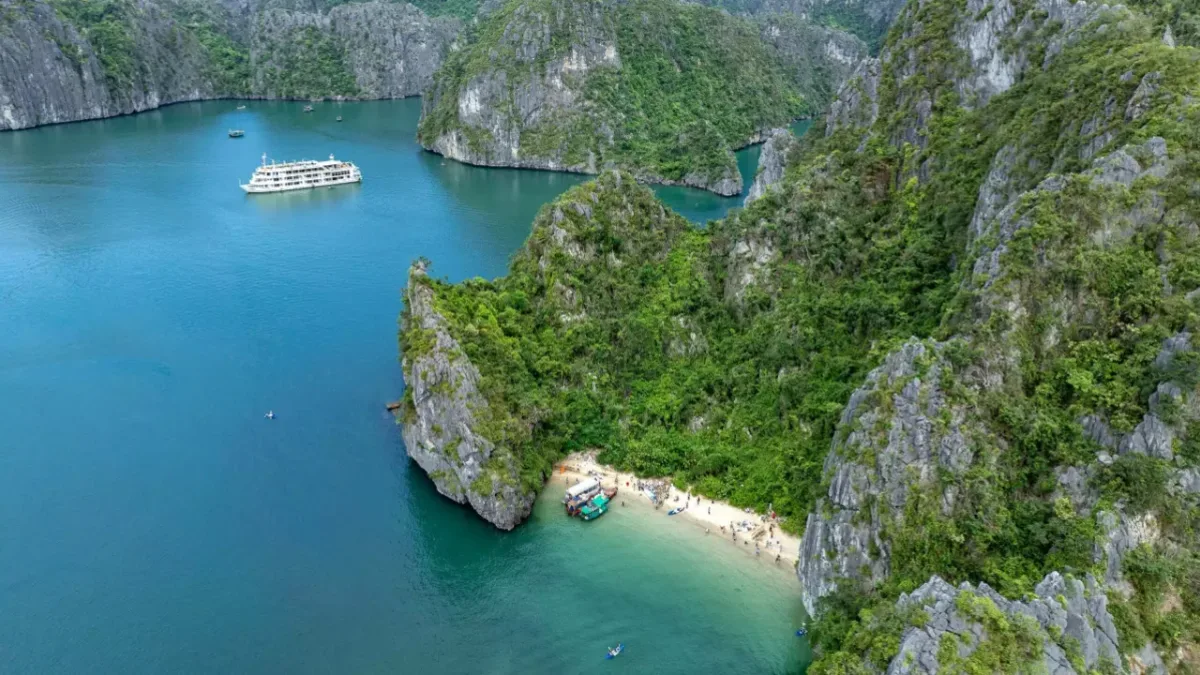
Cap La Island’s white sand beach — crystal-clear, calm, and far less visited than equivalent beaches on Halong Bay’s busier Route 2. The protected waters and minimal tourism development preserve a swimming and kayaking experience that is genuinely rare in the bay region.
Cap La Island’s beach is the primary reason most cruise passengers visit — and it consistently delivers the experience that Bai Tu Long Bay’s reputation promises: pristine white sand, crystal-clear water in shades of emerald and turquoise, and the extraordinary silence of a bay section where the only sounds are paddles in the water and occasional seabirds overhead.
Kayaking
Kayaking is the signature activity at Cap La, and the protected channel between the two limestone islands provides ideal conditions: calm, current-free water that is accessible to complete beginners while still offering enough exploration space for confident paddlers to spend 45 minutes to an hour finding hidden corners, small rock arches, and mangrove-lined coves that larger boats cannot access. The transparency of the water allows kayakers to watch marine life — small fish, sea urchins, jellyfish — drifting beneath the hull as they paddle.
The scale of the limestone formations surrounding the kayaking area is one of Cap La’s most striking qualities: the karst walls rise dramatically from the water to heights that dwarf the kayaker below, creating a sense of vertical grandeur that is entirely different from the open bay experience seen from a cruise ship’s sun deck. At the waterline, the rock formations are pockmarked, barnacled, and draped in marine growth — close enough to touch, and far more textured and alive than they appear from a distance.
2026 kayaking rule: Solo kayaking is not permitted in Bai Tu Long Bay. All visitors must paddle in pairs in a double kayak. This rule, which came into effect in recent years, applies across Halong Bay, Lan Ha Bay, and Bai Tu Long Bay for safety reasons — and at Cap La, where the water is calm and the distances short, it is a comfortable and sociable experience for most visitors.
Swimming
The beach at Cap La offers some of the clearest swimming water in Bai Tu Long Bay. The shallow-sloping entry into calm, transparent water makes it ideal for swimmers of all levels, including non-swimmers who prefer to wade and paddle close to shore. The beach sees far fewer visitors per day than comparable stops on Halong Bay’s busier Route 2, meaning the water is cleaner, the beach is quieter, and the experience is noticeably more exclusive than an equivalent swim at Ti Top Island or Soi Sim Beach.
5. Cap La Floating Fishing Village
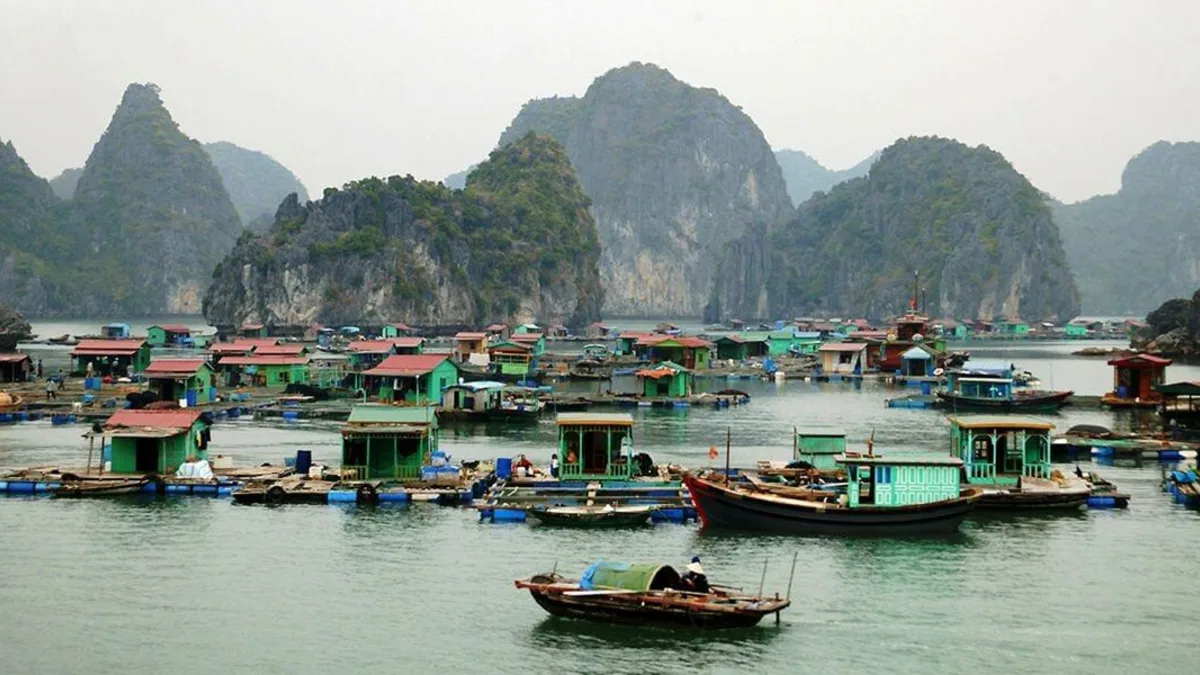
Cap La Floating Fishing Village — one of just four floating villages in the UNESCO World Heritage Site, with approximately 80 households and over 200 residents. No grid electricity, no school, and residents focused entirely on fishing — this is the most unscripted floating village experience in the bay region.
Cap La Floating Fishing Village is a small but historically significant floating community anchored in the sheltered waters at Cap La Island — and one of only four floating fishing villages officially recognised within the UNESCO World Heritage Site of Halong Bay (the others being Ba Hang, Cua Van, and Vung Vieng). That recognition reflects Cap La’s status not merely as a tourist curiosity, but as a living piece of the bay’s intangible maritime heritage.
The village is home to approximately 80 households with over 200 residents — a figure confirmed across seven independent sources including HalongHub (January 2026), Paradise Cruise, Origin Vietnam, and BestPrice Travel. Situated on the border zone between Bai Tu Long Bay and Halong Bay, the village occupies a position that makes it genuinely transitional: accessed on routes that serve the western edge of Bai Tu Long Bay, yet visible from the periphery of Halong Bay’s UNESCO core zone. The Quang Ninh People’s Committee officially added Cap La to recognised cruising destinations in recognition of its cultural and heritage value.
Life on the Water
Every aspect of daily life in Cap La is defined by the boat. Each floating vessel serves simultaneously as home, transport, and fishing platform — three functions that make the physical object of the boat the entire material basis of a family’s existence. There is no connection to the national power grid: electricity comes from generators, making fuel both precious and expensive. Clean water must be imported from the mainland at considerable cost and effort. The practical challenges of daily life here — severe weather conditions, healthcare access, the cost of fuel and clean water, and the uncertainty of fishing income — are real and not softened by the visual beauty of the setting.
Children & Education
Children in Cap La attend school only until around the age of 12, after which most leave education to join their families in fishing work. Strikingly, the village has no school of its own — Cap La’s children must take a daily boat journey to Vung Vieng Fishing Village to attend class, a commute across open water that reflects both the distances involved and the inter-dependence of the bay’s floating communities. After leaving school at 12, these young people join what becomes a lifelong identity as fishermen and aquaculture workers in one of the world’s most challenging natural environments.
Attitude Toward Tourism
One of Cap La’s most distinctive characteristics — and one of the most refreshing for visitors accustomed to heavily tourist-oriented floating village stops — is the village’s genuine indifference to tourism. As BestPrice Travel accurately notes, residents here are primarily focused on earning their living from the sea; they do not orient their day around tourist schedules or perform their daily routines for cameras. The fishing, the cage-checking, the net-mending, the morning sorting of the catch — all of this happens on the village’s own timetable, not on a tour operator’s. Visitors who observe Cap La by kayak or bamboo boat are watching a community going about its genuine daily life, not a curated experience.
Note for visitors: Because Cap La’s residents are primarily focused on fishing rather than tourism, the village experience is more observational than interactive compared to Cua Van or Vung Vieng. This is not a limitation — it is the authenticity that makes Cap La exceptional. Approach the visit quietly, let your guide facilitate any interactions, and resist the temptation to treat the village as a backdrop for selfies. The restraint will reward you with a far more genuine encounter.
6. Cap La Cave: A Recently Discovered Gem
Cap La Cave — Hang Cap La — is one of the most significant recent discoveries in Bai Tu Long Bay, and one that places the island in a different category from a simple beach-and-kayak destination. The cave was found on the large limestone foundation of the Cong Do island chain and assessed by experts from the Institute of Marine Resources and Environment, who concluded it possesses high geological, geomorphological, and biodiversity value — rare formal language that signals a cave of serious scientific and cultural significance.
Cave Specifications
- Length: Approximately 150 meters
- Structure: 4 chambers, 2 storeys (the upper storey has a lower ceiling and steeper walls; the lower storey is more spacious and houses the most dramatic formations)
- Formations: Dense stalactites and stalagmites; stone curtains; formations resembling bells, sticks, and elephant ears; during the rainy season, water seeping through cracks creates sparkling formations that resemble stars reflecting light
- Colour: The lower storey is particularly noted for brilliant white stalactites — rare in Bai Tu Long Bay’s cave inventory
- Archaeological content: The cave contains remains attributed to ancient Vietnamese peoples, opening significant opportunities for research into the prehistory of the bay’s human habitation
- Biodiversity: Flora (ferns, mosses, fungi on limestone), fauna (bats, snakes, insects), and microorganisms documented within the cave ecosystem
Important — Cap La Cave is not currently open to public visitors (as of 2025-2026). Following its discovery and expert assessment, the cave has been undergoing inspection and evaluation to ensure sustainable preservation and development. Treasure Junk (April 2025) notes the cave “will soon be allowed for visiting.” Visitors to Cap La Island in 2026 should check with their cruise operator for the latest access status — the cave’s opening would add a significant cultural and geological dimension to the island visit.
Cap La Island sits within Bai Tu Long National Park — a protected natural area covering 15,783 hectares that was designated as Quang Ninh Province’s first and only ASEAN Heritage Park, placing it among Southeast Asia’s most ecologically significant protected landscapes.
The national park encompasses a remarkable range of ecosystems across its protected area:
- Nearly 500 plant species documented across the park’s terrestrial zones
- 37 bird species recorded, including rare and endemic species dependent on the limestone karst habitat
- Mangrove forest ecosystems along the island shorelines
- Coral reef systems in the bay’s shallower waters
- Tropical forest on the limestone island summits
- Marine biodiversity across hundreds of species of fish, mollusks, and crustaceans
The ASEAN Heritage Park designation signals international recognition of the park’s biodiversity value and places obligations on Vietnam to maintain the highest standards of ecosystem protection. For visitors, it means that the waters around Cap La — and the cave, beach, and village — are managed within a framework that explicitly prioritises long-term conservation over short-term commercial gain. It is part of why Cap La retains the pristine quality that makes it so rewarding to visit — and why responsible visitor behaviour here carries genuine weight.
8. How to Visit Cap La Island in 2026
Cap La Island is accessible only via Bai Tu Long Bay overnight cruise itinerary on Route 4 — the route that covers the bay’s less-visited eastern section. It is not included on the standard Halong Bay Route 2 (which covers Sung Sot Cave, Ti Top Island, Cua Van Village, and Luon Cave), and is not reachable by standard day cruises from Tuan Chau or Halong City.
| Cruise Type |
Duration |
Cap La Included? |
| Standard Halong Bay cruise (Route 2) |
2D1N or 3D2N |
No — Route 2 does not cover Bai Tu Long Bay |
| Bai Tu Long Bay overnight cruise 2D1N |
2 days, 1 night |
Sometimes — confirm Cap La specifically with operator |
| Bai Tu Long Bay extended cruise 3D2N |
3 days, 2 nights |
More likely — Route 4 extended itineraries commonly include Cap La |
Key point: Not every Bai Tu Long Bay cruise includes Cap La specifically. The bay has multiple Route 4 sub-routes, and some itineraries focus more on Vung Vieng Village, Thien Canh Son Cave, and Cong Dam Area. Always confirm explicitly with your cruise operator that Cap La Island is included in your itinerary before booking.
Cruise operators known to include Cap La Island
Operators that have included Cap La Island in Bai Tu Long Bay itineraries include Dragon Legend Cruise, Swan Cruise, Renea Cruise, Prince Junk, and Dragon’s Pearl Junk — among others. Confirm current itineraries directly with operators, as routes change seasonally.
Getting There
- From Hanoi: Approximately 3-3.5 hours by road to Tuan Chau International Port or Halong International Port
- Cruise journey to Cap La area: Approximately 1.5-2 hours from departure port into Bai Tu Long Bay
-> Browse Bai Tu Long Bay cruises that include Cap La Island ->
9. Best Time to Visit Cap La Island
| Season |
Months |
Conditions |
Rating |
| Dry season (best overall) |
Nov — April |
Clear skies, calm seas, comfortable temperatures; ideal for kayaking, swimming, and photography |
⭐⭐⭐⭐⭐ Best overall |
| Autumn (ideal weather) |
Oct — Nov |
Clear skies, mild temperatures, extraordinary light quality for bay photography; fewer domestic tourists |
⭐⭐⭐⭐⭐ Excellent |
| Spring (pleasant) |
March — May |
Light sunshine, cool breezes, pleasant for kayaking; increasing visitor numbers from April |
⭐⭐⭐⭐⭐ Excellent |
| Summer |
Jun — Aug |
Warm water, green vegetation; higher storm risk and typhoon possibility; peak domestic tourism |
⭐⭐⭐ Caution advised |
Best months overall: October to April. Avoid June to August if possible due to typhoon risk (Bai Tu Long Bay is slightly more exposed to open-sea weather than the more sheltered inner Halong Bay). The shoulder months of May and September offer warm water with lower storm risk and fewer crowds than peak summer.
10. Practical Tips Before You Go
- Book a Bai Tu Long Bay cruise specifically. Cap La is not on Halong Bay’s Route 2 — booking a standard Halong Bay cruise will not get you to Cap La. Search explicitly for Bai Tu Long Bay or Route 4 cruise itineraries.
- Confirm Cap La is explicitly in the itinerary. Not every Bai Tu Long Bay cruise visits Cap La — some focus more on Thien Canh Son Cave and Vung Vieng Village. Ask directly.
- Pair in kayaks (mandatory). Solo kayaking is prohibited; all paddling is in double kayaks provided by the cruise operator.
- Bring reef-safe mineral sunscreen. The bay is a protected ASEAN Heritage Park ecosystem — chemical sunscreen is harmful to coral and marine life.
- Ask about Cap La Cave’s current access status when booking your cruise — the cave was not open to visitors as of 2025 but is expected to open for visits. If it has opened by the time you travel, do not miss it.
- Check Cap La Cave status again closer to departure. Bai Tu Long Bay attraction access can change with management board decisions — always confirm with your cruise operator in the week before travel.
- Bring VND cash for any direct purchases from village residents — no ATMs exist at Cap La or on any Bai Tu Long Bay cruise stop.
- Allow 1-1.5 hours at Cap La: 45-60 minutes kayaking, plus time to relax on the beach and observe the fishing village.
11. Cap La Island — Frequently Asked Questions
The questions we get asked most often by travelers planning to visit Cap La Island in Bai Tu Long Bay.
Cap La Cave is a recently discovered grotto on the Cong Do island chain, approximately 150 meters long with 4 chambers and 2 storeys. It features dramatic white stalactites and stalagmites (including formations resembling bells, sticks, and elephant ears), archaeological remains of ancient Vietnamese peoples, and a rich cave ecosystem including bats, ferns, and fungi. Experts from the Institute of Marine Resources and Environment have assessed it as having exceptional geological, geomorphological, and biodiversity value. As of 2025, the cave is not yet open to public visitors, but opening for tourism visits is expected. Always confirm the current access status with your cruise operator before travel.
Last updated: June 2026 | Information verified against multiple Bai Tu Long Bay tourism sources including Treasure Junk (April 2025), BestPrice Travel, HalongBayTours.com, Origin Vietnam (June 2025), HalongBayCruises.com, HalongHub (Jan 2026), Paradise Cruise, CruisingHalongBay, HalongBayCruiseHunters, and parfumdautomne.fr (Nov 2025). Cap La Cave access status based on Treasure Junk (April 2025) — confirm current status with cruise operator before travel. Village population (80 households / 200+ residents) confirmed across 7 independent sources. Cap La is one of 4 floating villages officially within the UNESCO World Heritage Site (Ba Hang, Cua Van, Vung Vieng, Cap La). Quang Ninh People’s Committee addition to cruising destinations confirmed by Paradise Cruise.