1. About Trung Trang Cave — Key Facts at a Glance
| Detail |
Information |
| Vietnamese name |
Hang Trung Trang (Trung Trang Cave) |
| Other names |
Bat Cave (historical) · Navy Cave (Vietnam War era) |
| Location |
Trung Trang Valley, Cat Ba National Park, Cat Ba Island, Hai Phong |
| Distance from Cat Ba Town |
Approximately 15 km northwest |
| Distance from National Park entrance |
Approximately 1 km |
| Cave length |
Approximately 300 meters through the mountain |
| Discovered |
1938, by local and French explorers |
| Stalactite/stalagmite age |
Estimated around 6 million years (scientific research) |
| Wartime use |
Secret naval radio base, 1964–1968 |
| Entrance steps |
Approximately 100–110 wooden steps |
| Entrance fee |
Approximately 80,000 VND (~$3.50 USD) |
| Accessed via |
Cat Ba National Park entrance, or Lan Ha Bay overnight cruise excursion |
2. Location: Where Is Trung Trang Cave?
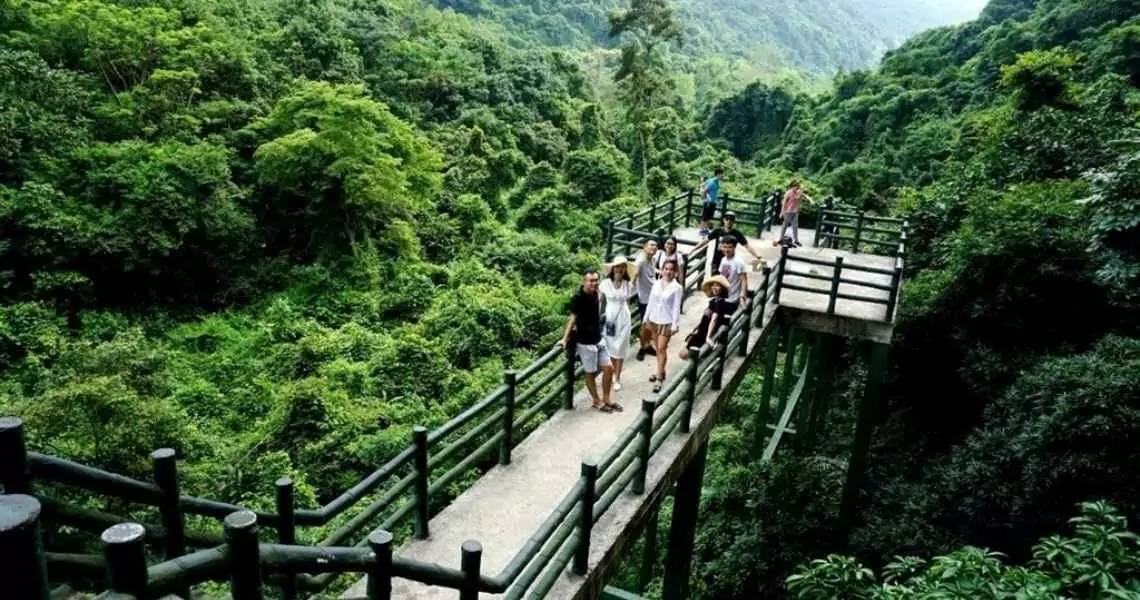 A paved jungle path through Cat Ba National Park leads visitors to the wooden staircase climbing up to Trung Trang Cave’s natural entrance.
Trung Trang Cave is located in Trung Trang Valley, inside Cat Ba National Park, approximately 15 kilometers northwest of Cat Ba Town on Cat Ba Island, Hai Phong. The cave sits roughly 1 kilometer from the main entrance of the national park, reached by a short walk along a paved jungle path before climbing a wooden staircase up to the cave’s natural entrance halfway up the mountainside.
Cat Ba Island is the gateway to Lan Ha Bay, and Trung Trang Cave is one of the few attractions in the region accessible entirely on foot rather than by boat — making it a popular land excursion on multi-day Lan Ha Bay cruise itineraries, as well as a standalone day trip for travelers staying on Cat Ba Island. The cave is often paired with nearby Hospital Cave (Hang Quan Y), a fascinating three-story wartime bunker also located within the national park.
3. The Legend of Lady Trung Trang
The cave takes its name from a local legend about Lady Trung Trang (Bà Chúa Trung Trang), a protective heroine said to have safeguarded Cat Ba Island in ancient times. According to the story passed down by island residents, the island was once a strategic and beautiful archipelago that repeatedly attracted foreign invaders. To defend her people and homeland, Lady Trung Trang rallied the island’s young men into a militia and led a successful resistance against the invading forces. After the victory, she is said to have taken refuge inside the cave that now bears her name, watching over the island’s safety from within the mountain.
Visitors entering the cave today are greeted by rock formations that local guides interpret as part of this legend: a natural stone figure resembling a young woman set against the cave wall — said to represent Lady Trung Trang herself — alongside a python-shaped formation believed to be her guardian spirit, protecting the cave’s tranquility. Deeper inside, some guides point to a chamber filled with glittering stalactite formations as the legendary “treasure trove” of the lady, its golden-hued mineral deposits said to resemble columns of gold, silver, and gemstones.
A note on the legend: Lady Trung Trang is a distinct local Cat Ba folk figure and should not be confused with the historical Trung Sisters (Hai Bà Trưng) who led a famous 1st-century rebellion against Han Chinese rule elsewhere in Vietnam — though some retellings blend elements of the two stories. As with most oral folklore, exact details vary between guides and sources; ask your local guide for their own telling of the legend during your visit.
4. Wartime History: From Bat Cave to Navy Cave
Long before it became a tourist destination, Trung Trang Cave was known simply as the “Bat Cave” — a name earned from the large colonies of bats that historically roosted within its dark chambers. The cave was formally discovered and documented in 1938 by a combination of local and French explorers, who began to map its winding passageways through the mountain.
The cave’s most significant chapter came during the Vietnam War, between 1964 and 1968, when it was repurposed as a secret radio base and operational headquarters for the Vietnamese naval command — earning it the wartime nickname “Navy Cave.” Its natural concealment within the limestone mountain made it an ideal hidden location for military communications and personnel. Visitors exploring the cave today can still see preserved relics of this era, including old water tanks, simple living quarters, and a meeting room once used by naval officers — tangible reminders of the cave’s role during one of Vietnam’s most difficult periods.
The cave also holds significant archaeological value: traces of ancient human habitation, with some estimates suggesting activity dating back thousands of years, have been documented inside, linking Trung Trang Cave to the very earliest chapters of human presence on Cat Ba Island.
5. Inside the Cave: What You’ll See
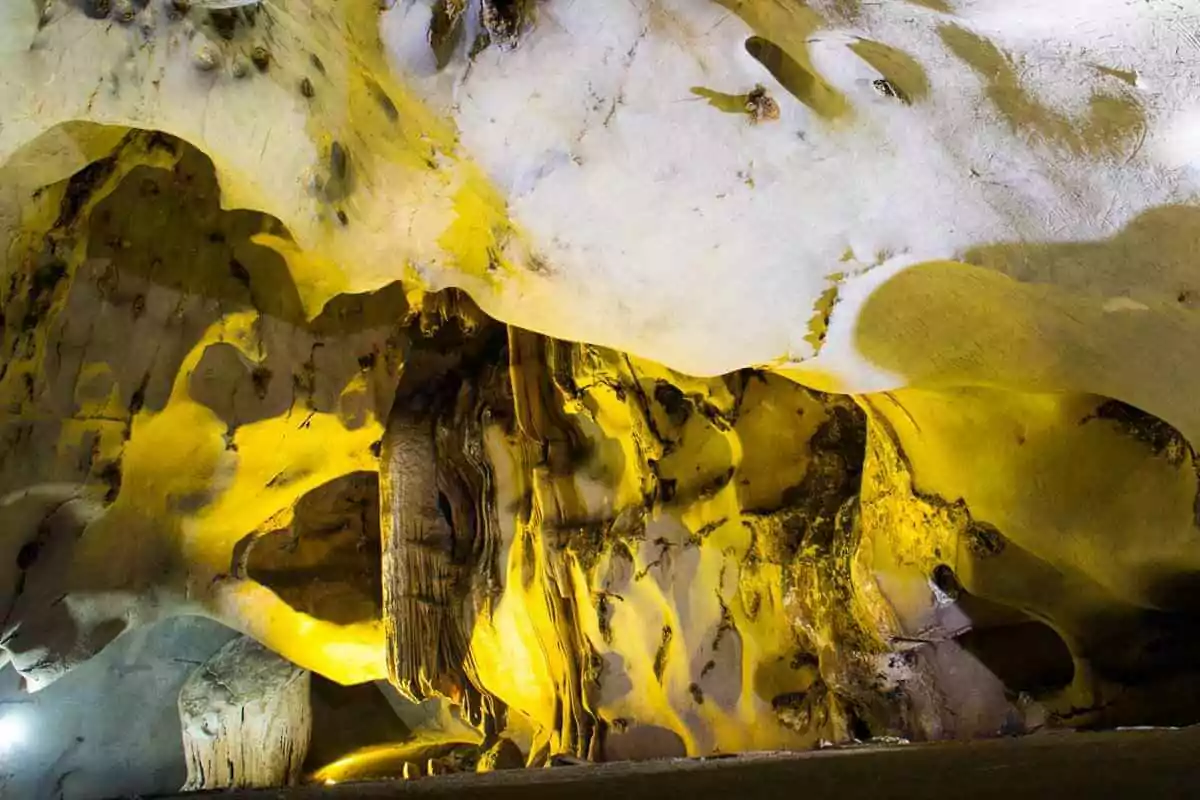 Local guides point out imaginative shapes throughout Trung Trang Cave, from a golden-maned lion formation to delicate stone curtain draperies.
The interior of Trung Trang Cave unfolds as a single winding tunnel stretching approximately 300 meters through the mountain, with a paved (though sometimes damp) walkway making the route manageable for most visitors. The path generally moves from a higher entrance down toward a lower exit point, with the ceiling height and passage width varying throughout — some sections open into spacious chambers large enough to comfortably hold hundreds of visitors, while others narrow enough that you may need to duck slightly.
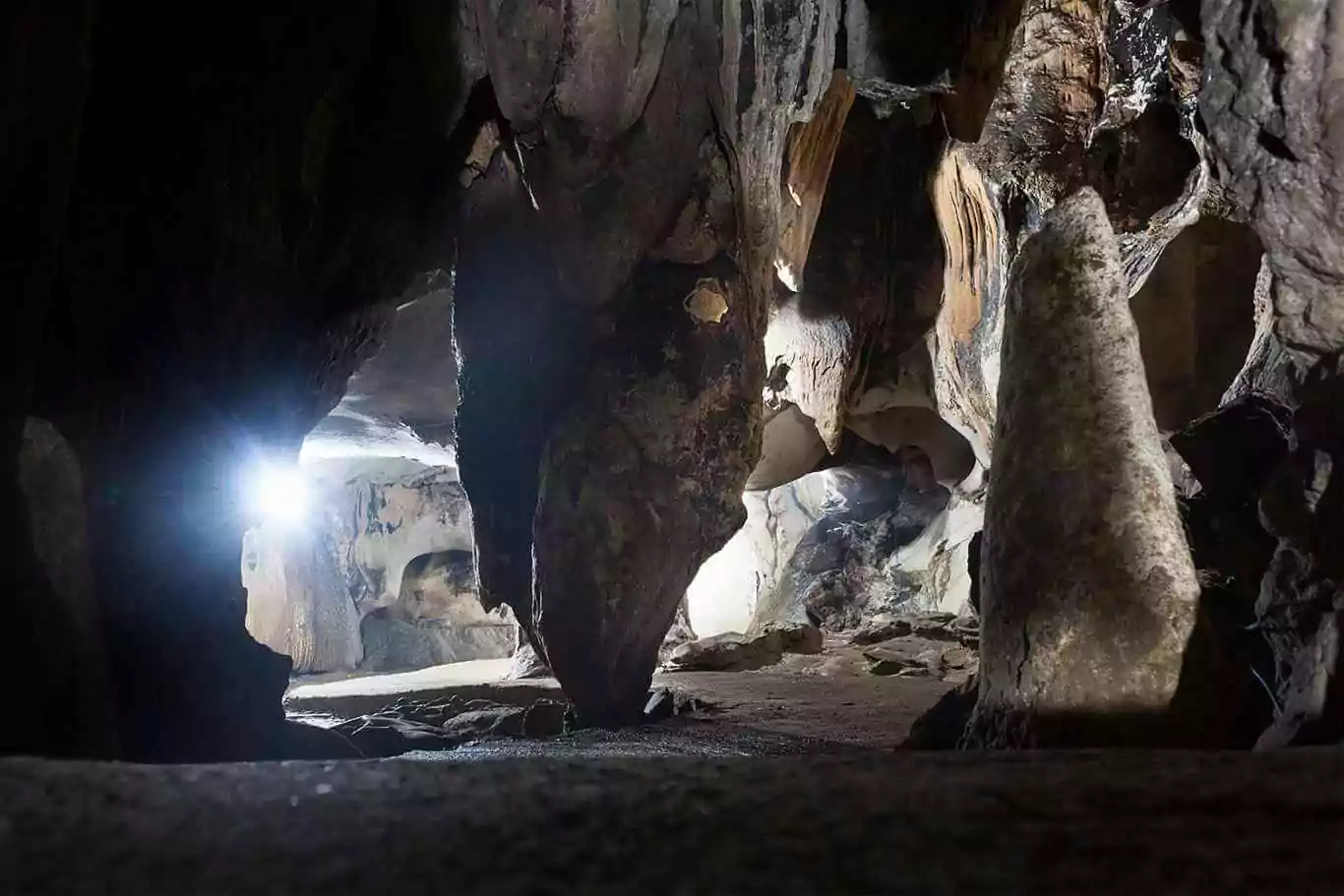 Trung Trang Cave’s stalactite and stalagmite formations, estimated at around 6 million years old, line a 300-meter natural tunnel through Cat Ba Island’s mountains.
Approximately 20 meters into the cave, visitors encounter the first dramatic display of stalactite and stalagmite formations, illuminated by soft, minimal lighting designed to preserve the cave’s natural dark ecosystem. Local guides point out a range of imaginative shapes throughout the walk, including formations resembling a golden-maned lion (said to guard Lady Trung Trang’s legendary treasure), eagles, crocodiles, and delicate “stone curtain” draperies. Midway through, some visitors report a formation resembling the outline of Vietnam’s coastline and the layout of the Cat Ba Archipelago — one of the cave’s most talked-about natural curiosities.
The cave remains a living ecosystem: bats, small reptiles, and various insects still inhabit its darker recesses, a reminder of its original name. Throughout the walk, the atmosphere stays cool, damp, and quiet — a striking contrast to the tropical heat and lush jungle canopy of Cat Ba National Park just outside.
6. Ticket Prices & How to Visit Trung Trang Cave in 2026
6.1 Entrance Fee
| Ticket Type |
Price (VND) |
Price (USD approx.) |
| Trung Trang Cave entrance |
~80,000 VND / person |
~$3.50 USD |
Note: The entrance fee is typically bundled with general Cat Ba National Park admission. If visiting as part of a Lan Ha Bay overnight cruise excursion, this fee is usually included in your cruise package — always confirm exact inclusions with your operator before booking.
6.2 How to Get There
- From Cat Ba Town: Approximately 15 km northwest by motorbike, car, or organized tour — roughly 30–40 minutes by road.
- From the cruise port: Most overnight Lan Ha Bay cruises that include a Cat Ba Island excursion will transport you directly from the dock to the national park entrance by van.
- To Cat Ba Island from Hanoi: By speedboat (~250,000 VND) from Got Port or Binh Port in Hai Phong; by ferry (~12,000–80,000 VND depending on departure point) from Dong Bai Port (Hai Phong) or Tuan Chau Port (Halong); or as part of an overnight Lan Ha Bay cruise package departing from Tuan Chau.
7. Best Time to Visit Trung Trang Cave
| Season |
Months |
Conditions |
Rating |
| Dry season |
Oct – April |
Clear skies, minimal rainfall, comfortable for the climb and trek |
⭐⭐⭐⭐⭐ Best overall |
| Autumn |
Oct – Nov |
Comfortable temperatures, fewer crowds than peak summer season |
⭐⭐⭐⭐⭐ Excellent |
| Summer peak |
Jun – Jul |
Sunny and dry, but the busiest period for Cat Ba Island tourism |
⭐⭐⭐⭐ Good but crowded |
| Wet season |
May – Sep |
Higher rainfall; cave paths can be slippery — always check ahead that the cave is open |
⭐⭐⭐ Manageable with caution |
Pro tip: Arrive by early-to-mid afternoon at the latest — Cat Ba National Park typically closes around 5:00 PM, and exploring Trung Trang Cave properly, especially when combined with nearby Hospital Cave, takes a couple of hours in total.
8. Practical Tips Before You Go
- Wear sturdy, non-slip shoes. Avoid flip-flops or open-toe sandals — the steps and walking surfaces inside the cave can be wet, mossy, and slippery.
- Bring a light jacket. The cave’s interior stays cool and damp even on hot days outside.
- No flashlight needed. The cave has artificial lighting installed, though it is kept deliberately dim to preserve the natural dark ecosystem for resident bats and other wildlife.
- Budget about 1 hour to walk through the cave slowly and take in the formations, plus additional time if combining the visit with Hospital Cave nearby.
- Bring water, insect repellent, and snacks — there are no shops or services directly at the cave site.
- Mobility note: The site is not wheelchair accessible, requiring a climb of approximately 100–110 wooden steps to reach the entrance — but it is manageable for most visitors of reasonable fitness, including many children with adult supervision.
- Do not touch or remove stalactite or stalagmite formations — these took millions of years to form and are easily damaged.
9. Trung Trang Cave — Frequently Asked Questions
The questions we get asked most often by travelers planning to visit Trung Trang Cave on Cat Ba Island.
Last updated: June 2026 | Information verified against multiple Cat Ba Island and Lan Ha Bay tourism sources. Some figures (exact dimensions, archaeological dating, legend details) vary across local sources and are presented as approximate where applicable.


