1. About Cua Van Fishing Village — Key Facts at a Glance
| Detail |
Information |
| Location |
Hung Thang Ward, Halong City, Quang Ninh Province, Vietnam |
| Distance from Bai Chay Wharf |
Approximately 20 km |
| Formed from |
Two former villages: Giang Vong and Truc Vong |
| Households |
176 households (as of 2025) |
| Population |
Approximately 733 residents |
| Size status |
Largest floating fishing village in Halong Bay |
| International recognition |
“16 Most Beautiful Ancient Villages in the World” — Journeyetc.com, 2012 |
| Floating school |
Halong Bay’s first floating school — 7 classes, primary and secondary |
| Cultural center |
Cua Van Floating Cultural Center (expanded March 2025, 850+ artifacts) |
| Main livelihoods |
Fishing (200+ fish species) · marine aquaculture · tourism services |
| No entrance fee |
Included in Halong Bay cruise itinerary |
| Accessed via |
Halong Bay overnight cruise (Route 2) or day cruise from Tuan Chau Port |
2. Location: Where Is Cua Van Village?
 Cua Van’s 176 households of colorful floating houses, anchored against the Va Gia limestone mountains — named one of the 16 most beautiful ancient villages in the world by Journeyetc.com in 2012.
Cua Van Fishing Village is located in Hung Thang Ward, Halong City, Quang Ninh Province — approximately 20 kilometers from Bai Chay Tourist Wharf, anchored in the tranquil waters at the heart of Halong Bay’s UNESCO World Heritage core zone. The village sits sheltered beneath the Va Gia limestone mountain range, which creates a natural barrier that protects the floating community from the open bay’s wind and waves.
The name “Cua Van” translates roughly to “gateway of the bay” — a name derived from the village’s strategic position between the open sea and the protected inner bay, where generations of fishermen found both abundant fishing grounds and shelter from storms. The village historically stood on the site of two former floating communities, Giang Vong and Truc Vong, which merged over time into the single, consolidated village known today.
Cua Van is accessible only by boat and is a standard stop on Halong Bay Sightseeing Route 2 — the bay’s most popular overnight cruise route, which also includes Sung Sot Cave, Ti Top Island, and Luon Cave. The village sits along the route between these major cave attractions and serves as one of the most culturally significant stops on any Halong Bay cruise itinerary.
3. History: Centuries of Life on the Water
Cua Van is one of the oldest continuously inhabited floating communities in Halong Bay. Historians and local accounts suggest that fishermen first established permanent floating residences in this sheltered section of the bay for generations, driven by the remarkable abundance of the bay’s waters — archaeological evidence at the Cua Van Cultural Center includes artifacts and ancient fishing tools that trace the community’s maritime heritage back through multiple centuries.
By the time Halong Bay received UNESCO World Heritage Status in 1994, Cua Van was already the largest and most established of the bay’s four remaining floating villages — a status it holds to this day alongside Ba Hang, Cong Tau, and Vong Vieng. Historical records cite a thriving fishing community here well before the 20th century, with residents relying on the bay’s extraordinary biodiversity: over 200 species of fish and 450 kinds of mollusks inhabit the bay’s waters, creating fishing grounds of exceptional richness for communities willing to build their entire lives on the water to access them.
The village gained international recognition in 2012, when travel website Journeyetc.com named it one of the 16 most beautiful ancient villages in the world. This recognition brought a new wave of international visitors and helped position Cua Van as the cultural centrepiece of Halong Bay tourism — not just a scenic backdrop to cruise past, but a community deserving of careful, respectful, close-up engagement.
4. Life in the Village: Floating Houses, School & Market
The Floating Houses
Cua Van’s 176 households live in colorful wooden floating houses, each approximately 30 square meters in size, anchored in loose clusters between the limestone karsts of the bay. The houses are secured to one another and to fixed anchor points near the Va Gia mountain, creating a stable community that can weather Halong Bay’s periodic storms. From a distance, the brightly painted rooftops — blues, yellows, and reds reflected in the emerald water — against the grey limestone cliffs behind them create one of the most photographed scenes in all of Vietnam.
The boats that serve as both homes and working vessels are engineered with practical ingenuity: counterweights maintain stability on the water, rainwater collection systems provide fresh water, and garden boxes on deck grow herbs and small vegetables despite the constant gentle motion. Many homes also function as small businesses — selling fresh seafood, offering boat tours, or providing simple meals to visiting cruise passengers.
Halong Bay’s First Floating School
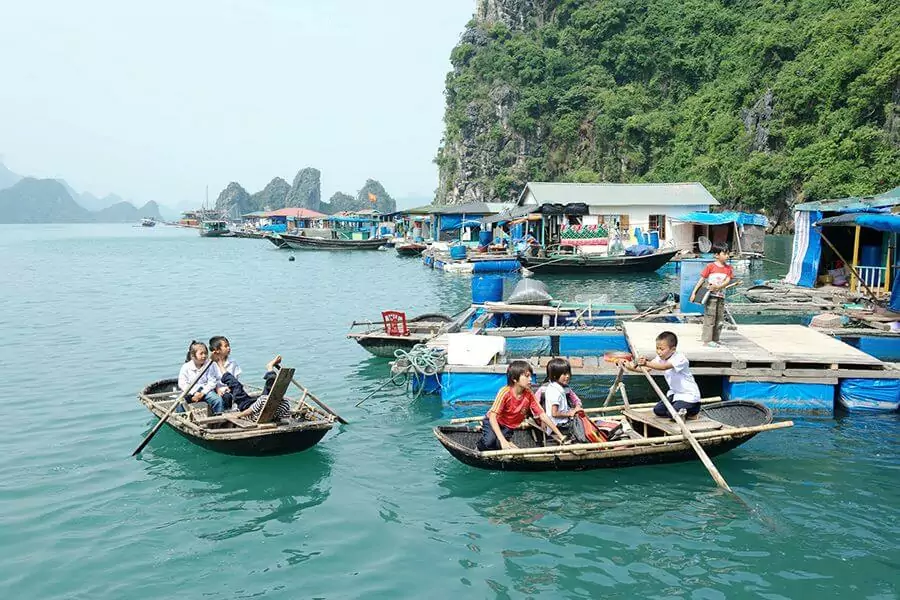 Children rowing to Cua Van’s floating school — Halong Bay’s first, now serving 7 classes of primary and secondary students from the village’s fishing families.
One of Cua Van’s most remarkable institutions is its floating school — the first school of its kind ever established in Halong Bay, now serving seven classes of primary and secondary students from the village’s fishing families. Children as young as five or six begin their school day by rowing themselves across the water to the floating school, a journey that — for visitors watching from a cruise ship or kayak — captures something essential about the extraordinary ordinariness of life at Cua Van.
The floating school reflects a community’s refusal to let its children be left behind educationally simply because of where they were born. Vocational training in traditional fishing techniques is offered alongside standard curriculum subjects, ensuring that young people carry forward both modern skills and the bay’s ancient maritime traditions.
The Floating Market
Cua Van’s informal floating market operates primarily in the early morning hours, before tourist cruise ships arrive. Residents trade fresh catch between boats — fish, squid, crabs, mollusks — and exchange supplies. This is when the village shows its most unmediated self: working families starting their day on the water, not performing for visitors, simply living. Overnight cruise guests who rise early enough can sometimes observe this market from a distance, one of the most authentic windows into floating village life available anywhere in Halong Bay.
5. The Cua Van Floating Cultural Center
The Cua Van Floating Cultural Center is the most tangible institutional expression of the village’s commitment to preserving its own heritage. Housed on a dedicated floating structure, the center was established to document and display the traditional cultural values of Halong Bay’s water-dwelling communities — and expanded significantly in March 2025 to accommodate a growing collection.
As of 2025–2026, the center holds:
- Over 850 archaeological artifacts, including ancient fishing tools, nets, hooks, and vessels used by bay fishermen across generations
- Traditional net-weaving demonstrations and displays
- Documentary films and archival photographs documenting the historical evolution of the floating villages
- A themed exhibition connecting the community’s maritime traditions to the broader history of Halong Bay
The center also hosts the “Voices of Ha Long” performance series — launched in 2024 and held on a floating platform, the 40-minute show features traditional Vietnamese water puppetry, folk songs performed by village elders, and demonstrations of traditional instruments. These performances represent one of the most direct and authentic cultural experiences available to visitors at any Halong Bay cruise stop.
6. What to See & Do at Cua Van Village
Bamboo Boat Ride Through the Village
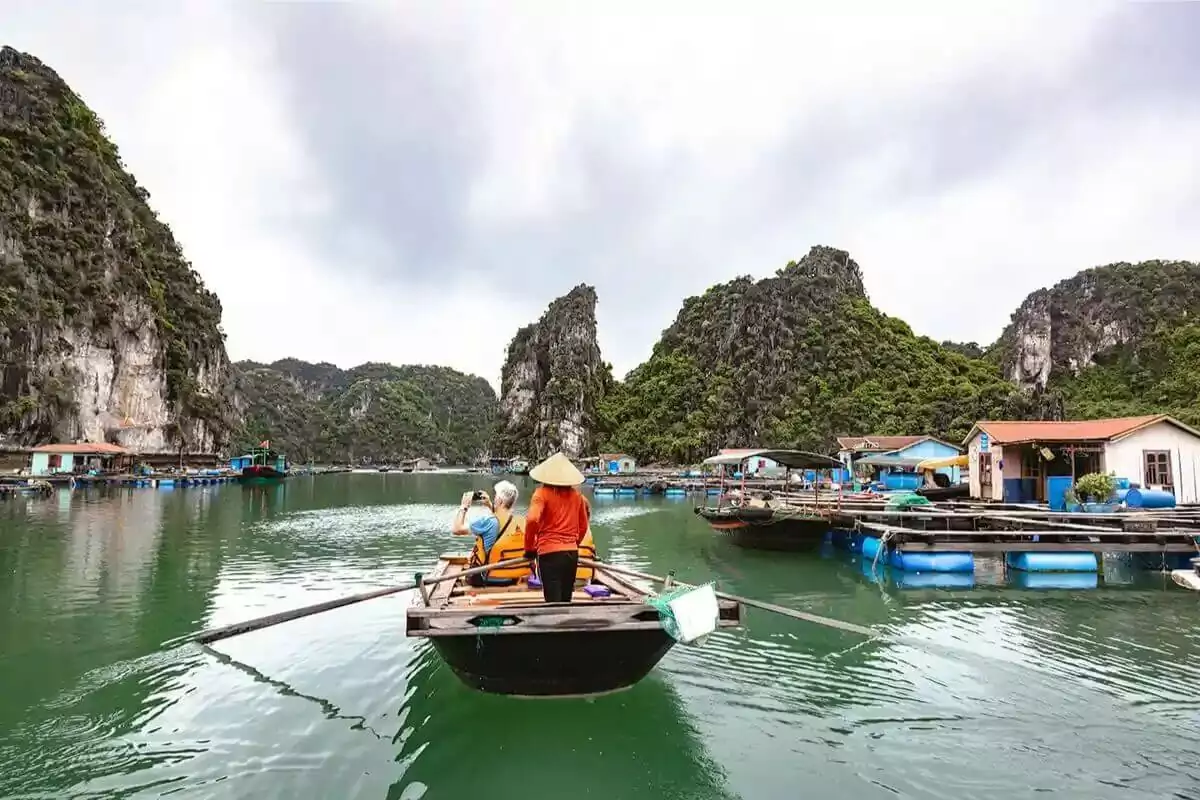 A bamboo boat ride through Cua Van’s floating houses — rowed by a village resident — gives visitors the closest and most intimate view of daily life in Halong Bay’s largest floating fishing community.
The standard visitor experience at Cua Van is a bamboo boat ride (rowboat) through the floating houses and along the village waterways, rowed by a local village resident. This 20–30 minute journey offers the closest and most intimate view of the floating houses, fishing boats, and daily village life from water level — close enough to see inside the homes through open doorways, observe children playing on the decks, and watch fishermen preparing their nets for the next trip.
Visit the Floating Cultural Center
A stop at the Cua Van Floating Cultural Center provides the historical and cultural context that transforms the village from a visual spectacle into a comprehensible human story. Allow 20–30 minutes. If timed correctly, visitors can catch a performance of the “Voices of Ha Long” traditional music series.
Traditional Fishing Activities
Many cruise operators arrange hands-on experiences alongside village fishermen: setting and hauling nets, preparing fishing hooks, and learning traditional techniques. Night squid fishing from the cruise ship deck — using lights to attract squid to the surface — is particularly popular during the squid season (February to April, July to October) and is offered by many overnight cruise operators as an after-dinner activity.
Traditional Folk Music
During festivals and occasional cultural events, visitors can hear “hat cheo” and “hat gheo” — traditional folk singing forms specific to Halong Bay fishing communities, characterized by call-and-response patterns between men and women, with lyrics that encode fishing wisdom, cultural values, and community history. These performances are among the rarest and most culturally specific musical experiences available anywhere in northern Vietnam.
Kayaking
Kayaking around the village perimeter — close to the floating houses and between the limestone formations that frame the village — gives visitors a more active, self-paced way to appreciate the community’s physical setting. Many cruise operators include kayaking as an option at Cua Van.
7. Responsible Tourism at Cua Van Village
Because Cua Van is a functioning residential community — not a theme park or heritage display — thoughtful visitor behavior is important both for respecting the residents and for ensuring the community can continue to welcome tourists sustainably.
2025–2026 Cua Van visitor guidelines:
- No docking directly at private homes. To protect the privacy and structural integrity of the floating houses, visitors may not land their boats or kayaks directly at residential structures.
- Zero-plastic zone. All visitors must use reusable water bottles within the village area — single-use plastic is banned.
- Reef-safe sunscreen only. Standard sunscreen chemicals damage the marine ecosystem; mineral (zinc-based) sunscreen is required when in the water.
- Photography with respect. Ask before photographing residents at close range — these are private homes, not tourist attractions.
- Buy directly from village stalls for seafood, crafts, and food where possible — revenue from direct purchases flows to fishing families rather than middlemen.
8. How to Visit Cua Van Village in 2026
Cua Van Village is included as a standard stop on most Halong Bay overnight cruise itineraries on Route 2, departing from Tuan Chau or Halong International Passenger Port.
| Option |
Duration |
Notes |
| Overnight cruise 2D1N |
2 days, 1 night |
Most popular — Cua Van typically visited on Day 1 or Day 2 |
| Extended cruise 3D2N |
3 days, 2 nights |
More time for the cultural center and traditional activities |
| Day cruise from Tuan Chau |
5–6 hours |
Possible; time at the village is brief — ~30 minutes by bamboo boat |
Departure & Journey
- From Hanoi: ~2.5–3 hours by road to Tuan Chau or Halong International Port
- Boat journey from Tuan Chau: ~45 minutes to 1 hour to reach the Cua Van area on Route 2
- No entrance fee: Cua Van is included in the Halong Bay Sightseeing Route 2 ticket (290,000 VND/person for day trips, or bundled into overnight cruise packages)
→ Browse Halong Bay cruises that visit Cua Van Village →
9. Best Time to Visit Cua Van Fishing Village
| Season |
Months |
Conditions |
Rating |
| Dry season |
Oct – April |
Clear skies, calm bay, best for bamboo boat rides and photography |
⭐⭐⭐⭐⭐ Best overall |
| Autumn |
Oct – Nov |
Clear, mild, ideal for dawn photography of the floating houses |
⭐⭐⭐⭐⭐ Excellent |
| Spring |
Mar – Apr |
Mild temperatures, squid fishing season begins — busy but beautiful |
⭐⭐⭐⭐⭐ Excellent |
| Summer peak |
Jun – Aug |
Hot and humid; higher storm risk; squid fishing at peak |
⭐⭐⭐ Manageable |
Squid fishing season: February–April and July–October — if night squid fishing from the cruise ship is a priority, plan your visit accordingly.
Best time of day: Dawn — arriving at Cua Van in the early morning, before the main wave of cruise ships, allows visitors to observe the informal floating market and the children rowing to the floating school, the two most authentic windows into daily village life.
10. Practical Tips Before You Go
- Arrive early. The most authentic experience of Cua Van happens before 9 AM, when the village operates on its own natural rhythm rather than tourist schedule. Overnight cruises that anchor near the village allow early-morning observation from the ship’s deck.
- Bring a wide-angle camera. The scale of the floating house clusters against the limestone karsts behind them is impossible to capture adequately with a standard phone camera. A wide-angle lens or ultra-wide phone mode produces the most striking images.
- Wear reef-safe sunscreen — required in the village water zone.
- Use a reusable water bottle. Single-use plastic is banned within the Cua Van zone.
- Buy fresh seafood at the village. Purchasing directly from village stalls ensures income goes to fishing families.
- Ask before photographing. Village residents are private people going about their daily lives — always seek eye contact and implicit permission before photographing individuals at close range.
- Allow 30–45 minutes for the bamboo boat ride and 20–30 minutes for the Cultural Center — plan for at least 60–75 minutes in total if both are included in your itinerary.
11. Cua Van Fishing Village — Frequently Asked Questions
The questions we get asked most often by travelers planning to visit Cua Van Fishing Village in Halong Bay.
Last updated: June 2026 | Information verified against multiple Halong Bay tourism and cultural sources including Revitrip (March 2026), Halong Junk Cruise, New Asia Tours, Wikipedia Halong Bay, and Vietnam Story. Population figures (176 households, ~733 residents) are consistent across multiple independent sources as of 2025.


