By Jimmy, Halong Bay cruise specialist · Updated
Dau Go Cave 2026: Halong Bay’s Wooden Stakes Cave, King Khai Dinh’s Stele and How to Visit
Dau Go Cave (Wooden Stakes Cave) is a three-chamber cave of about 5,000 m² on Dau Go Island in Halong Bay, a short boat ride from Bai Chay. Tradition says General Tran Hung Dao prepared the wooden stakes here that destroyed the Mongol-Yuan fleet at the Battle of Bach Dang in 1288, and a stone stele at its entrance records King Khai Dinh’s visit in 1918. It is visited on route VHL1 together with Thien Cung Cave, about 300 m away.
Status (checked October 2026): Dau Go Cave is open daily on route VHL1 and reopened on 10 September 2024 after Typhoon Yagi, which stripped most trees on Dau Go Island. Most overnight cruises do not include it; choose a VHL1 day boat or ask us to add it before your cruise.
Dau Go Cave at a Glance
| Location |
Dau Go Island, western edge of the Halong Bay core zone |
| Distance |
About 6 km from Bai Chay by boat; about 300 m from Thien Cung Cave |
| Size |
About 5,000 m²; entrance about 17 m wide and 12 m high, about 27 m above sea level; vault up to about 25 m |
| Steps |
About 90 stone steps to the entrance |
| Temperature inside |
About 20–22 °C |
| Known for |
Vast bright entrance hall, Bach Dang legend, King Khai Dinh’s 1918 stele |
| French name |
Grotte des Merveilles (Cave of Wonders) |
| Visit time |
About 30 minutes |
| Route |
VHL1 with Thien Cung Cave; also VHL5 and VHL8 |
| Ticket |
Part of the VHL1 ticket (250,000 VND, Management Board 2025) |
| Find it |
Google Maps · TripAdvisor |
Is Dau Go Cave worth it? Yes as a pair with Thien Cung: the size of the first hall and the history make it memorable. On its own it is a 30-minute stop, not a reason to plan a trip.
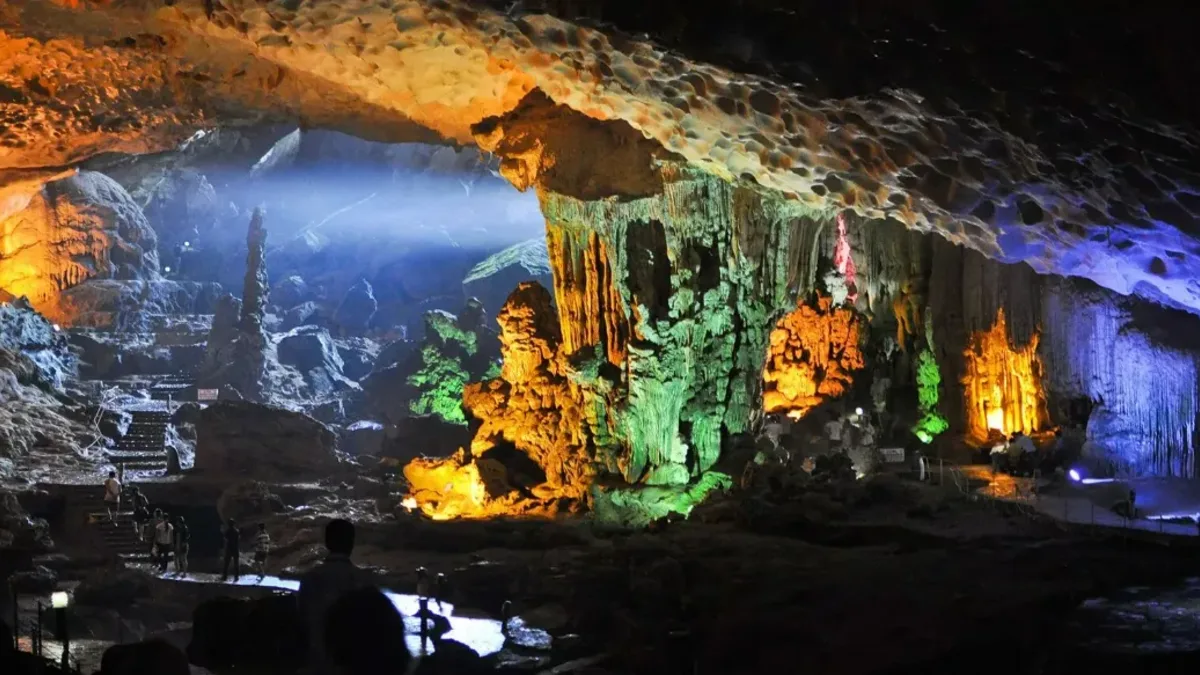 The stairway to Dau Go Cave on Dau Go Island
What Makes Dau Go Cave Special
A hall for thousands
The first chamber is one of the largest open spaces in any Halong Bay cave. Its wide mouth lets in daylight, so the ceiling looks like an oil painting of colours.
A link to Vietnam’s greatest naval victory
The name ties the cave to the 1288 Battle of Bach Dang, when iron-tipped stakes planted in the river destroyed the invading Mongol-Yuan fleet.
The only king’s stele in a Halong Bay cave
King Khai Dinh’s inscription is described by Vietnamese historians as the only stele in a Halong Bay cave commissioned by a monarch.
Deep prehistory nearby
Thien Long Cave on the same island is an archaeological site of the Soi Nhu culture, which dates back thousands of years.
History: Legend and Fact
The wooden stakes
The battle is well documented: in 1288 General Tran Hung Dao planted stakes in the Bach Dang River and lured the Mongol-Yuan fleet onto them as the tide fell (see Wikipedia). Tradition says the stakes were prepared or hidden in this cave and that leftover wood gave it its name, Đầu Gỗ, the heads of wood; another version says the name comes from Giấu Gỗ, hidden wood. Other folk explanations say fishermen repaired their boats here, or that the island looks like a log. The cave link is legend, not proven history.
King Khai Dinh’s visit, 1918
During his only tour of northern Vietnam, between 19 April and 8 May 1918, King Khai Dinh visited the cave with Governor-General Albert Sarraut. He named it Ngũ Sắc Tường Vân, five-coloured auspicious clouds, and wrote a preface and a twelve-line poem praising the stone forms, coloured light and echoes. Local officials had it carved on a stele dated 2 May 1918, decorated with two dragons facing the moon, clouds and a qilin, which stands at the right of the entrance. Historian Dinh Khac Thuan translated the worn text in 2009; some on-site signs give wrong dates. The story is told in detail by Bao Quang Ninh.
The French name
Vietnamese sources say a French travel magazine called it the Grotte des Merveilles, the Cave of Wonders, in 1938.
Renovation
After about twenty years of use, walkways and railings were renovated in 2016.
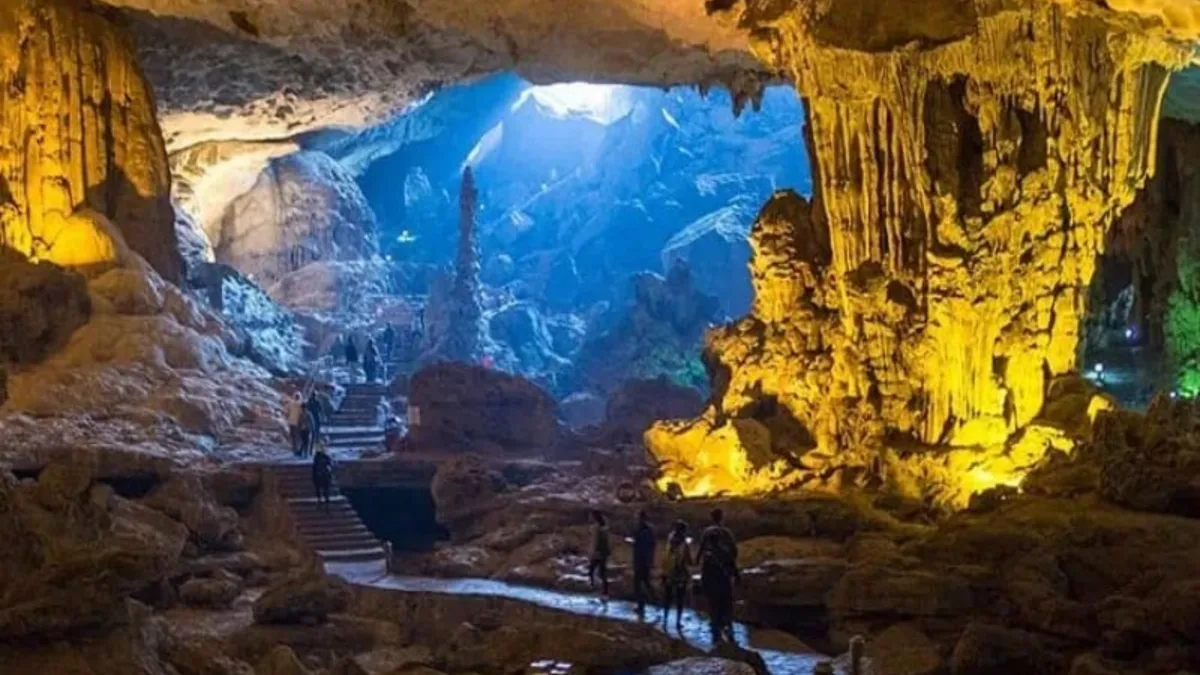 Columns and stalactites in the bright first chamber of Dau Go Cave
Inside Dau Go Cave: Chamber by Chamber
1. The outer hall
A huge, bright chamber with columns and stalactites. Guides point out shapes of a lion, turtle, elephant, deer and fighting roosters. This is the place for wide photos.
2. The middle chamber
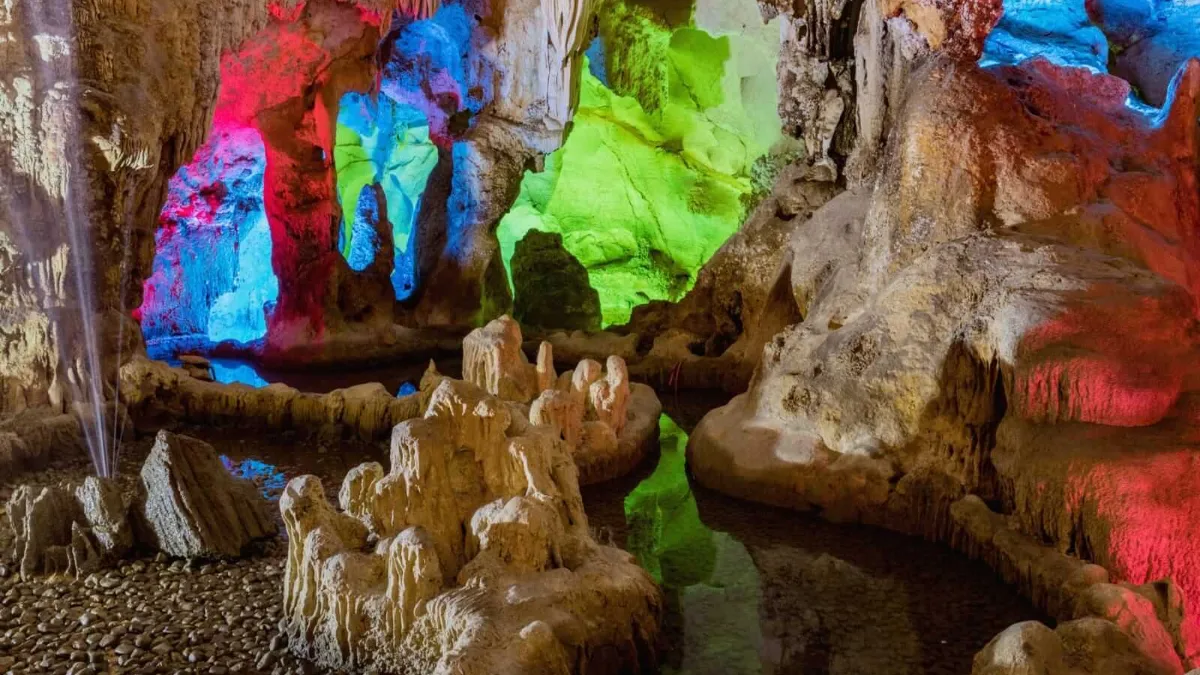
A narrow passage about 1.4 m wide leads into a dimmer chamber whose formations look like a miniature Halong Bay, with flower-shaped stalagmites.
3. The inner chamber
The cave widens again into a hall of column-like formations that guides call a frozen battle, with a freshwater well that stays full all year.
 King Khai Dinh’s 1918 stele at Dau Go Cave
Hours, Tickets and Rules
| Item |
Details (checked October 2026) |
| Hours |
Daytime, roughly 07:30–17:00; follows VHL1 boat schedules |
| Ticket |
VHL1 route ticket (250,000 VND on the Management Board’s 2025 list) |
| Access |
About 90 steps at the entrance; not wheelchair accessible |
| Rules |
Do not touch formations or the stele; no litter or single-use plastic |
How to Get to Dau Go Cave
| Option |
How it works |
Notes |
| VHL1 day boat |
About 4 hours from Ha Long International Cruise Port or Tuan Chau |
With Thien Cung Cave and famous rocks |
| VHL8 short route |
About 5 hours to Dau Go Island |
New from May 2025 |
| Day cruise |
Only some itineraries |
Check before booking |
| Overnight cruise |
Rarely included |
Visit before boarding |
Best Time to Visit
| Months |
Conditions |
Tip |
| October–April |
Cool and comfortable |
Best |
| May–September |
Hot, humid, storm risk |
Go early; the cave stays about 20–22 °C |
See our best time to visit Halong Bay guide.
Dau Go Cave vs Sung Sot Cave
|
Dau Go Cave |
Sung Sot Cave |
| Route |
VHL1 |
VHL2 |
| Highlight |
History and the bright entrance hall |
Size and bay view |
| On overnight cruises |
Rarely |
Usually |
Our view: For history lovers on a day trip, Dau Go and Thien Cung make a strong pair. Overnight guests will see Sung Sot Cave instead.
How Dau Go Cave Fits Your Trip
- Morning VHL1 boat: Dau Go Cave and Thien Cung Cave
- Afternoon: board an overnight cruise to Ti Top Island and Luon Cave
- Or return to Hanoi; see day cruise vs overnight cruise
Local Expert Tips
These tips come from more than a decade of arranging Halong Bay trips for international travellers.
- Ask your guide about Bach Dang before you go in
- Look for the Khai Dinh stele at the right of the entrance
- Wear trainers for the stairs
- Visit before 10:00 to avoid big groups
Plan Your Visit
Message us on WhatsApp +84 886 261 368 for a private VHL1 boat to Dau Go Cave, or compare our day cruises. Best Price Guarantee included.
Frequently Asked Questions about Dau Go Cave
1. Where is Dau Go Cave?
Dau Go Cave is on Dau Go Island at the western edge of the Halong Bay core zone, about 6 km from Bai Chay. See more Halong Bay attractions.
2. Why is it called Wooden Stakes Cave (Dau Go Cave)?
Tradition says Tran Hung Dao prepared wooden stakes here before the 1288 Battle of Bach Dang.
3. Did Tran Hung Dao really hide stakes in Dau Go Cave?
The battle and the stakes are historical; the cave link is a legend without firm evidence.
4. How big is Dau Go Cave?
About 5,000 m² in three chambers, with an entrance about 17 m wide and 12 m high.
5. How many steps are there at Dau Go Cave?
About 90 stone steps to the entrance.
6. Who visited Dau Go Cave in 1918?
King Khai Dinh, with Governor-General Albert Sarraut; his stele is dated 2 May 1918.
7. What does the Khai Dinh stele at Dau Go Cave say?
It records the visit, names the cave Ngũ Sắc Tường Vân and includes a poem praising its stone forms and light.
8. Is Dau Go Cave the same as Thien Cung Cave?
No, they are separate caves about 300 m apart; read our Thien Cung Cave guide.
9. Which route includes Dau Go Cave?
Route VHL1, a trip of about four hours.
10. Do overnight cruises visit Dau Go Cave?
Rarely; they visit Sung Sot Cave on VHL2.
11. How long does a Dau Go Cave visit take?
About 30 minutes.
12. Is there a ticket for Dau Go Cave?
It is part of the VHL1 sightseeing ticket, included in day tours.
13. Is Dau Go Cave open after Typhoon Yagi?
Yes, since 10 September 2024.
14. Is Dau Go Cave suitable for elderly travellers?
Manageable with care on the stairs. Ask about mobility options on our contact page.
15. When is the best time to visit Dau Go Cave?
Early morning, October to April; see our best time to visit guide.
16. Can I visit Dau Go Cave on a day trip from Hanoi?
Yes, with a VHL1 boat; compare Halong Bay day cruises.
17. What else is on the Dau Go Cave route?
Thien Cung Cave and famous rocks such as Dog Rock and Fighting Cocks. More in our travel guides.
18. Is Dau Go Cave worth visiting?
Yes for history lovers, ideally with Thien Cung. Plan Dau Go Cave into your trip with us.


