1. About Viet Hai Village — Key Facts at a Glance
| Detail |
Information |
| Location |
Inside Cat Ba National Park, Cat Hai District, Hai Phong City, Vietnam |
| Distance from Cat Ba Town |
Approximately 18 km |
| Cycling route from pier |
Approximately 4 km through forest (bicycle or electric tram) |
| Trekking route |
8–12 km from Beo Pier via Ao Ech Lake through Cat Ba National Park (3.5–5 hours) |
| Village area |
Approximately 141 hectares |
| Households |
Approximately 70–100 households |
| History |
Over 100 years — founded by fishermen seeking storm refuge |
| Nicknames |
“Sleeping Beauty” · “Island within an island” · “Hidden Valley” |
| Famous for |
“No-lock” culture · working rice paddies · cycling · heritage house |
| Livelihoods |
Fishing · rice farming · homestay · eco-tourism guiding · bike rental |
| Park entrance fee |
80,000 VND per person (Cat Ba National Park admission) |
| Accessed via |
Lan Ha Bay overnight cruise, or boat/trek from Cat Ba Town |
2. Location: The Island Within an Island
Viet Hai Village is located deep inside Cat Ba National Park, in the Cat Hai District of Hai Phong City, Vietnam — approximately 18 kilometers from Cat Ba Town and accessible only by boat or on foot through the national park’s jungle interior. It sits surrounded entirely by forested limestone karst mountains on one side and the pristine waters of Lan Ha Bay on the other, earning it the evocative nickname “the island within an island.”
There are no roads connecting Viet Hai to the wider Cat Ba Island road network — the village is intentionally removed from the kind of casual drive-through access that defines most tourist destinations. Reaching it requires either a 4-kilometer cycling or electric tram journey through old-growth forest from the boat pier, or an 8–12 kilometer jungle trek from Cat Ba Town’s Beo Pier via Ao Ech Lake, passing through some of the most pristine tropical forest in northern Vietnam. This enforced remoteness is precisely what has preserved the village’s extraordinary cultural character.
Viet Hai is typically visited as part of an overnight Lan Ha Bay cruise or Lan Ha Bay day excursion. The cruise anchors offshore and visitors transfer by smaller boat to the village pier, then proceed by bicycle, electric tram, or on foot into the village center.
3. History: A Century of Isolation & Resilience
Viet Hai Village was founded over 100 years ago by local fishermen who came to shelter in the natural protection of this enclosed valley during storms and rough weather on the open bay. Over time, the temporary shelters became permanent homes, and the small fishing community gradually evolved into a self-sufficient farming and fishing settlement that had almost no contact with the outside world for much of its existence.
For generations, residents of Viet Hai lived in wooden stilt houses, farming rice in the paddies carved from the valley floor, fishing the surrounding waters, raising livestock, and harvesting the national park’s resources with a careful balance that has sustained the community and the ecosystem alike. The village was so remote that it received electricity for the first time only about 10 years ago — an event that, alongside the gradual development of eco-tourism, significantly transformed daily life for younger generations.
During the French colonial resistance period, Viet Hai’s remote position made it strategically useful: the area reportedly served as a logistics base for resistance operations, and ruins of what is described as a Navy Peak Radar Station remain visible in the forested hills above the village — a tangible historical layer that adds depth to the visit beyond pure natural beauty.
Today, Viet Hai is officially designated as a community eco-tourism destination. Residents who once relied entirely on fishing and farming have diversified into homestay hosting, eco-tourism guiding, bicycle rental, and electric tram operation — new livelihoods that connect the village to the outside world while its cultural fabric remains remarkably intact.
4. The No-Lock Culture
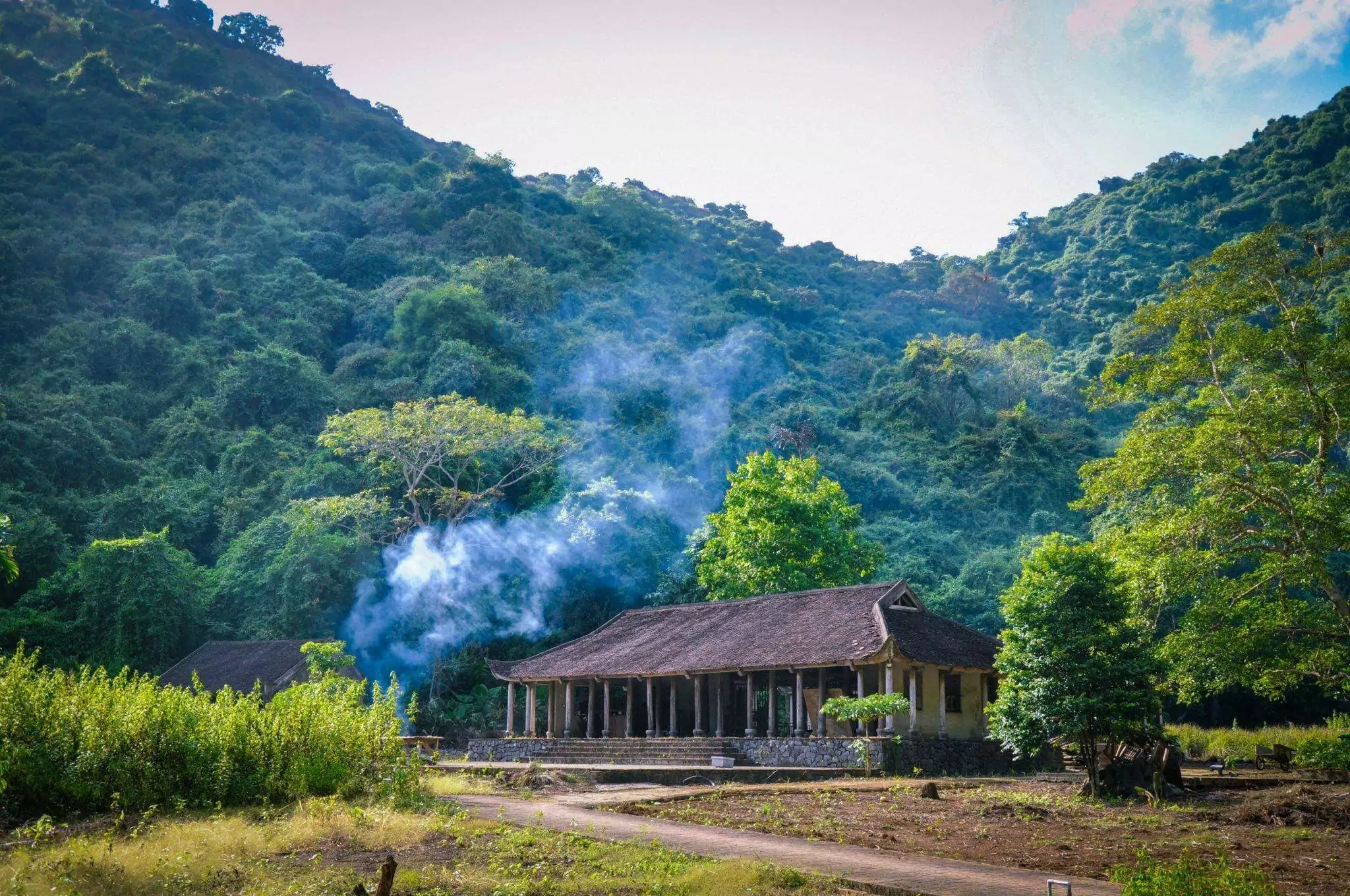 Traditional wooden houses in Viet Hai Village, many with open unlocked doors — a living symbol of the community’s extraordinary no-lock culture, preserved across more than a century of isolation.
Among everything that makes Viet Hai Village distinctive, no single characteristic captures travelers’ imaginations more powerfully than its “no-lock” culture.
With a population of 70–100 households living in a valley entirely enclosed by national park forest and bay, Viet Hai has historically had so little contact with the outside world — and so strong a sense of community identity — that the concept of locking one’s door was simply unnecessary. Residents have always known each other, watched each other’s homes, looked after each other’s children. In a community this small, in a location this isolated, there was no one to steal from and no one to steal.
The extraordinary thing is that this culture persists today, even as eco-tourism has brought hundreds of visitors through the village annually. Walk through Viet Hai in 2026, and you will still see many homes with open doors — unlocked, unguarded, simply open to the passing breeze and the occasional curious traveler looking in. Locals describe this not as naivety but as pride: the no-lock culture is understood as a reflection of a community’s integrity, a living embodiment of values that the modern world has largely lost.
A note for visitors: The open doors of Viet Hai are an invitation to observe, not to enter. Please respect residents’ privacy by keeping to the village paths and asking your guide before approaching or photographing any home or its inhabitants at close range.
5. How to Get to Viet Hai Village: Cycling vs Trekking
Option 1 — Cycling (4 km from pier, recommended for most visitors)
The most popular and enjoyable way to reach Viet Hai from the boat pier. The route follows a concrete path through old-growth jungle canopy, passing through a small cave covered in ancient tree roots and framed by rice fields on both sides, before opening into the village center. The cycling route takes approximately 30–45 minutes at a relaxed pace and is suitable for all fitness levels. Electric trams (buggies carrying 4–8 passengers) are available for visitors who prefer not to cycle.
Option 2 — Trekking through Cat Ba National Park (8–12 km, serious hikers only)
The trekking route from Cat Ba Town’s Beo Pier via Ao Ech Lake (Frog Pond) is one of the most rewarding — and demanding — walks in the entire Cat Ba region. The route crosses 8–12 kilometers of national park terrain, passing through primary tropical rainforest, alongside mountain streams, through limestone caves, and across steep rocky ascents with sweeping views over the karst landscape. Allow 3.5–5 hours for the one-way journey. The route is rated hard — not recommended for those without trekking experience. A local guide is strongly advised, both for navigation and for the trail’s identification of wildlife, plants, and historical sites along the way.
| Method |
Distance |
Duration |
Difficulty |
Best For |
| Cycling |
~4 km |
30–45 min |
Easy |
All visitors, families, seniors |
| Electric tram |
~4 km |
~20 min |
Easy |
Multi-generational groups, mobility-limited visitors |
| Trekking via Ao Ech |
8–12 km |
3.5–5 hours |
Hard |
Fit hikers with trekking experience, guided groups |
6. What to Do in Viet Hai Village
Cycling Through the Village
Even beyond the approach ride from the pier, cycling is the ideal way to explore Viet Hai itself. Rental bicycles are available in the village center at low cost. Riding through the narrow paths between rice paddies, past open-doored wooden houses, through small orchards, and along the water’s edge gives visitors an unhurried, immersive experience of village life that is impossible to replicate on foot or by tram.
The Village Heritage House
A visit to the village’s community heritage house is one of the most culturally rich stops in Viet Hai. The heritage house holds a collection of ancient farming tools, traditional household artifacts, hand-woven goods, and old photographs documenting the village’s evolution across more than a century. Local caretakers can walk visitors through the collection and explain the significance of key pieces — offering a window into a way of life that has largely vanished elsewhere in Vietnam.
Rice Paddy Walks
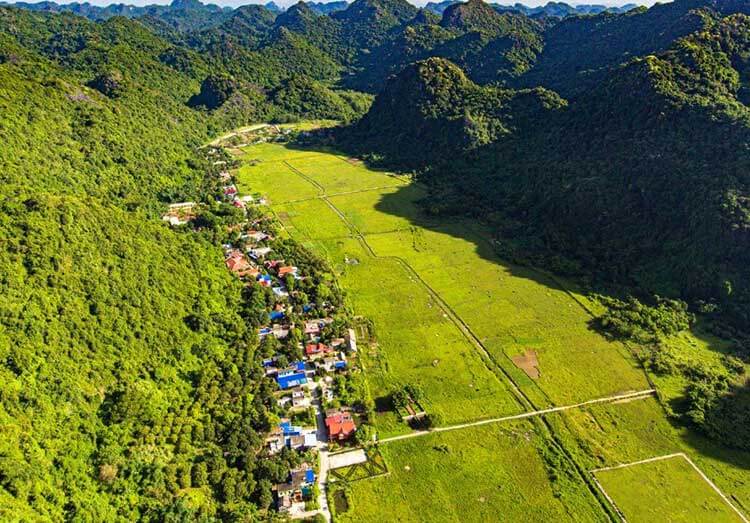 Viet Hai’s working rice paddies transform with the seasons — bright green shoots from February to April, lush growth through summer, and golden harvest fields in October and November.
Viet Hai’s valley floor is still actively farmed, with rice paddies that transform dramatically by season: bright green shoots from February to April and June to August, and golden ripening fields in the harvest months. Walking the paddy borders — narrow raised paths between flooded fields — is one of the most peaceful and photogenic experiences the village offers.
Eco-Tourism Experiences
The village’s community eco-tourism program allows visitors to participate in daily village life: fishing alongside local fishermen, sowing or harvesting rice, feeding livestock, and learning traditional cooking methods. These participatory experiences are arranged through the village’s local guides and are some of the most intimate cultural encounters available anywhere in the Lan Ha Bay region.
Seafood Dining
Several family-run restaurants in the village serve locally caught seafood — grilled squid, steamed grouper, lobster dishes, grilled sea urchin with scallion oil — alongside rice and vegetables grown in the village paddies. Dining here, steps from the water and surrounded by forest, is one of the culinary highlights of any Cat Ba Island visit.
Kayaking to Dark and Bright Cave
Viet Hai is located close to the Dark and Bright Cave — many overnight cruise itineraries that include Viet Hai also include a kayaking stop at the cave complex on the same day or consecutive day, allowing visitors to combine the village’s cultural experience with the bay’s most thrilling water-level cave adventure.
7. How to Visit Viet Hai Village in 2026
Via Lan Ha Bay Overnight Cruise (Most Popular)
The majority of international visitors reach Viet Hai as part of a Lan Ha Bay overnight cruise itinerary. The cruise anchors offshore, transfers passengers by smaller boat to the village pier, then provides cycling or tram access to the village center, a guided exploration, lunch at a local restaurant, and return to the cruise ship in the afternoon.
| Cruise Type |
Duration |
Viet Hai Included? |
| Day cruise from Cat Ba |
6–8 hours |
Sometimes — confirm with operator |
| Overnight 2D1N |
2 days, 1 night |
Commonly included — most popular option |
| Extended 3D2N |
3 days, 2 nights |
Typically included with more time at the village |
Independent Visit from Cat Ba Town
- By boat: 45-minute boat from Cat Ba Town’s Beo Pier (confirm schedule with local operators — service is limited)
- By trekking: 8–12 km from Beo Pier via Cat Ba National Park; National Park entrance fee 80,000 VND/person; local guide strongly recommended
→ Browse Lan Ha Bay cruises including Viet Hai Village →
8. Best Time to Visit Viet Hai Village
| Season |
Months |
Conditions |
Rating |
| Rice bloom (best photos) |
Feb – Apr & Jun – Aug |
Green paddies or ripening golden fields — the most photogenic periods |
⭐⭐⭐⭐⭐ For photography |
| Dry season |
Oct – April |
Clear skies, dry paths — ideal for both cycling and trekking routes |
⭐⭐⭐⭐⭐ Best overall |
| Autumn |
Sep – Nov |
Comfortable temperatures, clear days, golden light on the bay |
⭐⭐⭐⭐⭐ Excellent |
| Summer |
Jun – Aug |
Green paddies beautiful; higher humidity and occasional rain; trekking paths can be muddy |
⭐⭐⭐⭐ Good with preparation |
For the rice paddies: February–April offers fresh green shoots; June–August is the lush growth period; October–November features harvest season — golden fields being cut by hand under clear skies.
9. Practical Tips Before You Go
- Bring insect repellent. The forest route to the village and the paddy paths in the village itself attract mosquitoes — this is the most commonly cited essential by visitors and guides alike.
- Wear closed-toe shoes for cycling or trekking. Open sandals and flip-flops are unsuitable for the forest paths, paddy walks, and especially the trekking route.
- Bring cash (VND). The village has no ATM or card facilities — bike rental, food, drinks, and heritage house donations are all cash only.
- A light jacket is useful for the boat journey from the cruise ship to the pier, which can be breezy even in summer.
- For the trekking route: Pack water, snacks, and a first aid kit; wear hiking boots; book a local guide through the national park or your cruise operator. Do not attempt the 8–12 km route alone or without trekking experience.
- Respect the no-lock culture. Open doors are not invitations to enter. Follow your guide’s lead and ask before photographing village interiors or residents up close.
- Budget 2–3 hours for the full village experience: the cycle in, heritage house, paddy walk, lunch, and cycle back to the pier.
10. Viet Hai Village — Frequently Asked Questions
The questions we get asked most often by travelers planning to visit Viet Hai Village on Cat Ba Island.
Last updated: June 2026 | Information verified against multiple Cat Ba Island and Lan Ha Bay tourism sources including Heritage Cruises, Vietnam Story, BestPrice Travel, and Genesis Cruise. Household counts vary between sources (70–100) and are presented as approximate.


