1. About Ba Trai Dao Islets — Key Facts at a Glance
| Detail |
Information |
| Vietnamese name |
Ba Trái Đào — “Three Peaches” |
| Also known as |
Three Peaches Islet · Three Peaches Beach · Ba Trai Dao Beach |
| Location |
Lan Ha Bay, near Cat Ba Island, Hai Phong Province, Vietnam |
| Distance from Bai Chay Wharf |
Approximately 22 km southeast |
| Number of islets |
3 limestone islets |
| Islet height |
Approximately 23 meters above sea level |
| Beach shape |
Crescent/bow-shaped — curves around all three islets |
| Beach accessibility |
Approximately 2–3 hours per day (tide-dependent) |
| Water depth |
Shallow — knee-deep in most places at low tide |
| Activities |
Swimming · kayaking · snorkeling · sunbathing · wildlife spotting · photography |
| Access |
Lan Ha Bay overnight or day cruise itinerary |
2. Location: Where Are the Ba Trai Dao Islets?
 Ba Trai Dao’s three rounded limestone islets, approximately 23 meters high, enclose a crescent of white sand beach accessible for 2–3 hours per day at low tide — one of Lan Ha Bay’s most photographed destinations.
Ba Trai Dao Islets are located in Lan Ha Bay, Hai Phong Province — approximately 22 kilometers southeast of Bai Chay Tourist Wharf in Halong City, near the coast of Cat Ba Island. The islets sit in a relatively exposed section of the bay, further from the mainland than most cruise anchorages, which contributes both to the pristine clarity of the water and to the occasional conditions that can make it challenging for cruise ships to hold a steady position there.
The three islets form a natural arc that encloses a shallow, calm cove on the sheltered side — creating a beach and swimming area protected from the open bay’s waves. The seaward side of the islets faces more open water, which is why cruise ships anchor at a distance and passengers travel the final approach by smaller boat or kayak. The surrounding seabed supports coral formations and a diverse range of fish species, making the waters around Ba Trai Dao among the most productive snorkeling spots in Lan Ha Bay.
3. The Legend of the Three Peaches
Like many of the limestone islands scattered across Halong Bay and Lan Ha Bay, Ba Trai Dao carries a legend as beautiful as the landscape itself. According to local folklore passed down across generations of bay fishermen, the three islets were once three heavenly peaches — celestial objects turned to stone by the anger of the gods.
The story tells of the youngest daughter of the Jade Emperor, who slipped away from the heavens to visit the bay below. While exploring its emerald waters, she fell deeply in love with a poor fisherman. Their love was powerful but impossible: she was immortal and celestial; he was mortal and earthbound. Desperate to find a way to be together with him forever, the fairy made a fateful decision — she secretly stole three divine peaches from the heavenly gardens, intending to give them to her beloved so he would gain immortality and live with her eternally.
But the theft was discovered. The Jade Emperor, furious at his daughter’s defiance, punished her by transforming the three stolen peaches into three stone islands on the surface of the bay — forever separating the fairy and the fisherman, as she was forbidden to approach the islands that now bore the shape of what she had taken. The three islets we see today — their rounded, peach-like limestone profiles rising from the water — are said to be those three divine fruits, turned to stone as a monument to a love that could not be.
This legend of romantic devotion and eternal sacrifice is why Ba Trai Dao has long been considered a symbol of love and devotion in Vietnamese culture — and why the islets remain one of the most popular destinations for couples and honeymooners among all of Lan Ha Bay’s attractions.
4. The Beach: A Tide-Dependent Paradise
The beach at Ba Trai Dao is unlike any other beach in Lan Ha Bay — primarily because of its impermanence. The narrow crescent of fine white sand that wraps around the sheltered inner cove of the three islets is exposed by the receding tide for only approximately 2–3 hours per day. Outside this window, the waterline rises to cover the sand entirely, and the “beach” disappears beneath the surface of the bay.
This tidal rhythm creates an experience unlike anything at a conventional beach destination: visitors who time their arrival correctly arrive at the beach before the crowd (cruise itineraries are generally timed to coincide with the low-tide window), enjoy a few magical hours of swimming and sunbathing in an extraordinary setting, and then return to their cruise ship as the tide returns to reclaim the sand beneath their feet.
What the Beach Is Like
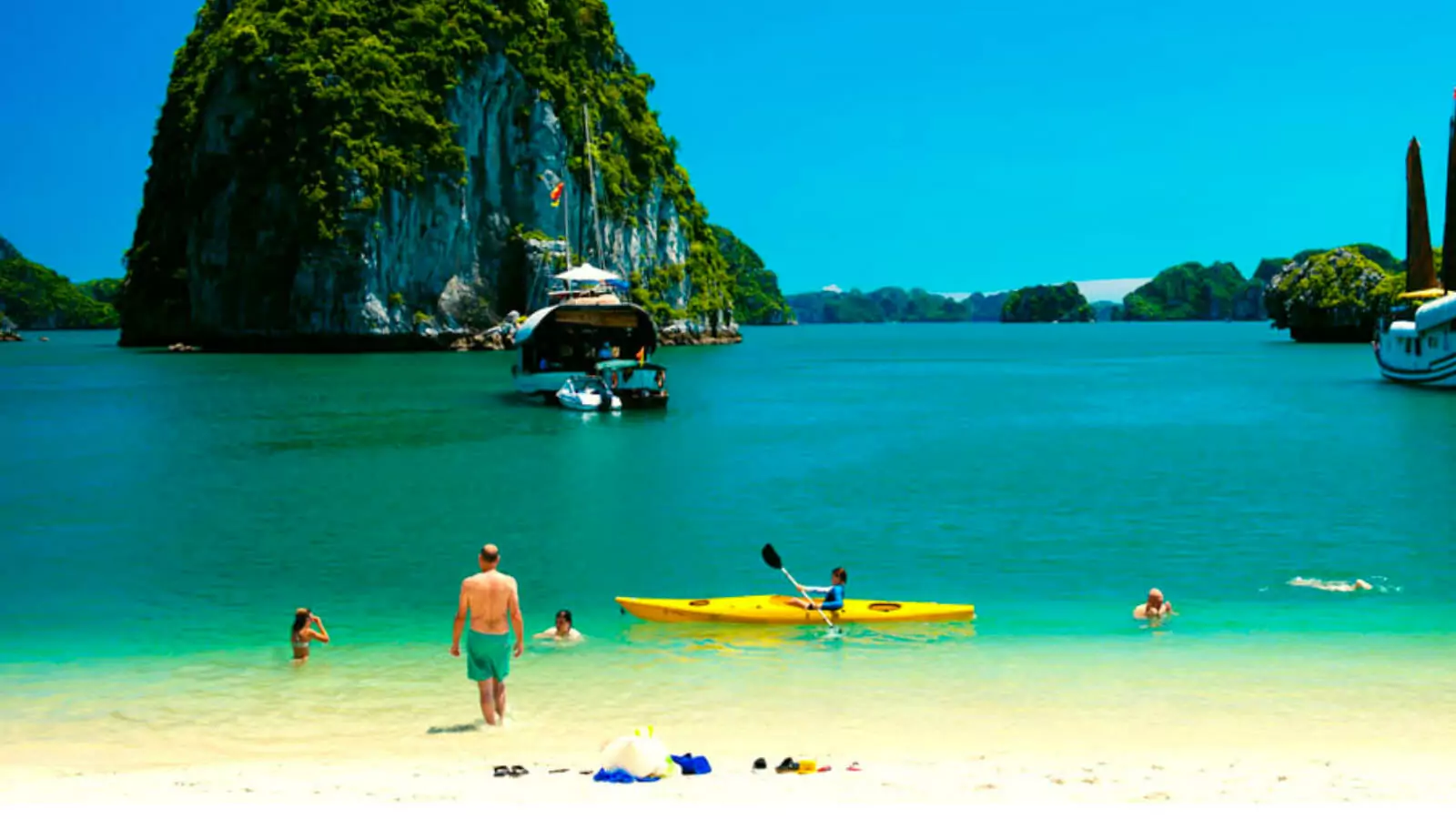 Ba Trai Dao Beach emerges for approximately 2–3 hours per day during low tide — the shallow, knee-deep water in the sheltered cove makes it one of the safest and most beautiful swimming spots in Lan Ha Bay.
During the low-tide window, the beach presents a genuinely beautiful landscape: soft, pale sand curves in a gentle arc around the base of the three limestone islets, their rounded profiles rising above and enclosing the cove like a natural amphitheater. The water at the beach is shallow — knee-deep in most places — and exceptionally clear, with visibility to the bottom on calm days. The seaward-facing sides of the islets are covered with lush tropical vegetation and seasonal wildflowers, adding bursts of color to the dramatic grey limestone above the waterline.
Important tidal note: Ba Trai Dao Beach is only safely accessible for swimming during the low-tide window of approximately 2–3 hours per day. Do not enter the water as the tide is rising — the shallow beach is quickly submerged, and currents can develop. Your cruise operator will time the visit to coincide with the low-tide window; always follow your guide’s instructions about when it is safe to swim and when to return to the boat.
5. Activities: What to Do at Ba Trai Dao
Swimming
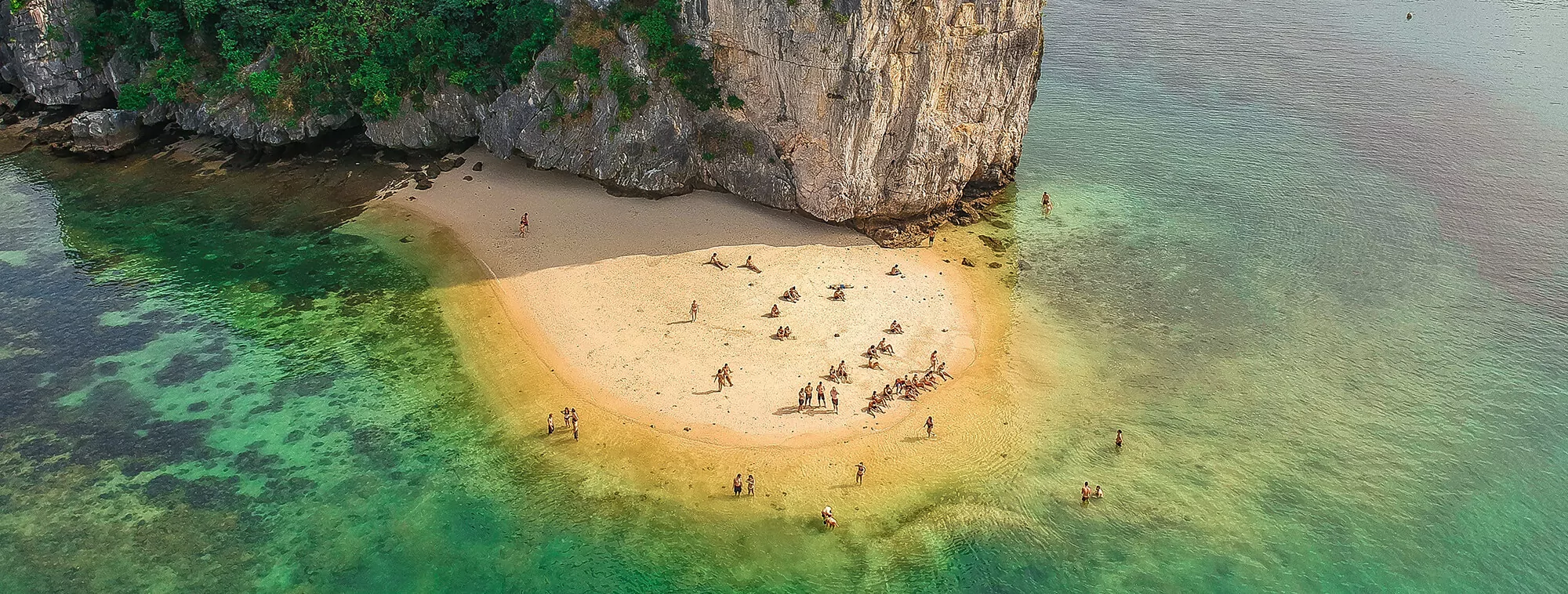 Ba Trai Dao Beach (Three Peaches Beach) at low tide, swimming in Lan Ha Bay, Vietnam
Swimming at Ba Trai Dao Beach during the low-tide window is the primary reason most travelers stop here. The sheltered, shallow cove creates exceptionally calm and safe conditions — more protected than almost any other open-water swimming spot in Lan Ha Bay, and ideal for families with children, as the knee-deep water allows young swimmers to paddle safely in the enclosure formed by the three surrounding islets. The water temperature is most comfortable from May to September (summer months); the beach is most dramatic to visit from October to April (dry season, clearest skies).
Kayaking
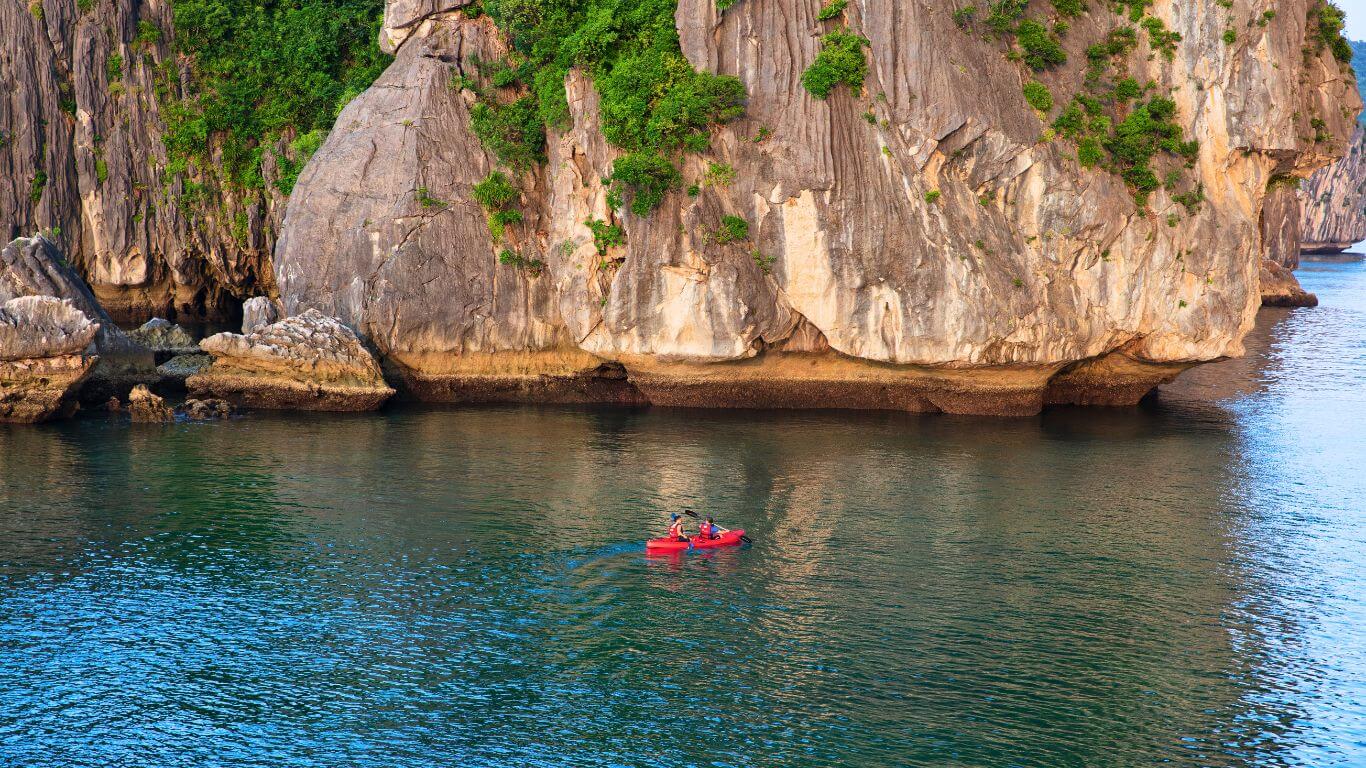 Kayaking around Ba Trai Dao’s three islets is the best way to appreciate their rounded, peach-like forms — and to discover the small caves and rock channels between the limestone walls invisible from the cruise ship deck.
Kayaking around and between the three islets is widely considered the best way to appreciate Ba Trai Dao’s unique geometry. From a kayak at water level, the three rounded limestone profiles rise above you in a way that perfectly evokes the peach-shaped forms that inspired the name. Paddling around the outer sides of the islets also reveals small caves, rock arches, and narrow channels between the limestone walls — hidden features invisible from the cruise ship’s deck. Most Lan Ha Bay cruise operators include a kayaking session at Ba Trai Dao as part of the standard itinerary.
Snorkeling
The waters around Ba Trai Dao support coral formations and a variety of tropical fish species, visible even with a basic mask and snorkel. The consistently clear, offshore water — kept pristine by its relatively remote location and low boat traffic — means snorkeling visibility here is typically better than in the busier sections of the bay closer to the mainland.
Wildlife Spotting & Photography
The islets’ lush vegetation and sheer limestone cliffs provide habitat for seabirds and, occasionally, monkeys on the surrounding rocky formations. For photographers, Ba Trai Dao is one of the most distinctive compositions available in Lan Ha Bay — the three rounded islets against the open water, framed by the bay’s broader karst landscape, create a scene that is both recognizably “Lan Ha Bay” and completely unique to this location. Sunrise and sunset photography are particularly rewarding, when the golden light emphasizes the peach-like silhouettes of the islets against the water.
6. How to Visit Ba Trai Dao Islets in 2026
Via Lan Ha Bay Cruise
Ba Trai Dao is included on most Lan Ha Bay cruise itineraries as a beach and kayaking stop. Both day cruises and overnight cruises (2D1N and 3D2N) commonly include Ba Trai Dao in their Route schedules, timed to coincide with the low-tide window when the beach is accessible.
| Cruise Type |
Typical Duration |
Ba Trai Dao Included? |
| Day cruise |
6–8 hours |
Often included — confirm with operator |
| Overnight 2D1N |
2 days, 1 night |
Usually included as a main beach stop |
| Extended 3D2N |
3 days, 2 nights |
Included — with more time at the beach |
Access caveat: Ba Trai Dao’s exposed seaward position means that on days with strong winds or rough conditions, cruise ships may be unable to hold position near the islets, and the stop may be shortened or skipped by the captain for safety. This is relatively uncommon but worth asking your cruise operator about in advance.
Departure & How to Get There
- From Hanoi: Approximately 2.5–3 hours by road to Tuan Chau Port (Ha Long City), from which Lan Ha Bay cruises depart
- From Tuan Chau Port: Approximately 1.5–2 hours by cruise ship to reach the Ba Trai Dao area of Lan Ha Bay
- Final approach: By kayak or small boat from the cruise ship anchorage — no large vessels can enter the sheltered cove directly
→ Browse all Lan Ha Bay cruises that include Ba Trai Dao →
7. Best Time to Visit Ba Trai Dao Islets
| Season |
Months |
Conditions |
Rating |
| Dry season |
Oct – April |
Clear skies, calm seas, best visibility for photography and the bay view |
⭐⭐⭐⭐⭐ Best overall |
| Spring |
Mar – May |
Mild, dry, ideal for kayaking and photography |
⭐⭐⭐⭐⭐ Excellent |
| Summer |
Jun – Aug |
Warmest water for swimming, longest low-tide windows; higher rain and storm risk |
⭐⭐⭐⭐ Best for swimming |
| Winter |
Dec – Feb |
Cool and dry; fewer crowds; less comfortable for beach activities |
⭐⭐⭐ Quietest season |
For swimming: June–August offers the warmest water and often the longest predictable low-tide windows, making it the best season specifically for swimming at the beach.
For photography: October–April, clear skies and low-angle morning or evening light bring out the best in the three islets’ peach-like silhouettes.
8. Practical Tips Before You Go
- Check the tidal window. Your cruise operator will time the visit to the low-tide window — ask in advance what time the beach stop is scheduled so you are ready to disembark promptly and make the most of the 2–3 hour window.
- Bring snorkeling gear. Basic mask and fins are ideal — some cruise operators provide them, but bringing your own guarantees availability and fit.
- Wear reef-safe sunscreen. The coral formations around Ba Trai Dao are a living ecosystem — standard sunscreen chemicals can damage coral; use mineral (zinc-based) sunscreen where possible.
- Non-slip water shoes are recommended for the approach to the beach by kayak or small boat, as landing on rocky or sandy surfaces can be uneven.
- Waterproof your camera. The kayak approach and beach landing can involve some splashing — a waterproof case or bag is strongly recommended.
- Do not remove coral or shells. Ba Trai Dao is within the Lan Ha Bay protected zone — collecting marine life or rock formations is prohibited.
- Leave no trace. There are no facilities at Ba Trai Dao (no toilets, no bins, no shops) — all waste returns to your cruise ship with you.
- If the stop is cancelled: Strong winds can make it impossible for the cruise ship to hold position near the islets. This is uncommon but occasionally happens — ask your operator’s cancellation policy before booking if Ba Trai Dao is your top priority.
9. Ba Trai Dao Islets — Frequently Asked Questions
The questions we get asked most often by travelers planning to visit Ba Trai Dao Islets in Lan Ha Bay.
Last updated: June 2026 | Information verified against multiple Lan Ha Bay tourism sources including BestPrice Travel, Capella Cruise, Vietnam Story, and Halong Junk Cruise. Tidal windows are approximate and vary by season and weather conditions — always confirm with your cruise operator for the most current tidal schedule at the time of your visit.


