1. About Thien Canh Son Cave — Key Facts at a Glance
| Detail |
Information |
| Vietnamese name |
Hang Thiên Cảnh Sơn — “Mountain of the Heavenly View” |
| Former name |
Hang Co (“Grass Cave”) — for the lush vegetation covering the island’s cliffs |
| Location |
Hon Co Island, Cong Do Nature Reserve, Bai Tu Long Bay, Quang Ninh Province, Vietnam |
| Distance from Tuan Chau Port |
Approximately 20 km (~2 hours by cruise boat) |
| Entrance steps |
Approximately 100 steps (some sources cite up to 400; variation reflects different counting methods including path length) |
| Number of chambers |
2–3 connected chambers |
| Unique features |
Panoramic viewpoint over Bai Tu Long Bay · natural lighting · white-sand beach at base of island |
| Position vs. other caves |
Only major cave stop on Bai Tu Long Bay cruise itineraries · significantly fewer visitors than Halong Bay caves |
| Entrance ticket |
Included in Route 4 (240,000 VND/person including port fee) |
| Accessed via |
Bai Tu Long Bay cruise (Route 4) or overnight cruise excursion |
2. Location: Where Is Thien Canh Son Cave?
Thien Canh Son Cave is located on Hon Co Island (Grass Island) within the Cong Do Nature Reserve, in the heart of Bai Tu Long Bay, Quang Ninh Province — approximately 20 kilometers from Tuan Chau International Tourist Wharf and around 25 kilometers from Bai Chay Port in Halong City. The boat journey from Tuan Chau takes approximately 2 hours, passing through the scenic waters of the bay’s eastern reaches.
The Cong Do Nature Reserve area is one of the most protected and least visited zones in the broader Halong Bay region. It is surrounded by other attractions including Cap La Island, Hang Thay Cave, and the Vung Vieng Fishing Village — all commonly combined on Bai Tu Long Bay Route 4 itineraries. The cave’s remote position is precisely what keeps it so pristine: only cruise boats with Bai Tu Long Bay permits may enter this zone.
3. The Name: From Hang Co to Thien Canh Son
The cave’s original name, Hang Co — meaning “Grass Cave” — was given by local fishermen because of the abundant green vegetation, orchids, and climbing plants that drape the limestone cliffs of Hon Co Island. The island’s rich plant life is itself unusual in the generally bare karst landscape of the bay, giving the site a distinctive lush, forested appearance that sets it apart visually from the rocky outcrops surrounding it.
The name was later changed to Thien Canh Son, meaning “Mountain of the Heavenly View” — a name that more accurately captures what makes this cave exceptional: not only its interior formations, but the extraordinary panoramic vista of Bai Tu Long Bay that opens from the cave’s entrance, offering one of the finest natural viewpoints in the entire region. Visitors often report that the view from the cave entrance — 180 degrees of emerald water, towering limestone karsts, and the open sky — is as memorable as anything they see inside the cave itself.
4. Inside the Cave: Chambers & Formations
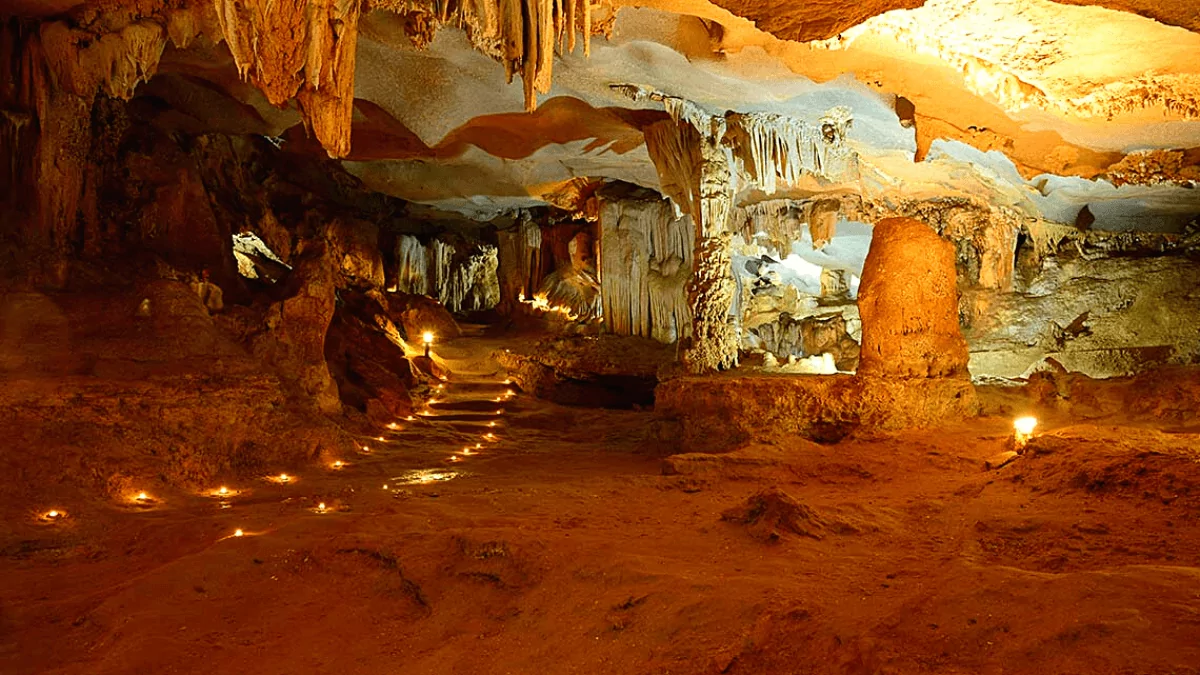 Thien Canh Son Cave’s stalactite formations, lit by natural light, include shapes resembling lotus flowers, chandeliers, elephants, and seals — Bai Tu Long Bay’s signature cave stop.
The approach to Thien Canh Son Cave begins with a short but energetic climb of approximately 100 stone steps carved into the cliffside of Hon Co Island, flanked by dense tropical vegetation. The cave entrance is modest in size — visitors need to stoop slightly to enter — making the transition from the bright open air outside to the cool, dim chambers within feel even more dramatic.
The Chambers
The cave consists of 2 to 3 connected chambers (sources vary slightly, and the distinction between separate “chambers” and connected passages in this particular cave is more fluid than in Halong Bay’s larger caves). Throughout the cave, natural light filters through openings and crevices in the limestone, creating shifting patterns of light and shadow across the formations — an effect particularly magical on sunny days when the interplay of sunlight and internal humidity creates shimmering, crystalline reflections.
The cave’s interior maintains a pleasantly cool and fresh temperature year-round, providing immediate relief from the tropical heat outside. Unlike many of Halong Bay’s most famous caves — which rely heavily on artificial colored lighting — Thien Canh Son Cave is celebrated for the more subtle, natural quality of its illumination, which local guides often describe as giving it an almost “fairy land” atmosphere.
Notable Formations
The cave’s stalactites and stalagmites have been shaped over millions of years into a remarkable variety of forms. Local guides and fishermen have named many of the distinctive formations based on the shapes they resemble:
- Lotus flowers — clusters of stalactites resembling opening petals, among the most photographed formations
- Chandeliers and hanging lanterns — dense stalactite clusters that catch light from above like intricate natural light fixtures
- Stone elephant — a prominent formation frequently pointed out by local guides
- Seals and other animals — naturally shaped rock formations that different visitors see as different creatures
- Stone curtains — thin, translucent sheets of calcium carbonate that appear to flow down the cave walls like hanging fabric
A note on formations: As with all limestone cave formations in the Halong Bay region, the stalactites and stalagmites of Thien Canh Son Cave formed over millions of years through the slow process of calcium carbonate deposition. They cannot be replaced once damaged — touching or removing any formation is strictly prohibited and, in some cases, illegal. Please follow all guidance from your local guide during the visit.
5. The Panoramic Viewpoint & Beach Below
The Viewpoint — One of Bai Tu Long Bay’s Best Photo Spots
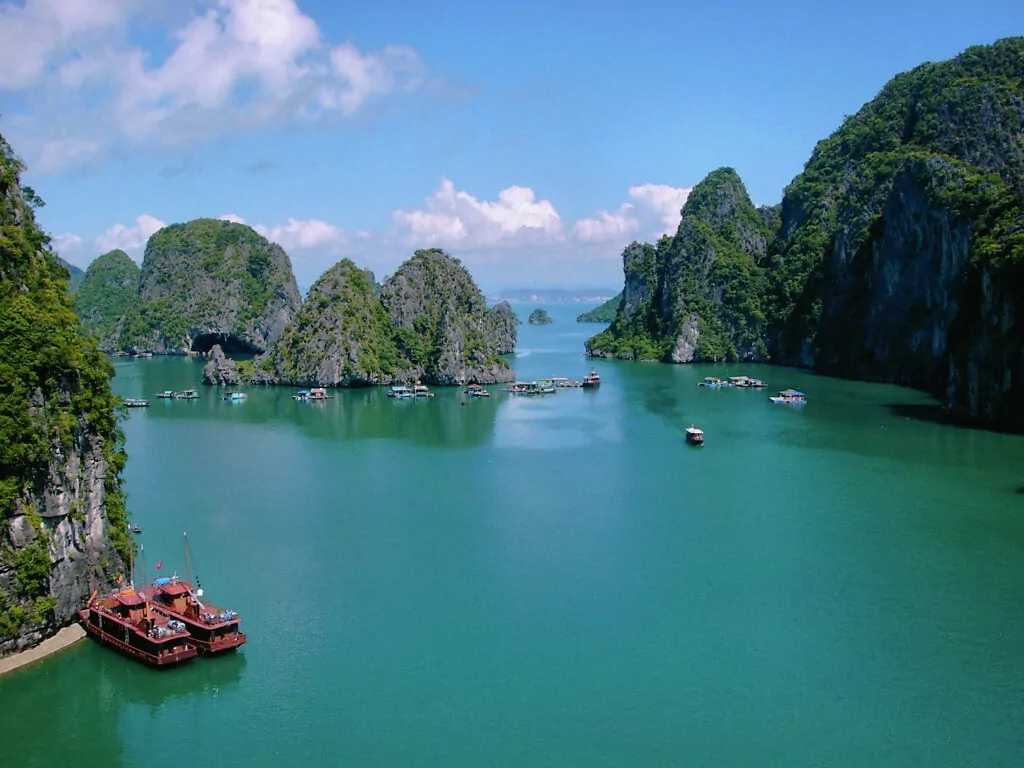 The 180-degree panoramic view of Bai Tu Long Bay’s emerald waters and limestone karsts from Thien Canh Son Cave’s entrance is widely considered one of the finest natural viewpoints in the entire region.
One of the defining features that distinguishes Thien Canh Son Cave from all the other major caves in the Halong Bay region is what greets visitors at the cave entrance: a sweeping, unobstructed 180-degree panoramic view of Bai Tu Long Bay from a high cliff-face position. Dozens of limestone karsts rise from the bay’s emerald waters in every direction, with few or no other tourist boats visible on the clearer days — a view that, in Halong Bay’s more visited core zone, would be impossible to experience without sharing it with dozens of other cruise groups.
The viewpoint is considered by many visitors to be the highlight of the entire stop — a rare case where the journey to a cave entrance is itself one of the finest vantage points in the region. Photographers particularly prize this spot for its combination of natural framing (the cave entrance and surrounding jungle) with the spectacular bay view beyond.
The Beach at the Island’s Base
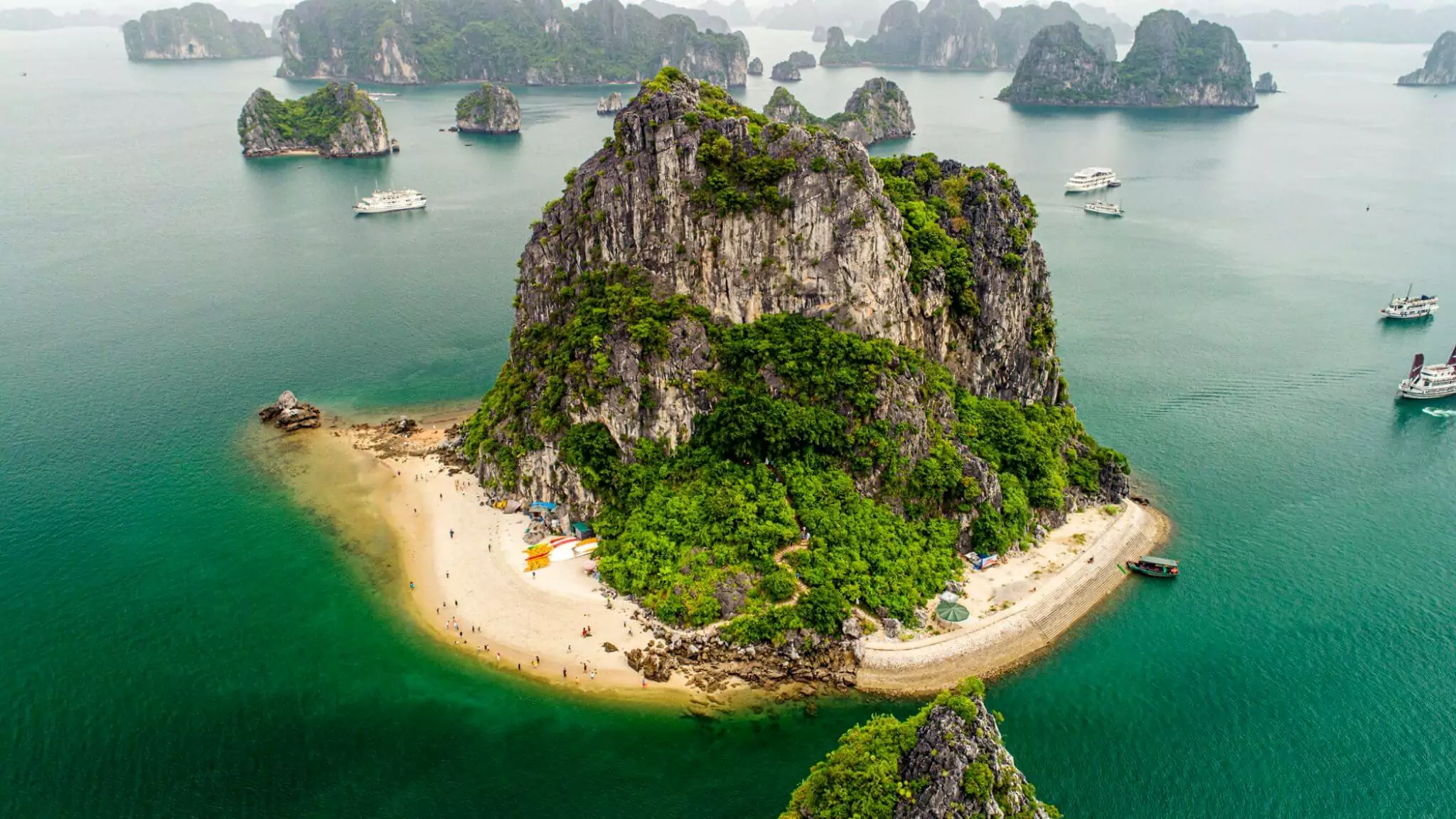 A small white-sand beach at the base of Hon Co Island, accessible via a descending path from Thien Canh Son Cave’s exit — one of the most pristine beach spots on any Bai Tu Long Bay cruise itinerary.
After exploring the cave, a descending path leads from the exit down to a small white-sand beach at the foot of Hon Co Island — one of the most pristine and secluded beaches accessible on any Bai Tu Long Bay cruise itinerary. Sheltered by the limestone cliffs above and protected from the open bay, the water here is calm and clear, excellent for a refreshing swim or for kayaking around the base of the island. Local wildlife — colorful fish, occasional monkeys on nearby cliffs, and flowering orchids on the rock faces — add to the sense of being in an entirely natural, undisturbed environment.
6. Ticket Prices & How to Visit in 2026
6.1 Entrance Ticket
| Ticket Type |
Price (VND) |
Price (USD approx.) |
| Route 4 sightseeing (incl. port fee) |
240,000 VND / person |
~$10 USD |
Note: If visiting Thien Canh Son Cave as part of an overnight Bai Tu Long Bay cruise, the entrance fee is typically included in your cruise package — always confirm with your operator before booking.
6.2 Halong Bay Route 4 — What’s Included
Route 4 is a cruise itinerary covering Bai Tu Long Bay’s eastern attractions, typically combining:
- Thien Canh Son Cave ⭐ (Hang Co — cave + viewpoint + beach)
- Hang Thay Cave
- Cong Do Island area (Cong Do Nature Reserve)
- Tung Ang Ecological Area
- Vung Vieng Fishing Village
Important note: Only cruise operators holding specific Bai Tu Long Bay permits can include Thien Canh Son Cave in their itinerary. Always confirm with your cruise operator that they are licensed to enter the Cong Do Nature Reserve zone and that Thien Canh Son Cave is explicitly included in your itinerary.
6.3 How to Get There from Hanoi
- From Hanoi by road: Approximately 2.5–3.5 hours to Halong City (via 5B Expressway), then board cruise from Tuan Chau Port
- Boat journey from Tuan Chau: Approximately 2 hours cruising through Bai Tu Long Bay to reach the Cong Do area
- For day cruise visitors: Depart early morning (6:30–7:00 AM) to maximize time at the cave and beach
7. Best Time to Visit Thien Canh Son Cave
| Season |
Months |
Conditions |
Rating |
| Dry season |
Oct – April |
Clear skies, calm seas, ideal for the climb and panoramic viewpoint — best visibility |
⭐⭐⭐⭐⭐ Best overall |
| Autumn |
Oct – Nov |
Comfortable temperatures, clear days, fewer crowds — widely considered optimal |
⭐⭐⭐⭐⭐ Excellent |
| Spring |
Mar – May |
Mild, pleasant weather, low rainfall — good for photography and the viewpoint |
⭐⭐⭐⭐⭐ Excellent |
| Summer |
Jun – Aug |
Hot and humid; higher chance of rain and storms; can still visit but visibility at viewpoint may be reduced |
⭐⭐⭐ Manageable with caution |
Photography tip: Morning light (9:00–11:00 AM) illuminates the viewpoint and cave entrance most effectively. On sunny days, the natural light inside the cave creates beautiful shimmering effects on the formations — avoid cloudy days if photography is a priority.
8. Practical Tips Before You Go
- Wear sturdy, non-slip shoes. The stone steps up to the cave and the cave floor itself can be uneven and damp — open-toe sandals and flip-flops are not suitable.
- Bring water and insect repellent. The climb and warm tropical climate outside the cave make hydration essential; insects are common around the forested island path.
- Bring a camera. Both the cave formations and the panoramic bay viewpoint at the entrance are exceptional photography subjects — this is one of the most photogenic stops on a Bai Tu Long Bay cruise.
- Budget 35–45 minutes for the full experience: the climb, cave exploration, viewpoint, and descent to the beach.
- Confirm your cruise operator’s permit. Not all Bai Tu Long Bay operators have access to the Cong Do Nature Reserve zone — confirm that Thien Canh Son Cave is specifically included in your itinerary before booking.
- Swimming and kayaking at the beach below the cave are available and highly recommended after the cave visit — check with your cruise operator whether equipment is provided.
- Do not touch the formations. Stalactites and stalagmites are irreplaceable and easily damaged by contact with skin oils — always follow guide instructions inside the cave.
9. Thien Canh Son Cave — Frequently Asked Questions
The questions we get asked most often by travelers planning to visit Thien Canh Son Cave in Bai Tu Long Bay.
Last updated: June 2026 | Information verified against multiple Bai Tu Long Bay tourism sources. Some figures (exact step counts, chamber numbers) vary across local sources and are presented as approximate. Figures cited from a single unverified source (exact square meter dimensions and named formations with metric measurements) have been omitted in favor of widely agreed-upon descriptions.


