1. What is Bai Tu Long Bay? History & UNESCO Status
Geography & the Legend of the Dragon’s Children
Bai Tu Long Bay lies to the northeast of Halong Bay, spreading across Van Don and Cam Pha Districts in Quang Ninh Province. The bay covers approximately 158 square kilometers and contains hundreds of limestone islands and islets — many entirely uninhabited and untouched by tourism infrastructure. According to the same Vietnamese legend that names Halong Bay, when the Mother Dragon descended from the heavens to help defend the coastline, her children continued the work afterward, and the place where they settled became Bái Tử Long — “Children of the Dragon.” This legendary connection reflects the bay’s geological reality: Bai Tu Long Bay shares the exact same limestone karst formation as Halong Bay, sculpted by the same 500-million-year geological process.
UNESCO World Heritage — Shared Status with Halong Bay
Bai Tu Long Bay forms part of the same UNESCO World Natural Heritage Site as Halong Bay — first inscribed in 1994 (Criterion VII, natural beauty) and extended in 2000 (Criterion VIII, geological significance) to cover the broader karst zone of the region. While the most visited core zone of the UNESCO site sits within Halong Bay proper, the geological and aesthetic qualities that earned the inscription — towering limestone karsts, marine-invaded tower karst topography, ancient caves — are identical across both bays.
The bay also encompasses Bai Tu Long National Park, which spans 15,783 hectares (157.83 km²) across approximately 40 islands, established in 2001 and recognized as an ASEAN Heritage Park in 2016. Two-thirds of the park’s area is marine, protecting coral reefs, mangrove forests, and seagrass beds that support diverse marine life, while the terrestrial portion shelters tropical forest ecosystems and rare endemic plant species recorded on the IUCN Red List.
Permit-Restricted Access — Why So Few Boats
The defining characteristic of Bai Tu Long Bay is not its geology — which mirrors Halong Bay — but its access restrictions. Cruise operations across the entire Halong Bay region are regulated by zone-specific government permits. While hundreds of licensed vessels operate within Halong Bay’s core zone, only a small number of operators hold separate permits to navigate Bai Tu Long Bay’s protected northeastern waters — industry estimates suggest approximately 25–30 vessels in total. This is the single most important factor explaining why Bai Tu Long Bay feels, in the words of one luxury operator, “like Halong Bay 20 years ago.”
Why Bai Tu Long Bay matters for travelers in 2026: Of Vietnam’s three great bays, Bai Tu Long is the least commercialized and most exclusive. With 30–50% fewer boats at anchor than comparable Halong Bay routes, it offers the rare experience of genuine silence between islands, uncrowded floating villages, and beaches with no other visitors in sight — all within the same UNESCO-recognized karst landscape that draws millions to Halong Bay each year.
2. 🏝️ Top Must-See Attractions in Bai Tu Long Bay
These are the four signature destinations that define a Bai Tu Long Bay cruise itinerary — fewer in number than Halong Bay or Lan Ha Bay, but each offering a markedly quieter, more intimate experience.
Cap La Island — Hidden kayaking & swimming spot in the Cong Do area
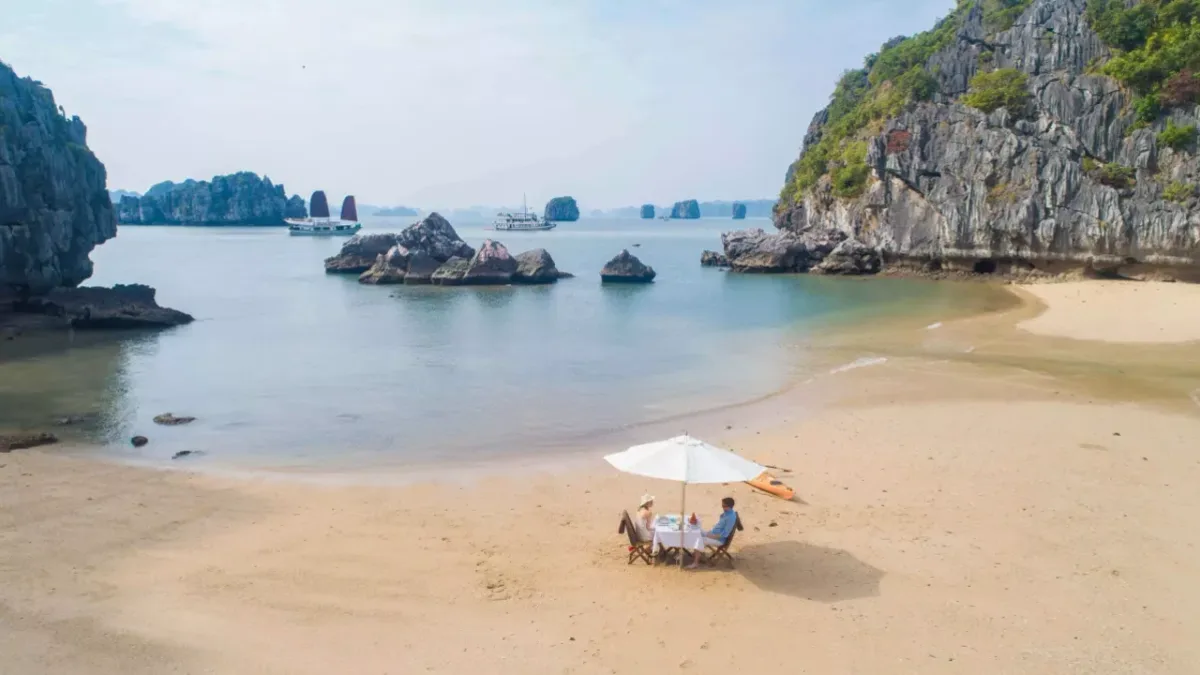
Cap La Island’s quiet sandy beach, framed by limestone cliffs in the Cong Do area, offers some of the most pristine kayaking and swimming waters in Bai Tu Long Bay.
Cap La Island is one of the lesser-known gems of Bai Tu Long Bay, tucked within the broader Cong Do area — a region renowned for its coral reefs, underground lakes nestled inside limestone mountains, and hidden sea caves. Cap La offers a quiet sandy beach ideal for kayaking and swimming, framed by breathtaking limestone scenery with virtually no other visitors in sight. The surrounding waters of Cong Do are considered among the most pristine in the entire Halong Bay region, supporting concentrated coral gardens and over 100 fish species.
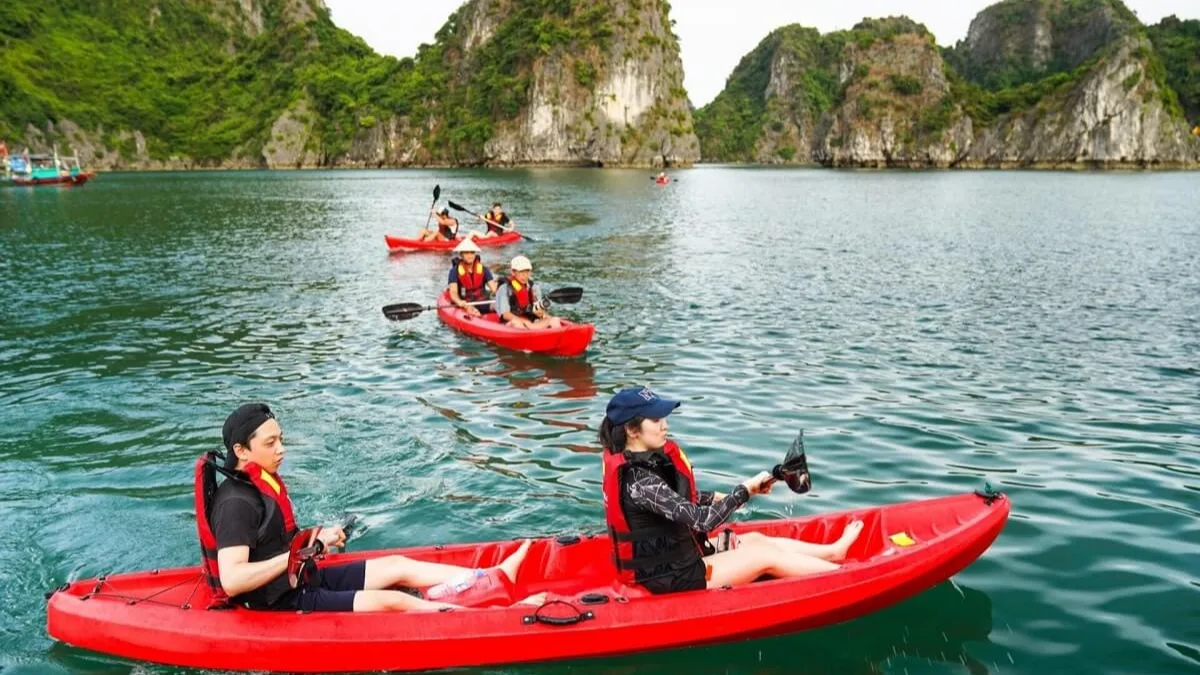
Most overnight cruise itineraries include a kayaking session around Cap La Island and the broader Cong Do waterways, allowing visitors to paddle close to limestone cliffs and explore narrow channels inaccessible to larger vessels.
Cong Dam Area — Remote floating village & tranquil kayaking corridor
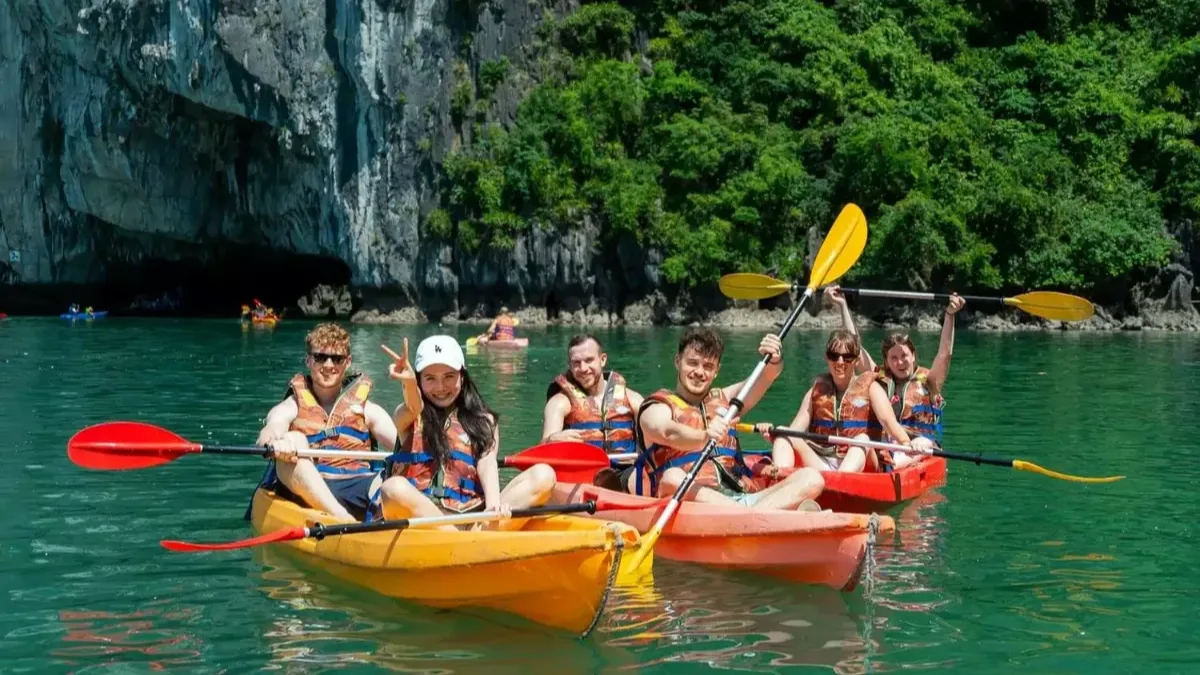
Kayaking through the Cong Dam to Vung Vieng waterway corridor — one of the most photographed routes in Bai Tu Long Bay, especially during golden hour.
Cong Dam Area is one of the most remote and serene corners of Bai Tu Long Bay, located far from the mainland. The area was once home to a small floating fishing community, and today invites visitors to discover its natural beauty by kayak or bamboo boat through calm, sheltered waters. The surrounding scenery includes dramatic limestone cliffs rising up to 100 meters, secluded lagoons, and several pristine beaches in the broader vicinity, including Tra Gioi, Cay Bang, and Cat Oan.
The Cong Dam to Vung Vieng waterway corridor is one of the most photographed kayaking routes in the bay, particularly during golden hour in the late afternoon when the limestone formations are bathed in warm light.
Thien Canh Son Cave — “Heavenly Scenery Cave” · Bai Tu Long Bay’s only major cave stop
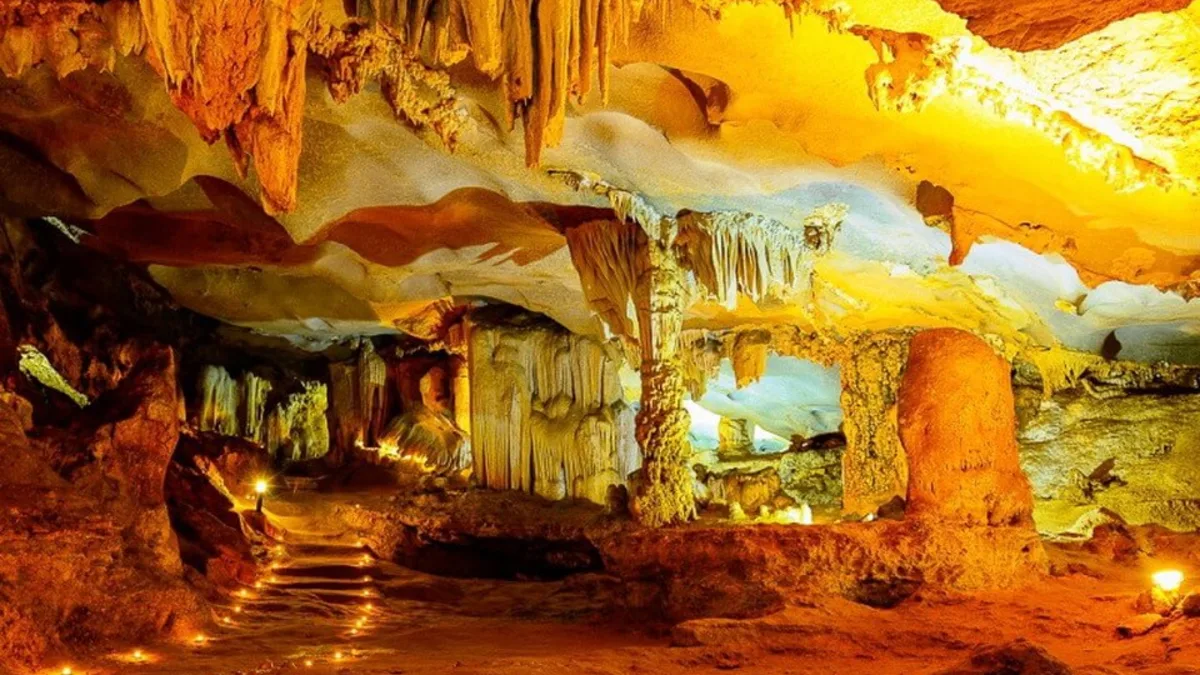
Thien Canh Son Cave’s three chambers span roughly 10,000 square meters, with limestone formations resembling lotus blossoms and a panoramic viewpoint at the entrance.
Thien Canh Son Cave — meaning “Heavenly Scenery Cave” — is the only cave most Bai Tu Long Bay cruise itineraries include, and it is widely considered one of the most impressive in the broader Halong Bay region. Located in the protected Cong Do area, often cited as sitting on Hon Co Island (also known as Ban Chan Island in some sources), the cave’s hidden entrance lies beneath a dense forest canopy along a dramatic cliff face — itself part of the adventure of reaching it.
Inside, the cave unfolds across three connected chambers spanning roughly 10,000 square meters, with limestone formations resembling lotus blossoms, animals, and flowing draperies. Ceiling heights in the main chamber reach up to 20 meters. A viewpoint near the cave entrance — reached via a stepped pathway — offers a sweeping panoramic vista of the surrounding bay, considered one of the best photo opportunities in Bai Tu Long Bay.
Vung Vieng Fishing Village — One of the last traditional floating communities in Vietnam
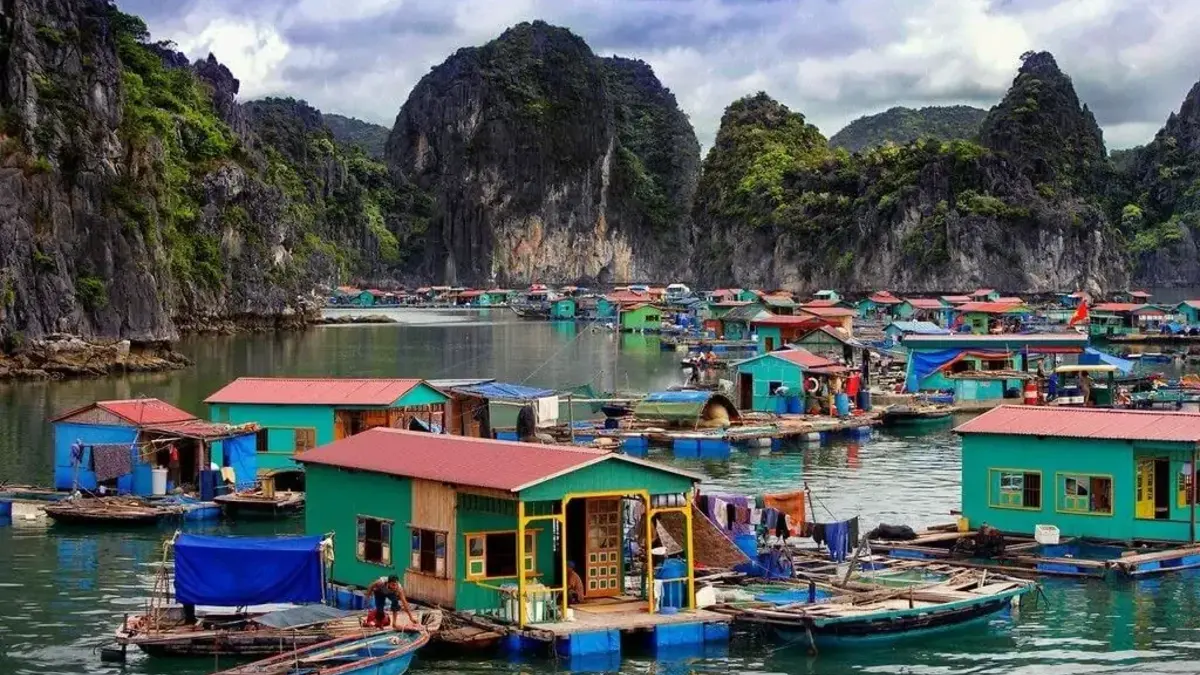
Vung Vieng Fishing Village, more than 20 km from the mainland, remains one of the last authentic floating communities in Vietnam — explored by rowing boat or kayak.
Vung Vieng Fishing Village sits more than 20 km from the mainland in the heart of Bai Tu Long Bay — one of the most authentic and least commercialized floating communities remaining in northern Vietnam. The village is built entirely of wooden homes on floating pontoons, with residents living by traditional fishing and, in some areas, pearl cultivation methods passed down through generations. Visitors explore by traditional rowing boat or self-paddled kayak, moving through the village at an unhurried pace that allows genuine observation of daily life — drying nets, fish farming cages, and the quiet rhythm of a community shaped entirely by the water.
Some cruise operators include a stop at a small pearl cultivation facility near the village, where visitors learn about the multi-year process of growing cultured pearls in the bay’s nutrient-rich waters. Population estimates for the village vary by source — ranging from roughly 20 to 50 households — reflecting the area’s ongoing relocation programs, similar to those affecting floating villages elsewhere in the Halong Bay region.
3. 🌿 Best for Nature & Wildlife
Bai Tu Long National Park — ASEAN Heritage Park
Spanning 15,783 hectares across approximately 40 islands, Bai Tu Long National Park was established in 2001 and recognized as an ASEAN Heritage Park in 2016, protecting one of the most biodiverse coastal ecosystems in northern Vietnam. Approximately two-thirds of the park’s area is marine, sheltering coral reefs, seagrass beds, and mangrove fringes that support sea turtles and dozens of fish species. The terrestrial third covers tropical forest, home to rare and endemic plant species recorded on the IUCN Red List. Some remote islands within the park — including Tra Ngo Lon, Ba Mun, Sau Nam, and Dong Ma — remain almost entirely untouched by tourism.
Pristine, Uncrowded Beaches
Ban Chan Beach offers clear water, white sand, and dramatic limestone cliffs — considered one of the most unspoiled beaches in the entire Halong Bay region.
Bai Tu Long Bay holds several beaches considered among the most unspoiled in the entire Halong Bay region. Ban Chan Beach — often cited as the bay’s signature beach — offers clear water, white sand, and a backdrop of rugged limestone cliffs and lush forest, with notably better visibility than equivalent beaches in the busier sections of Halong Bay. In the broader Cong Do area, smaller beaches including Tra Gioi, Cay Bang, and Cat Oan offer similarly pristine, uncrowded settings for swimming and relaxation.
Coral Reefs & Marine Life
The waters around Cong Do and the Cap La area protect some of the healthiest coral formations in the region, supporting more than 100 documented fish species. Snorkeling here reveals a richer and more colorful underwater environment than the busier zones of central Halong Bay, owing largely to the lower volume of boat traffic and the protected status of the surrounding national park waters.
4. 🏘️ Best for Culture & Local Life
Vung Vieng Fishing Village — Living Maritime Heritage
As detailed above, Vung Vieng remains one of the most genuine floating community experiences left in the Halong Bay region — without the higher visitor volume affecting similar villages closer to Halong City. Local guides, often village residents themselves, share firsthand accounts of life on the water that cannot be found in any guidebook.
Ethnic Minority Communities on Outlying Islands
Several of Bai Tu Long Bay’s more remote islands are home to ethnic minority communities, including Tay, Dao Do, and San Diu peoples, each maintaining distinct cultural traditions and local specialties. Quan Lan Island (also known as Van Don or Canh Cuoc Island), located approximately 45 km from Ha Long City, is one of the most biodiverse islands in the bay and home to the rare peanut worm (sá sùng) — a local delicacy dried, fried, or stewed into traditional broths.
5. How to Get to Bai Tu Long Bay from Hanoi
Bai Tu Long Bay is reached via the same route as Halong Bay — through Ha Long City — before cruising northeast into the bay’s quieter waters.
| Transport |
Journey Time |
Cost (approx.) |
Notes |
| Limousine bus / shuttle (recommended) |
2.5–3.5 hours |
~$20–30 USD / way |
Most cruise packages include round-trip shuttle transfers from Hanoi hotels |
| Private car |
2.5–3 hours |
$60–100 USD |
Flexible door-to-door from Hanoi hotel to Ha Long City |
| From Noi Bai Airport |
~3 hours 20 min |
Varies |
157 km to Ha Long City by bus/car |
| From Cat Bi Airport (Hai Phong) |
~2 hours |
Varies |
79 km to Ha Long City — useful if flying from HCMC, Da Nang |
Departure ports: Bai Tu Long Bay cruises depart from either Tuan Chau Pier in Ha Long City or Halong International Cruise Port (Sun Group Port) in Bai Chay — the same ports used for Halong Bay cruises. From there, the vessel sails northeast for 1.5–3 hours into Bai Tu Long Bay’s quieter waters, passing through the broader Halong Bay area before reaching the permit-restricted Bai Tu Long zone.
Important: Not every cruise operator licensed for Halong Bay’s core zone holds a separate permit for Bai Tu Long Bay. Some itineraries marketed as “Bai Tu Long Bay cruises” may navigate only the boundary area without entering the genuinely quieter permit zone — always confirm with your operator that Vung Vieng Village and Thien Canh Son Cave are explicitly included.
6. Bai Tu Long Bay Cruise Routes
| Route |
Duration |
Key Stops |
Best For |
| Day Cruise |
6–8 hours |
Cong Do area, Thien Canh Son Cave, Cap La Island, kayaking, lunch onboard |
Limited time; tight schedule from Hanoi |
| Standard Route |
2D / 1N |
Thien Canh Son Cave, Vung Vieng Fishing Village, beach stop, kayaking |
First-time visitors; most popular route |
| Extended Route |
3D / 2N |
All standard stops + Cong Dam Area, Cap La Island, Ban Chan Beach, additional kayaking |
Slow travelers wanting full immersion; remote attractions |
| Combined Route |
3D / 2N |
Halong Bay highlights (Day 1) + Bai Tu Long Bay (Day 2–3) |
Travelers wanting both iconic landmarks and tranquility — limited operators offer this |
⚠️ Note: Only a handful of cruise operators currently offer a combined Halong Bay + Bai Tu Long Bay itinerary on a single trip. Most cruises focus exclusively on one bay or the other — confirm your itinerary’s exact route before booking if visiting both bays is a priority.
7. Best Time to Visit Bai Tu Long Bay 2026
| Season |
Months |
Conditions |
Rating |
| Autumn |
Sep–Nov |
Driest, clearest skies, minimal rainfall, comfortable temperatures — widely cited as the best season |
⭐⭐⭐⭐⭐ Best overall |
| Spring |
Mar–May |
Dry season, mild temperatures, blue skies, low storm risk |
⭐⭐⭐⭐⭐ Excellent alternative |
| Summer |
Jun–Aug |
Most sunshine and warmest water for swimming; higher chance of heavy rain and storms |
⭐⭐⭐⭐ Good for beach, budget season |
| Winter |
Dec–Feb |
Cooler, occasional mist; fewer crowds but less swimming weather |
⭐⭐⭐ Quietest season |
Migratory bird watching: October–December, when waterfowl and shorebirds — including some endangered species — use the bay’s wetlands as a wintering ground.
Cheapest season: Summer (May–August), when cruise pricing is typically lowest despite higher rain risk.
8. Things to Do in Bai Tu Long Bay
| Activity |
Where |
Best For |
Availability |
| Kayaking through karst grottos & lagoons |
Cong Dam, Cap La, Vung Vieng corridor |
Everyone — signature activity |
All overnight cruises |
| Bamboo boat village tour |
Vung Vieng Fishing Village |
Culture seekers, families |
All overnight cruises |
| Cave exploration |
Thien Canh Son Cave |
Geology and history lovers |
Most cruises |
| Swimming & snorkeling |
Ban Chan Beach, Cap La, Cong Do beaches |
Beach lovers |
Overnight cruises |
| Squid fishing at night |
Bay anchorage |
Everyone |
Overnight cruises |
| Pearl farm visit |
Near Vung Vieng Village |
Families, curious travelers |
Select cruise operators |
| Vietnamese cooking class |
Onboard kitchen |
Food lovers |
Most overnight cruises |
| Tai Chi at sunrise |
Cruise sundeck |
Wellness travelers |
Overnight cruises |
| Sunset cocktails & tea ceremony |
Cruise sundeck |
Couples, photographers |
All overnight cruises |
| Candlelit cave dining |
Select cave locations (operator dependent) |
Special occasions |
Select luxury cruises |
9. How to Choose a Bai Tu Long Bay Cruise
Bai Tu Long Bay has far fewer cruise operators than Halong Bay or Lan Ha Bay — a deliberate result of the permit system that keeps the bay quiet. This means slightly fewer choices, but also a more curated, generally higher-quality selection at every price point.
| Category |
Price per Person |
Best For |
Typical Features |
| Day Cruises |
$54–$80 USD |
Limited time; day trip from Hanoi |
Cong Do area, Thien Canh Son Cave, kayaking, lunch; 6–8 hours |
| Budget / Economical Overnight |
$110–$150 USD |
Budget travelers, solo travelers |
3-star vessels, standard cabins, meals, kayaking, cave + village visit (2D1N) |
| Mid-range / Deluxe |
$150–$300 USD |
Couples, families |
4-star vessels, en-suite cabins, quality meals, full excursion program |
| Luxury / Ultra-luxury |
$300–$680+ USD |
Honeymooners, privacy seekers, special occasions |
5-star boutique vessels, suites with balcony/jacuzzi, full-board dining, small group (6–24 guests) |
⚠️ Note on pricing: Prices are approximate, per person, based on double occupancy for overnight cruises, and vary by season, vessel star rating, and cabin type. Bai Tu Long Bay cruises generally include meals, guided excursions, and kayaking as standard; drinks, tips, spa treatments, and private transfers are typically extra. Because so few operators hold Bai Tu Long permits, always confirm your specific itinerary explicitly includes Vung Vieng Village and Thien Canh Son Cave before booking.
Key factors when choosing:
- Confirm the permit zone: Ask the operator directly whether their itinerary enters Bai Tu Long Bay’s protected waters or only the boundary area near Halong Bay
- Duration: 2D/1N covers the core highlights (Thien Canh Son Cave, Vung Vieng Village); 3D/2N adds Cong Dam Area and more remote beaches
- Vessel age: Since most new cruise ships launch in Halong and Lan Ha Bay, some Bai Tu Long vessels are older — though still well-maintained — so check recent reviews for cabin condition
- Group size: Smaller boutique vessels (6–24 guests) are common here and ideal for travelers prioritizing privacy and a quieter atmosphere
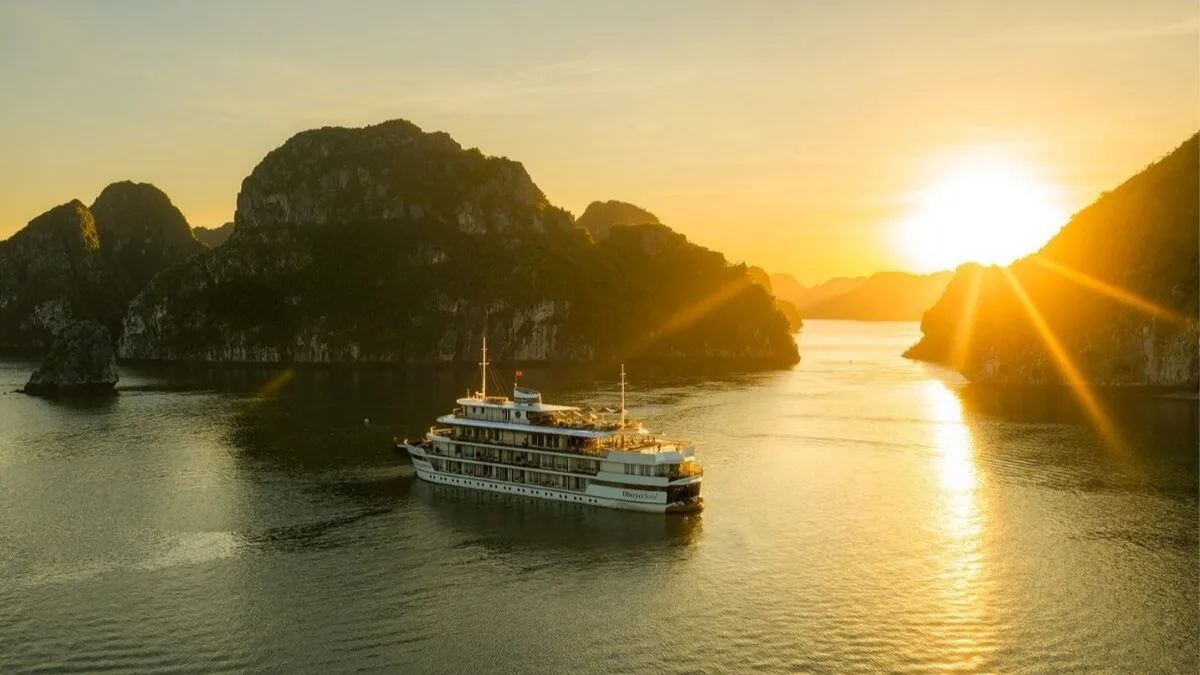
A boutique cruise vessel sails through Bai Tu Long Bay’s uncrowded waters at sunset — among the most exclusive cruise experiences in northern Vietnam.
→ Browse and compare all Bai Tu Long Bay cruises →
10. Bai Tu Long Bay vs Halong Bay vs Lan Ha Bay
All three bays share the same dramatic 500-million-year-old karst geology and overlapping UNESCO recognition, but differ sharply in crowd levels, infrastructure, and atmosphere. Cruise routes do not cross between them.
| Feature |
Bai Tu Long Bay |
Halong Bay |
Lan Ha Bay |
| UNESCO Status |
Part of Halong Bay World Heritage (1994/2000) |
World Heritage 1994 + 2000 |
World Heritage 2023 + Biosphere Reserve 2004 |
| Crowd level |
Lowest — only ~25–30 licensed vessels |
Highest — hundreds of vessels |
Medium-low — 40% fewer boats than Halong Bay |
| Number of attractions |
4 signature sites |
8 signature sites |
5 signature sites |
| Unique character |
Most pristine; ASEAN Heritage Park; fewest tourists of all 3 bays |
Iconic landmarks; most developed cruise infrastructure |
139 beaches; rock climbing; bioluminescent plankton |
| Cruise fleet |
Smaller, sometimes older vessels; very limited operators |
Largest fleet — hundreds of operators, all tiers |
Newer fleet (2022–2026 launches), higher average standard |
| Best for |
Ultimate privacy seekers; repeat visitors; nature/wildlife focus |
First-time visitors; iconic landmarks; Route 2 highlights |
Active travelers; beaches; second-visit explorers |
| Sub-destinations |
Bai Tu Long Bay — 4 attractions |
Halong Bay — 8 attractions |
Lan Ha Bay — 5 attractions |
Which bay should I choose? For a first visit to Vietnam, Halong Bay delivers the iconic landmarks. For active travel and beaches, Lan Ha Bay offers the best balance of infrastructure and tranquility. For maximum privacy and the most pristine, untouched experience of the entire region, Bai Tu Long Bay is unmatched — at the cost of fewer cruise choices and slightly older average vessels.
11. Practical Travel Tips & Frequently Asked Questions
Essential Tips Before You Go
- Confirm the permit zone: Not every cruise marketed as “Bai Tu Long Bay” actually enters the protected zone — ask explicitly whether Vung Vieng Village and Thien Canh Son Cave are confirmed stops.
- Book in advance: With far fewer operators than Halong Bay, popular departure dates on quality vessels can sell out, especially in peak season (Sep–Nov, Mar–May).
- Bring cash: No ATMs exist within the bay itself. Nearest banking services are in Cai Rong town (Van Don Island) or Ha Long City. Most cruises accept major credit cards onboard, but small purchases in fishing villages typically require Vietnamese Dong cash.
- Respect the national park zone: Bai Tu Long National Park is an ASEAN Heritage Park. Do not feed fish, remove coral, shells, or rocks, or dispose of plastic in or near the water.
- Pack for limited connectivity: Wi-Fi coverage on the bay is partial and depends on proximity to the coastline. Embrace the digital detox.
- Non-slip shoes: Essential for Thien Canh Son Cave’s stepped, sometimes uneven pathway.
Bai Tu Long Bay — Frequently Asked Questions
The most common questions travelers ask when planning a Bai Tu Long Bay visit — optimized for Google Search, AI Overviews, and Google AI Mode.
Geologically, Bai Tu Long Bay and Halong Bay are nearly identical — both feature the same limestone karst towers, the same drowned valleys, and the same ancient caves carved by 500 million years of geological history. The practical difference is access and crowd levels: Halong Bay’s core zone accommodates hundreds of licensed cruise vessels, while Bai Tu Long Bay’s permit zone supports only an estimated 25–30 operators, resulting in 30–50% fewer boats at anchor, quieter kayaking corridors, and a more remote, unhurried atmosphere. Halong Bay also has 8 major designated attractions compared to Bai Tu Long Bay’s 4, and a far larger, more modern cruise fleet overall.
Yes — day cruises to Bai Tu Long Bay are available, typically lasting 6–8 hours and covering the Cong Do area, Thien Canh Son Cave, Cap La Island, kayaking, and lunch onboard. However, given Bai Tu Long Bay’s more remote location compared to Halong Bay’s core zone, most experienced travelers recommend at least one overnight (2D/1N) to fully experience the bay’s tranquility, including sunset, squid fishing at night, and a relaxed second day on the water. The 3–3.5 hour drive from Hanoi each way means a day trip leaves limited time on the bay itself.
Bai Tu Long National Park is a protected area spanning 15,783 hectares (157.83 km²) across approximately 40 islands within Bai Tu Long Bay, established in 2001 and recognized as an ASEAN Heritage Park in 2016. Approximately two-thirds of its area is marine, protecting coral reefs, mangrove forests, and seagrass beds that support sea turtles and dozens of fish species, while the terrestrial third covers tropical forest ecosystems with rare endemic plant species recorded on the IUCN Red List. The park encompasses several remote, largely untouched islands, including Tra Ngo Lon, Ba Mun, Sau Nam, and Dong Ma, and is also home to ethnic minority communities including Tay, Dao Do, and San Diu peoples.
Last updated: June 2026 | Information verified against Wikipedia, UNESCO official records, Bai Tu Long National Park data, Vietnam Tourism official sources, and multiple independent travel sources. Population and pricing figures for floating villages and cruise operators vary across sources and should be confirmed directly with operators at time of booking.