Vung Vieng Fishing Village

Vung Vieng Fishing Village: Bai Tu Long Bay’s Most Authentic Floating Community

Vung Vieng Fishing Village is one of the last traditional floating fishing communities remaining in northern Vietnam — and the most celebrated of the four floating villages that once thrived across the broader Halong Bay region. Nestled in the heart of Bai Tu Long Bay, approximately 24 kilometers from the mainland, the village is surrounded by towering limestone cliffs that create a natural shelter from wind and waves, enclosing the community within one of the most serene and spectacular settings imaginable.

Founded in the 19th century as a mooring point for fishermen trading goods across the bay — including with Chinese merchants — Vung Vieng was at its peak home to approximately 50 families and 300 residents, living entirely on wooden homes built on floating bamboo rafts. Following a government resettlement program that began in 2012, most families relocated to the mainland to access better education and healthcare. Today, approximately 30 households remain on the water, maintaining the village’s aquaculture operations — pearl cultivation, fish farming (sea bass, grouper, and cobia) — while welcoming visitors who arrive by bamboo boat through the natural stone arch gateway of nearby Cao Cave.

Detail Information
Vietnamese name Làng Chài Vụng Viêng (Vung Vieng Fishing Village)
Location Heart of Bai Tu Long Bay, 24 km from mainland (Halong City)
Founded 19th century — fishermen mooring and trading in the bay
Peak population ~50 families, ~300 residents (pre-2012 resettlement)
Current residents ~30 households remaining (aquaculture families)
Main livelihoods Pearl cultivation · fish farming (sea bass, grouper, cobia) · tourism
Gateway Cao Cave (natural stone arch) — bamboo boat entry only
Resettlement program 2012–2021, government relocation to mainland for education & healthcare
International recognition Cited among the world’s most beautiful traditional fishing villages
Accessed via Bai Tu Long Bay cruise Route 4 or overnight cruise excursion

Read on for the complete guide: history, community life today, how to get there, things to do, ticket prices, best time to visit, and practical tips for 2026.


1. About Vung Vieng Fishing Village — Key Facts at a Glance

Detail Information
Vietnamese name Làng Chài Vụng Viêng
Location Heart of Bai Tu Long Bay, 24 km from Halong City
Founded 19th century — fishing and trading mooring
Peak population ~50 families, ~300 residents (pre-2012)
Residents today ~30 aquaculture households
Livelihoods Pearl cultivation · fish farming (sea bass, grouper, cobia) · community tourism
Village gateway Cao Cave — natural stone arch passable by bamboo boat only
Resettlement Government program 2012–2021 (education & healthcare access)
Visitor access Bamboo boat (20–30 min ride from cruise anchorage)
Accessed via Bai Tu Long Bay cruise (Route 4) or overnight cruise excursion

2. Location & How to Arrive

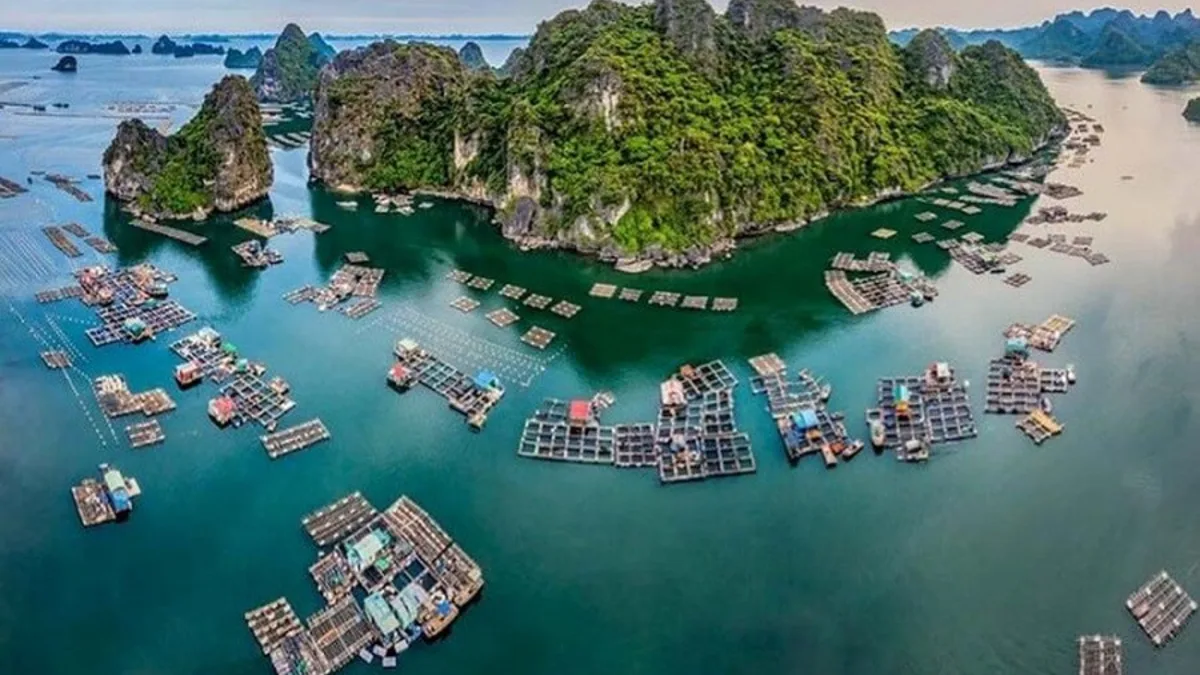
Vung Vieng Fishing Village colorful floating houses on the emerald waters of Bai Tu Long Bay, surrounded by limestone cliffs, Vietnam
Vung Vieng Fishing Village, Bai Tu Long Bay – floating wooden homes connected by walkways, surrounded by limestone cliffs and working fish farms.

Vung Vieng Fishing Village lies at the heart of Bai Tu Long Bay, approximately 24 kilometers from Halong City on the mainland — positioned well beyond the more heavily visited zones of Halong Bay’s core UNESCO area, in a naturally sheltered cove enclosed by towering limestone cliffs on all sides. The surrounding karst formations create an almost lake-like stillness to the water, providing a natural windbreak and wave barrier that has made this location ideal for a floating community for generations.

The journey to Vung Vieng is itself an experience: cruise ships anchor at a distance and visitors transfer to a bamboo boat rowed by a local village woman for the final 20–30 minutes of the approach. This approach passes through the natural stone arch gateway of Cao Cave — a narrow, low limestone arch through which the boat must pass at water level, emerging into the quieter waters of the village bay beyond. This natural gateway, combined with the remoteness of the location, gives Vung Vieng a sense of genuine discovery that begins long before the village itself comes into view.

Vung Vieng is a designated stop on Halong Bay Route 4 — a cruise itinerary covering Bai Tu Long Bay’s attractions, also including Thien Canh Son Cave, Hang Thay, and the Cong Do area. Most visitors reach it as part of an overnight Bai Tu Long Bay cruise.


3. History: A 19th-Century Maritime Community

Vung Vieng’s origins trace back to the 19th century, when local fishermen began mooring their boats in the sheltered cove to exchange goods and trade with one another. Over time, temporary moorings became permanent floating homesteads, and homesteads became a village — one of what eventually grew into four such floating communities across the broader bay region.

The trading culture was never purely local: Chinese merchants, based roughly 100 kilometers away across the Gulf of Tonkin, were among the regular trading partners at Vung Vieng. The village’s sheltered position, natural limestone barrier, and proximity to rich fishing grounds made it a natural gathering point not just for Vietnamese fishermen but for the entire maritime trading network of the region.

For generations, life at Vung Vieng revolved entirely around the sea. Families lived in wooden homes built on bamboo rafts, catching fish by net and line, harvesting shellfish from the limestone cliff faces, and trading their catch with passing boats and with one another. At its peak, the village supported approximately 50 families and around 300 residents — including roughly 100 children, many of whom were educated in a floating school on the water, one of the most evocative and emblematic features of life in the village.


4. The Village Today: Heritage in Transition

In 2012, the Halong Bay Management Board announced a program to relocate the residents of Halong Bay’s floating villages to new homes on the mainland, citing concerns about safety, access to education, and long-term environmental sustainability. The program was carried out gradually between 2012 and 2021, with most of Vung Vieng’s families eventually accepting the move — receiving new housing, land, and access to the educational and healthcare services that life on the water could not provide, especially for their children.

Today, approximately 30 households remain on the water — not as full-time residential families in the traditional sense, but as working aquaculture operators maintaining the village’s fish farms and pearl cultivation operations. These remaining residents continue to raise sea bass, grouper, and cobia in floating cage systems, and produce cultured pearls through a multi-year cultivation process, much as Vung Vieng families have worked the bay’s resources for generations.

The village today functions as what one source calls “a beautiful hybrid between a working community and a living museum.” Its floating communal house — once the center of community meetings and decision-making — is now a space where visitors can see and buy locally made handicrafts. The old floating school, though no longer in daily educational use, remains a poignant reminder of the extraordinary community life that existed here for over a century.

Note on the resettlement: The government’s decision to relocate Vung Vieng’s residents was not universally welcomed by those who had lived for generations on the water. However, the program is generally understood today as having provided the village’s children with access to mainland schools and healthcare they could not otherwise have. The aquaculture families who remain have chosen to continue their traditional water-based livelihoods alongside the village’s new role as a heritage and tourism destination.

5. The Visitor Experience: What You’ll See & Do

Arriving by Bamboo Boat Through Cao Cave

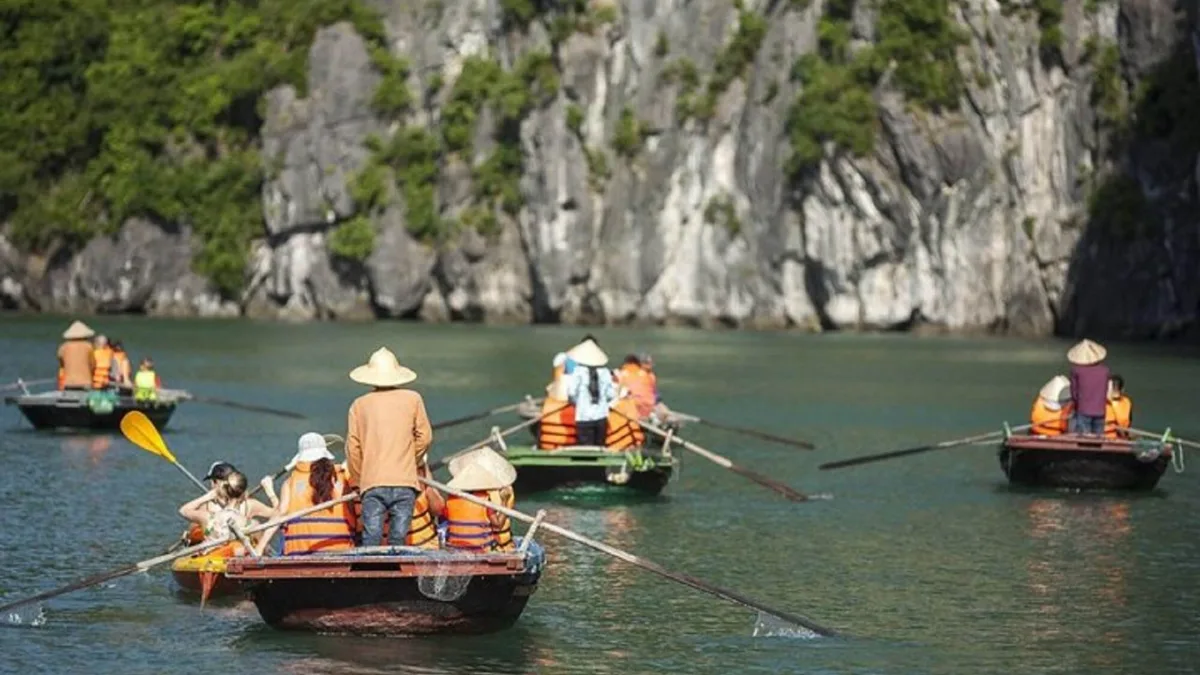
Bamboo boat passing through the natural limestone arch of Cao Cave, the gateway to Vung Vieng Fishing Village, Bai Tu Long Bay Vietnam
The approach to Vung Vieng begins with a 20–30 minute bamboo boat ride through the natural stone arch of Cao Cave — the defining gateway arrival moment of a Bai Tu Long Bay cruise.

The single most memorable moment of most visitors’ Vung Vieng experience comes before they arrive: the approach by bamboo boat through the natural stone arch of Cao Cave — a low, dramatic limestone gateway through which the boat passes at water level. Visitors sit low in the traditional bamboo boat as the arch passes overhead, then emerge into the calm, enclosed waters of the village bay. The transition from open bay to this sheltered cove has a profound quality of arrival — a sense of having entered somewhere genuinely apart from the rest of the world.

The Floating Village Itself

Arriving at Vung Vieng, visitors find a collection of colorful floating wooden homes — painted blue, red, and yellow — connected by wooden walkways and floating on combinations of traditional bamboo and modern buoy systems. Each floating home is approximately 30 square meters. The central communal floating platform anchors the village’s social life, surrounded by the cage systems of the fish farms and the rope lines of the pearl cultivation operation.

Activities Available

  • Bamboo boat ride (20–30 minutes): The standard visitor experience — sitting in a traditional boat rowed by a local village woman through the village waterways and around the fish farms, in near-total silence.
  • Pearl farm visit: Learn the multi-year process of culturing pearls in the bay’s mineral-rich water from one of the village’s remaining aquaculture families.
  • Fish farm tour: See the cage systems where sea bass, grouper, and cobia are raised, and hear from local operators about the economics and ecology of aquaculture in the bay.
  • Fishing net demonstration: Some cruise itineraries include a hands-on demonstration of traditional net-casting techniques with local fishermen.
  • Night squid fishing: Overnight cruise guests can participate in squid fishing from the boat after dark — one of the most popular evening activities on Bai Tu Long Bay cruises that anchor near the village.
  • Kayaking: Some operators offer self-paddled kayaking around the village perimeter and through the limestone channels near the Cao Cave gateway.
  • Handicraft shopping: The communal floating house offers locally made handicrafts — woven goods, shell jewelry, and other small items — as a source of income for remaining village families.
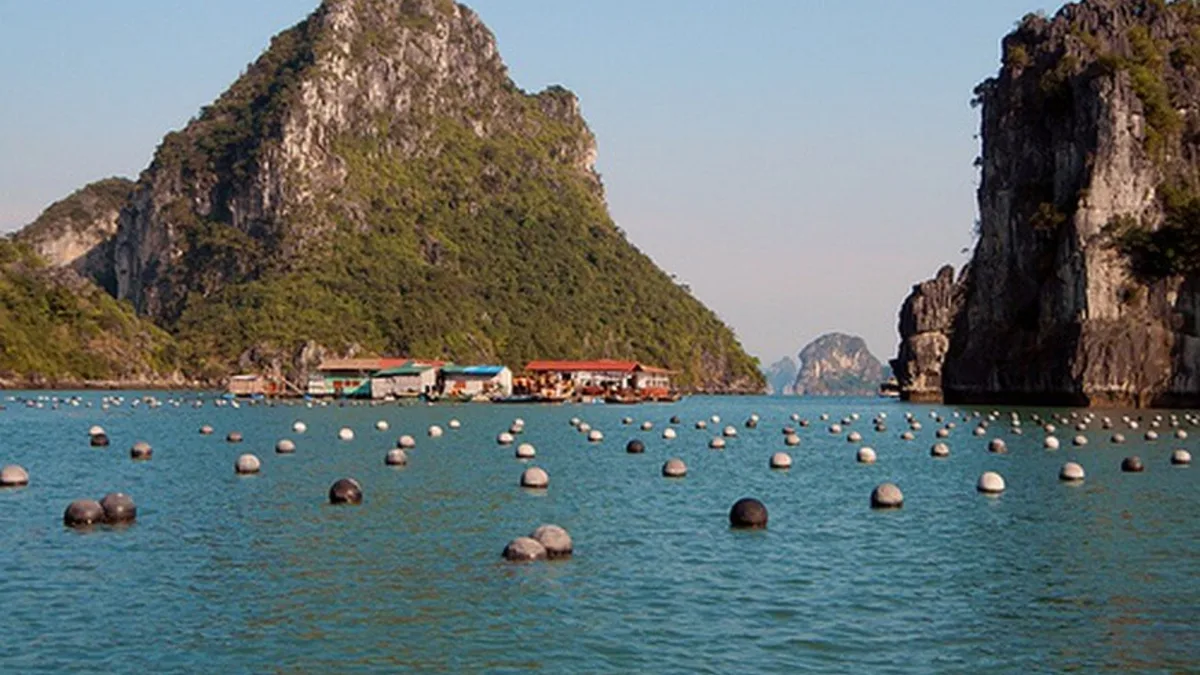
    Pearl cultivation and fish farming cages at Vung Vieng Fishing Village, Bai Tu Long Bay — the village's primary livelihood for remaining aquaculture families
    Pearl cultivation and fish farming (sea bass, grouper, cobia) are the primary livelihoods of the approximately 30 aquaculture households that remain at Vung Vieng today.
⚠️ Responsible tourism note: Vung Vieng is a working community, not a stage set. The families remaining on the water are managing real livelihoods — fish farms, pearl cultivation, boat maintenance. During your visit, follow your guide’s instructions, respect the privacy of residents going about their daily work, avoid touching or disturbing fish cages or pearl lines, and buy handicrafts directly from village stalls where possible to ensure income flows to the community rather than intermediaries.

6. Ticket Prices & How to Visit in 2026

6.1 Entrance & Route

Ticket Type Price (VND) Price (USD approx.)
Route 4 sightseeing (incl. port fee) 240,000 VND / person ~$10 USD

Note: If visiting as part of an overnight Bai Tu Long Bay cruise, both the Route 4 entrance fee and the bamboo boat ride to the village are typically included in your cruise package — always confirm exact inclusions with your operator before booking.

6.2 Bai Tu Long Bay Route 4 — What’s Included

  1. Thien Canh Son Cave
  2. Hang Thay Cave
  3. Cong Do Island area
  4. Tung Ang Ecological Area
  5. Vung Vieng Fishing Village ⭐

Important note on access: Larger cruise boats cannot enter the village directly — they anchor at a distance and visitors transfer to bamboo boats for the final 20–30 minutes. As with Thien Canh Son Cave, only operators holding a specific Bai Tu Long Bay permit may include Vung Vieng in their itinerary — always confirm your cruise operator’s permit before booking.

6.3 How to Get There from Hanoi

  • By road to Halong City: Approximately 2.5–3.5 hours via the 5B Expressway
  • Boat journey from Tuan Chau Port: Approximately 2–2.5 hours to reach the Vung Vieng area of Bai Tu Long Bay
  • Recommended: Overnight cruise (2D1N or 3D2N) to allow a relaxed village visit combined with Thien Canh Son Cave and the broader bay experience

7. Best Time to Visit Vung Vieng Fishing Village

Season Months Conditions Rating
Spring Mar – May Mild, dry, blue skies — ideal for photography and bamboo boat rides ⭐⭐⭐⭐⭐ Best overall
Autumn Sep – Nov Clear weather returns after summer rains; comfortable temperatures ⭐⭐⭐⭐⭐ Excellent
Dry season Oct – April Consistently good conditions; peak international season ⭐⭐⭐⭐⭐ Reliable
Summer Jun – Aug Warmest water; squid fishing at its best; higher rain/storm risk ⭐⭐⭐ Good with caution

Night squid fishing best season: Summer months (June–August), when squid populations are highest. If squid fishing is a priority, plan an overnight cruise during this period.

Avoid: Vietnamese public holidays (Tết, April 30–May 1, September 2) — even Bai Tu Long Bay sees more domestic visitors during these dates.


8. Practical Tips Before You Go

  • Wear a life jacket. Mandatory and provided by your cruise operator for all bamboo boat and kayaking activities — no exceptions.
  • Bring small VND cash for buying handicrafts at the communal floating house — the village does not have card payment facilities.
  • Dress modestly. You are a guest in a working community — light, respectful clothing is appropriate. Swimwear is not suitable for the village visit itself (swimming at the village is not part of the standard experience).
  • Follow your guide. Do not climb onto floating structures uninvited, touch fish cages or pearl lines, or enter residential areas without a guide’s direction.
  • Photography: ask first. Village residents are not performers. If you would like to photograph someone at close range, ask through your guide — most residents are accommodating when asked respectfully.
  • Support local directly. Where possible, buy handicrafts from the village stalls rather than from cruise ship gift shops — more of the revenue reaches the community directly.
  • Allow 1.5–2 hours for the full experience including the bamboo boat ride in, village exploration, pearl farm or fish farm visit, and boat ride back.

9. Vung Vieng Fishing Village — Frequently Asked Questions

The questions we get asked most often by travelers planning to visit Vung Vieng Fishing Village in Bai Tu Long Bay.

Yes. Vung Vieng is widely considered the most authentic floating village experience in the broader Halong Bay region — more intimate and less commercialized than the closer-to-port villages visible from mainstream Halong Bay cruises. The 20–30 minute bamboo boat ride through the Cao Cave stone arch gateway, the colorful floating homes surrounded by working fish farms and pearl cultivation operations, and the genuine quietude of the bay combine for an experience that many travelers describe as one of the most memorable moments of their entire Vietnam trip.

Yes, partially. Following a government resettlement program carried out between 2012 and 2021, most of Vung Vieng’s original 50 families relocated to new homes on the mainland, primarily for better access to education and healthcare. Approximately 30 aquaculture households remain on the water, managing the village’s fish farms (sea bass, grouper, cobia) and pearl cultivation operations. The village now functions as a combination of a working aquaculture site and a heritage destination, rather than a full-time residential community.

Vung Vieng is accessible only by water. Cruise ships anchor in the bay approximately 20–30 minutes from the village, then transfer passengers to traditional bamboo boats rowed by local village women. The bamboo boat passes through the natural stone arch of Cao Cave before arriving at the village itself. Day and overnight Bai Tu Long Bay cruises departing from Tuan Chau Port (Halong City) include Vung Vieng as part of Route 4, a 2-hour boat journey from port. Most visitors combine the village with Thien Canh Son Cave on an overnight cruise itinerary.

Vung Vieng is accessed via Bai Tu Long Bay Route 4, with a ticket of approximately 240,000 VND (~$10 USD) per person including port fee. Most overnight Bai Tu Long Bay cruise packages include both the Route 4 entrance fee and the bamboo boat ride to the village in the overall cruise price — always confirm exact inclusions with your operator. Small additional costs may include handicraft purchases at the communal floating house.

The main activities at Vung Vieng include: a bamboo boat ride through Cao Cave and around the village waterways (included in all cruise visits); pearl farm and fish farm visits; a fishing net demonstration; handicraft shopping at the communal floating house; photography of the floating homes and surrounding limestone cliffs; and night squid fishing for overnight cruise guests. Kayaking around the village perimeter is available with some operators. The bamboo boat ride itself — rowed in near-silence through the enclosed bay, surrounded by cliffs and fish cages — is for most visitors the highlight of the stop.

The best time is March to May (spring — dry, mild, ideal for photography) and September to November (autumn — clear skies, comfortable temperatures). The full dry season (October–April) is reliably good. Summer (June–August) offers the highest squid fishing activity for overnight guests but brings higher rain and storm risk. Avoid major Vietnamese public holidays for a quieter experience.

Yes, significantly. Cua Van is located in Halong Bay proper and is included on mainstream Halong Bay overnight cruise itineraries, making it the more visited and more commercialized of the two. Vung Vieng is located in Bai Tu Long Bay, 24 km from the mainland, requiring a specific Bai Tu Long permit — meaning it sees far fewer visitors and has a quieter, more authentic atmosphere. Vung Vieng is generally described as the more “off the beaten path” and less staged experience; Cua Van is the more accessible option for travelers on standard Halong Bay Route 2 itineraries.

In 2012, the Halong Bay Management Board announced a program to relocate the residents of Halong Bay’s floating villages, citing concerns about safety, access to education and healthcare, and long-term environmental sustainability. Families at Vung Vieng (along with those at other floating villages) were offered new housing on the mainland, land, and access to schools and medical services that life on the water could not provide. The program was carried out between 2012 and 2021. Some families welcomed the move for the opportunities it gave their children; others were initially reluctant to leave a way of life that had defined their family for generations. Today approximately 30 aquaculture households remain on the water voluntarily.

Several of the remaining aquaculture families at Vung Vieng cultivate pearls in the mineral-rich waters of Bai Tu Long Bay. The process involves introducing a nucleating bead into live oysters, which are then suspended on ropes underwater in cages or lines for 2–4 years while they coat the bead with layers of nacre — the organic material that gives pearls their characteristic luster. The bay’s pristine water quality and protected location create excellent conditions for pearl cultivation. Visitors can see the oyster lines and cages during the bamboo boat ride, and some cruise operators arrange a short demonstration of the process as part of the village visit.

Yes, through Route 4 day cruises departing from Tuan Chau Port. However, given the approximately 2-hour one-way boat journey from Tuan Chau to the Vung Vieng area, a day cruise leaves limited time at the village and the other Route 4 stops. Most experienced travelers strongly recommend an overnight cruise (2D1N or 3D2N) for Bai Tu Long Bay — this allows a relaxed village visit combined with Thien Canh Son Cave, the Cong Do area, and the experience of anchoring overnight in the bay’s quiet waters, including night squid fishing.

Last updated: June 2026 | Information verified against multiple Bai Tu Long Bay and floating village tourism sources. Household and population figures for Vung Vieng vary between sources and have changed during the government resettlement program (2012–2021). Current figures are approximate and reflect the most commonly cited estimates.

Show More Show Less

Top Cruises which visit Vung Vieng Fishing Village

Show Filter Close Filter
Sort by:

Other Halong Bay Cruise Destinations

Ao Ech Area

Ao Ech Area

Halong Bay Cruise Destinations

Ao Ech Area: Lan Ha Bay’s Mirror Lagoon & Bioluminescent Kayaking Paradise Ao Ech Area — known in English as Frog Pond — is one of the most serene, unspoiled,...

More
Thien Canh Son Cave

Thien Canh Son Cave

Halong Bay Cruise Destinations

Thien Canh Son Cave: Bai Tu Long Bay’s Most Spectacular Cavern, Vietnam Thien Canh Son Cave — meaning “Mountain of the Heavenly View” — is the signature cave of Bai...

More
Trung Trang Cave

Trung Trang Cave

Halong Bay Cruise Destinations

Trung Trang Cave: Cat Ba Island’s Ancient Limestone Cavern, Vietnam Trung Trang Cave is one of the largest and most fascinating caves on Cat Ba Island, the gateway to Lan...

More
Sung Sot Cave

Sung Sot Cave

Halong Bay Cruise Destinations

Sung Sot Cave: The Largest Cave in Halong Bay, Vietnam Sung Sot Cave — also known as Surprise Cave or Surprising Cave — is the largest and most spectacular limestone...

More
Luon Cave

Luon Cave

Halong Bay Cruise Destinations

Luon Cave: Halong Bay’s Hidden Kayaking Lagoon, Vietnam Luon Cave — meaning “tunnel” in Vietnamese — is one of the most unique and beloved attractions in Halong Bay, Vietnam. Unlike...

More
Bai Tu Long Bay

Bai Tu Long Bay

Halong Bay Cruise Destinations

Bai Tu Long Bay Attractions: Top Must-See Destinations & Best Cruises to Visit Them Bai Tu Long Bay — Vịnh Bái Tử Long, “Children of the Dragon Bay” — is...

More
Lan Ha Bay

Lan Ha Bay

Halong Bay Cruise Destinations

Lan Ha Bay Attractions: Top Must-See Destinations & Best Cruises to Visit Them Lan Ha Bay — Vịnh Lan Hạ — is Vietnam’s most pristine bay and the hidden gem...

More
Halong Bay

Halong Bay

Halong Bay Cruise Destinations

Halong Bay Attractions: Top Must-See Destinations & Best Cruises to Visit Them Halong Bay — Vịnh Hạ Long, meaning “Bay of the Descending Dragon” — is Vietnam’s most iconic natural...

More
Cap La Island

Cap La Island

Halong Bay Cruise Destinations

Cap La Island: Bai Tu Long Bay’s Quietest Beach & Most Pristine Cave Cap La Island — Cap La in Vietnamese — is one of the least-visited and most genuinely...

More
Cong Dam Area

Cong Dam Area

Halong Bay Cruise Destinations

Cong Dam Area: Bai Tu Long Bay’s Open-Air Geological Museum Cong Dam Area is one of the most distinctive and least-visited destinations in all of Bai Tu Long Bay —...

More

Login