1. What is Halong Bay? History & UNESCO Recognition
The Legend of the Descending Dragon
The name Hạ Long — “Descending Dragon” — comes from one of Vietnam’s most beloved creation legends. When foreign invaders threatened the ancient Vietnamese kingdom, the Jade Emperor sent a Mother Dragon and her children to protect the land. The dragons spat out jewels and jade, which transformed into thousands of islands, forming a natural fortress that stopped the enemy fleet. The Mother Dragon was so captivated by the bay’s beauty that she chose to remain forever. The spot where she descended became Hạ Long Bay; where her children landed became Bái Tử Long Bay — “Children of the Dragon Bay.”
500 Million Years of Geology
400–500 million years ago, the area was a warm, shallow tropical sea near the equator — teeming with corals and marine creatures whose compressed shells became the limestone layers more than 1,000 meters thick that form every island visible today. Between 300 and 250 million years ago, tectonic forces lifted this ancient seabed above water. Then millions of years of erosion — rainwater dissolving rock, saltwater undercutting island bases, wind shaping pinnacles — created what geologists call “marine-invaded tower karst”: the world’s most complete example of this unique landscape type. NASA’s Earth Observatory confirms the karsts rise up to 400 meters above the water surface, visible from space.
8,000–10,000 years ago, the last Ice Age ended and sea levels rose approximately 120 meters. The sculpted karst plateau was gradually submerged — its highest peaks remaining as the 1,969 islands visitors see today. You are cruising through a flooded ancient mountain range.
Prehistoric Human History
Archaeological surveys confirm human habitation for tens of thousands of years. Artifacts from the Soi Nhu Culture (18,000–7,000 years ago), Cai Beo Culture (7,000–5,000 years ago), and the Halong Culture (4,000–3,500 years ago) have been found across the islands, including in Dau Go Cave. Ha Long-style stone axes discovered in both northern Vietnam and southern China confirm ancient maritime trade routes spanning thousands of kilometers. In the 13th century, military genius Tran Hung Dao used Dau Go Cave to hide iron-tipped wooden stakes, later planted in the Bach Dang River to destroy the invading Mongol fleet — one of history’s most celebrated underdog victories.
UNESCO World Heritage & International Recognition
- December 1994: First inscribed as a UNESCO World Natural Heritage Site — outstanding universal natural beauty (Criterion VII)
- December 2000: Re-inscribed for exceptional geological and geomorphological significance (Criterion VIII) — the world’s most complete example of marine-invaded tower karst
- 2012: Officially confirmed as one of the New 7 Wonders of Nature — alongside the Amazon, Iguazu Falls, Jeju Island, Komodo, Puerto Princesa Underground River, and Table Mountain
- September 2023: UNESCO expanded the World Heritage boundary to formally include the Cat Ba Archipelago, creating Vietnam’s first inter-provincial World Heritage Site
- 2024: Crowned “World’s Leading Natural Landscape” at the World Travel Awards
Vietnamese national poet Nguyen Trai called Halong Bay “a marvel of the earth erected towards the high skies” — five centuries before UNESCO agreed.
2. ☀️ Top Must-See Attractions in Halong Bay
These are the five landmarks that define Halong Bay — the stops on virtually every Route 2 cruise itinerary and what every first-time visitor should prioritize.
Sung Sot Cave (Surprise Cave) — Largest cave in Halong Bay · Top 10 most beautiful caves in the world
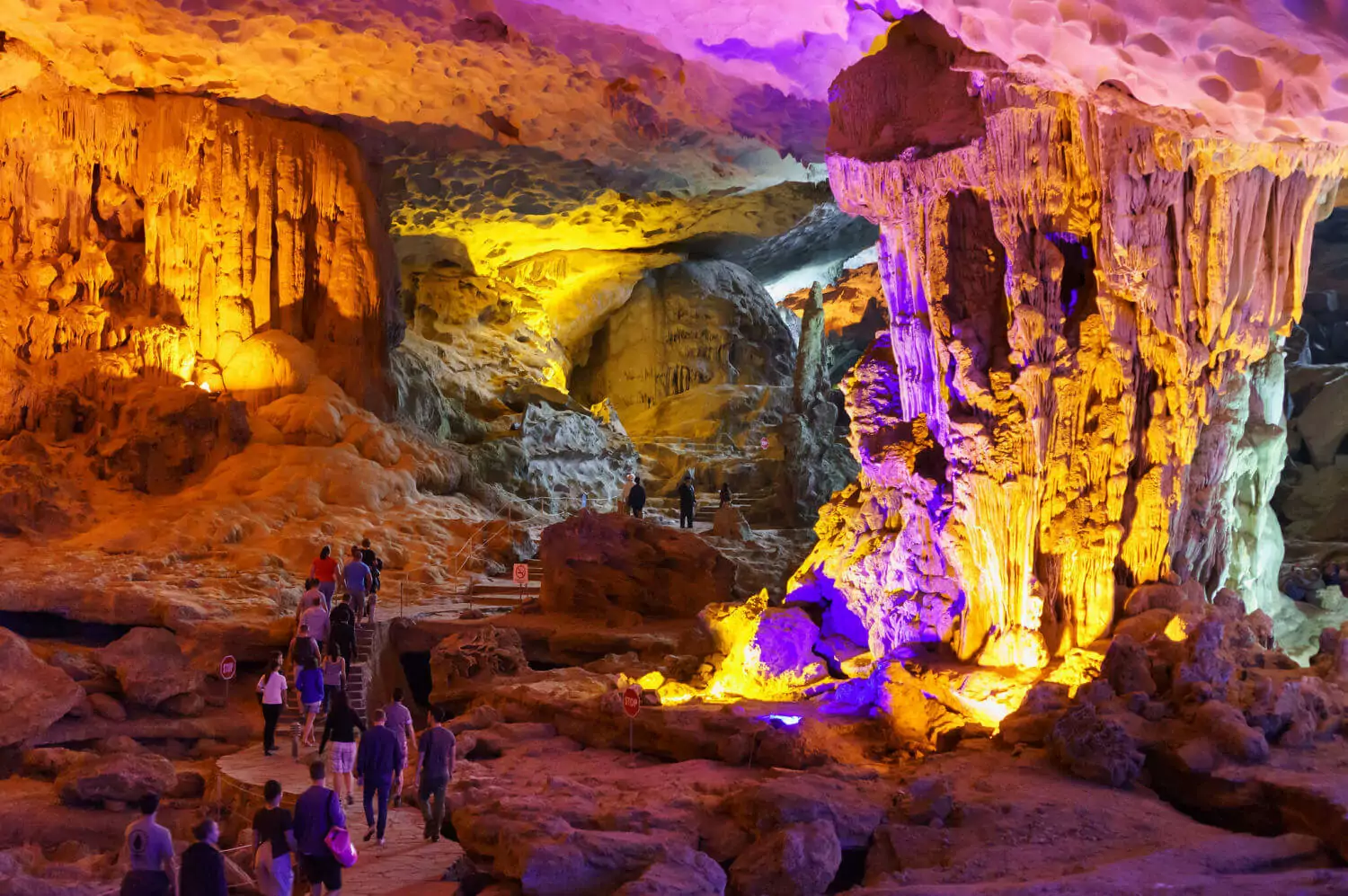 The Grand Hall of Sung Sot Cave features 30-meter-high ceilings adorned with stalactite formations. Ranked among the top 10 most beautiful caves in the world (Czech ATAB, 2012).
Sung Sot Cave — also known as Surprise Cave or the French original Grotte des Surprises — is the undisputed centerpiece of Halong Bay. Covering over 10,000 square meters across three spectacular chambers, it was discovered in 1901, opened to tourists in 1993, and ranked among the top 10 most beautiful caves in the world by the Czech Association of Travel Agents and Brokers (2012). CNN Travel named it among Vietnam’s top 7 most stunning caves.
An 800-meter paved walkway guides visitors through: the intimate Waiting Room (stalactite chandeliers, freshwater lake), the cathedral Grand Hall (30-meter ceilings, formations shaped like Buddha and animals), and the vast Royal Garden — where rock formations linked to the legend of hero Thanh Giong include an unmistakable iron horse and sword. The cave exit opens onto a panoramic viewpoint with one of the best vistas in Halong Bay.
Ti Top Island (Titov Island) — Best panoramic viewpoint · Named after a Soviet cosmonaut in 1962
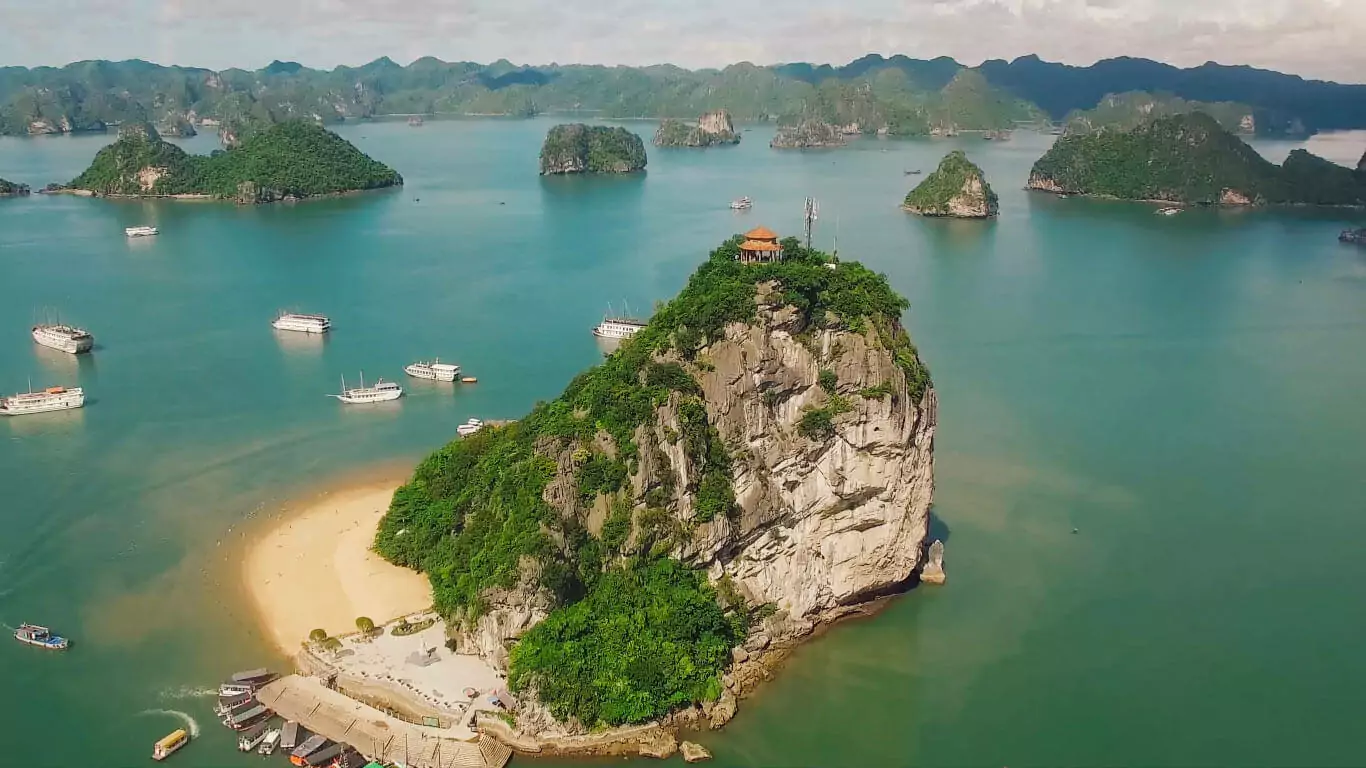 The 360° view from Ti Top Island’s 110-meter summit — reached via 400–450 steps — is widely considered the most spectacular panorama in all of Halong Bay.
Ti Top Island offers the single most spectacular view in all of Halong Bay: a 360° panorama from 110 meters above the water, reached via 400–450 stone steps through tropical forest. The crescent-shaped Vang Trang Beach (“Moon Beach”) below is one of the bay’s only genuine white sand swimming beaches.
The island was renamed by President Ho Chi Minh on November 22, 1962 in honor of Soviet cosmonaut Gherman Titov — the second human to orbit Earth and the youngest person ever in space. A bronze statue of Titov unveiled in September 2015 stands at the beach entrance today.
Thien Cung Cave (Heavenly Palace Cave) — Route 1 centerpiece · Most accessible major cave
Thien Cung Cave — meaning Heavenly Palace — covers approximately 10,000 square meters and is famous for extraordinary stalactite formations illuminated in multicolored lighting. It contains three natural ponds that have never dried — unique among Halong Bay caves. According to legend, this was the palace of the Dragon King of the Eastern Sea. Located on Dau Go Island, just 4 km from Bai Chay Wharf — the most accessible major cave in the bay.
Dau Go Cave (Wooden Stakes Cave) — 13th-century war legend · 5,000 m² of history
Dau Go Cave carries one of the most dramatic stories in Vietnamese history. In the 13th century, military genius Tran Hung Dao hid thousands of iron-tipped wooden stakes here, later planted in the Bach Dang River to destroy the invading Mongol fleet. The cave covers 5,000 square meters; its jellyfish-shaped entrance glows emerald from outside. King Khai Dinh composed a poem in its honor, still engraved on the cave wall today.
3. 🚣 Best for Active Travelers & Sightseers
Luon Cave — Halong Bay’s iconic kayaking lagoon · Only by kayak or bamboo boat
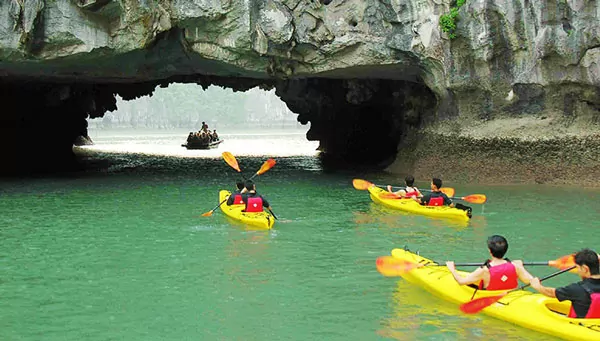 Kayaking through Luon Cave’s 60-meter limestone arch into a 1-square-kilometer hidden lagoon — accessible only by kayak or bamboo boat. Golden monkeys inhabit the surrounding cliffs.
Luon Cave is unlike any other attraction in Halong Bay. Its name means “to duck through” — the defining experience: kayaking through a natural 60-meter limestone arch into a hidden lagoon. The entrance measures just 4 meters wide and 2.5–4 meters high — only kayaks and small bamboo boats can pass. Beyond the arch: a 1-square-kilometer enclosed lagoon surrounded by sheer cliffs up to 25 meters high. Golden monkeys inhabit the cliff faces; schools of fish are visible through the clear water.
Soi Sim Island — Eco-trekking, beach & conservation area
Soi Sim Island is a compact forested island approximately 12 km from Bai Chay Wharf, covered in endemic plant species. It features a conservation eco-park with a central display house and viewing platforms in the shape of a 9-petal flower. A small sand beach offers calm, crystal-clear water for swimming and kayaking.
4. 🏘️ Best for Culture & Local Life
Cua Van Fishing Village — Halong Bay’s last traditional floating community
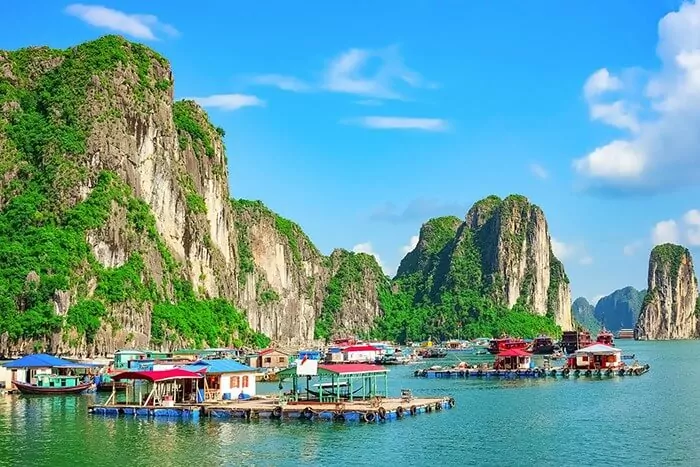 Cua Van Fishing Village — home to approximately 300 residents living entirely on the water. One of the last traditional floating communities in Halong Bay, following relocation programs in 2014.
Cua Van Fishing Village is the most authentic stop in Halong Bay. Once home to over 700 residents, today approximately 300 people live entirely on the water in colorful floating homes — one of the last traditional floating communities in the bay after most families were relocated to the mainland in 2014. A floating cultural center and school allow visitors to learn about fishing traditions and the unique rhythms of a life lived on the sea.
Tung Sau Pearl Farm — Halong Bay’s pearl cultivation & demonstration center
Tung Sau Pearl Farm offers a rare look at traditional oyster pearl cultivation. Akoya oysters are raised in sheltered bay waters for 2–4 years before harvest. Visitors observe the full process — seeding through extraction and quality grading — and browse finished Halong Bay pearls in the showroom. Popular with families and photography enthusiasts.
5. How to Get to Halong Bay from Hanoi
Halong Bay is approximately 165 kilometers east of Hanoi — most travelers complete the journey in under 3 hours.
| Transport |
Journey Time |
Cost (approx.) |
Notes |
| Limousine bus (recommended) |
2.5–3 hours |
~$15–20 USD / way |
Most popular; comfortable; included in most cruise packages |
| Private car / taxi |
2–2.5 hours |
$60–100 USD |
Flexible door-to-door service |
| Public bus |
3–4 hours |
~$5–8 USD |
Budget option from My Dinh Bus Station, Hanoi |
| Van Don Airport (fly) |
~50 km from port |
Varies |
Domestic flights from HCMC / Da Nang; ~1 hr to port by car |
| Cat Bi Airport, Haiphong (fly) |
~60 km from port |
Varies |
Regional flights; ~45 min–1 hour to port |
Note: Seaplane service from Hanoi to Tuan Chau has been discontinued as of April 2026 and is no longer available.
Two main departure ports:
- Tuan Chau International Passenger Port — ~12 km from Halong City center. Most popular departure point with the widest selection of cruise operators.
- Halong International Cruise Port — closer to the city center (opened 2019). Fewer operators but easier access from central Halong City.
Most Halong Bay cruise packages include round-trip limousine transfers from Hanoi hotels, departing around 7:30–8:30 AM and arriving at port by 11:00–11:30 AM.
6. Halong Bay Cruise Routes — Route 1 vs Route 2
| Route |
Duration |
Key Attractions |
Swimming? |
Best For |
| Route 1 |
4 hours |
Thien Cung Cave, Dau Go Cave |
No |
Visitors with limited time; half-day cruise |
| Route 2 ⭐ Most Popular |
5–6 hours |
Soi Sim Island · Ti Top Island · Sung Sot Cave · Bo Nau Cave · Ho Dong Tien Cave · Luon Cave · Trong Cave · Trinh Nu Cave |
✅ Yes — only route with swimming |
First-time visitors; most complete experience |
| Route 2 Overnight |
2–3 days |
All Route 2 stops + Tung Sau Pearl Farm + Cua Van Village + remote areas |
✅ Yes |
Best overall Halong Bay experience |
Route 2 Entrance Ticket Prices 2026 (official Halong Bay Management Board rates):
| Ticket Type |
Price (VND) |
Price (USD approx.) |
| Day trip (Route 2) |
290,000 VND / person |
~$12 USD |
| 2 Days / 1 Night |
590,000 VND / person |
~$24.60 USD |
| 3 Days / 2 Nights |
790,000 VND / person |
~$33 USD |
7. Best Time to Visit Halong Bay 2026
| Season |
Months |
Temperature |
Conditions |
Rating |
| Spring |
Mar–May |
20–26°C |
Mild, clear skies, ideal for all activities |
⭐⭐⭐⭐⭐ Best overall |
| Autumn |
Sep–Nov |
24–28°C |
Sunny, slightly cooler, peak international season |
⭐⭐⭐⭐⭐ Most popular |
| Summer |
Jun–Aug |
28–35°C |
Hot, ideal for swimming; typhoon risk Jul–Aug |
⭐⭐⭐⭐ Good for beach |
| Winter |
Dec–Feb |
16–20°C |
Cool, occasional mist, dramatic atmosphere |
⭐⭐⭐ Fewest crowds |
Avoid during Vietnamese public holidays: Tết (late Jan / early Feb), April 30–May 1, September 2 — sharp price increases and crowding at all attractions on these dates.
Pro tip: Visit Sung Sot Cave and Ti Top Island before 10:00 AM or after 2:00 PM — the majority of cruise boats arrive between 10:00 AM and 1:00 PM. Overnight cruise guests can schedule visits outside peak hours.
8. Things to Do in Halong Bay
| Activity |
Where |
Best For |
Availability |
| Cave exploration |
Sung Sot, Thien Cung, Dau Go, Luon |
Everyone |
All cruises |
| Summit climb & viewpoint |
Ti Top Island — 110 m, 400–450 steps |
Active travelers |
Route 2 cruises |
| Swimming |
Ti Top Beach (Vang Trang), Soi Sim |
Families, beach lovers |
Route 2 only |
| Kayaking through limestone arch |
Luon Cave |
Adventure seekers |
Most Route 2 cruises |
| Bamboo boat ride |
Luon Cave lagoon |
Families, relaxed travelers |
Most Route 2 cruises |
| Floating village visit |
Cua Van Fishing Village |
Culture seekers |
Overnight cruises |
| Pearl farm tour |
Tung Sau Pearl Farm |
Families, curious travelers |
Overnight & extended cruises |
| Sunset cocktail hour |
Cruise sundeck |
Couples, photographers |
All cruises |
| Night squid fishing |
Bay anchorage |
Everyone |
Overnight cruises |
| Tai Chi at sunrise |
Cruise sundeck |
Wellness travelers |
Overnight cruises |
| Onboard cooking class |
Cruise kitchen |
Food lovers |
Most overnight cruises |
| Limestone karst photography |
Throughout the bay |
Photographers |
All cruises |
9. How to Choose a Halong Bay Cruise
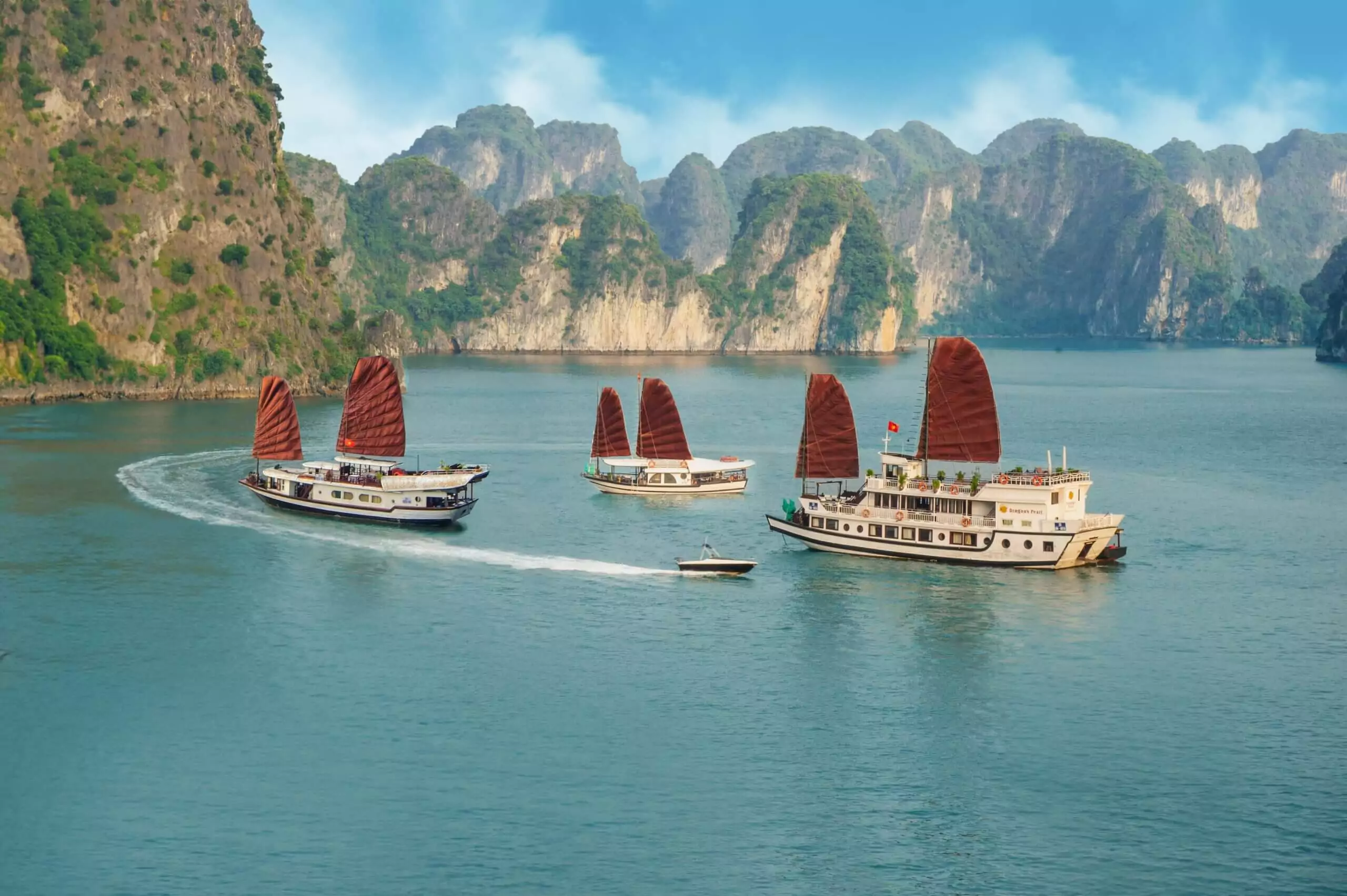 A traditional wooden junk boat cruises through Halong Bay’s limestone karsts at sunset. Overnight cruises (2D1N or 3D2N) provide the most complete Halong Bay experience, including Sung Sot Cave, Ti Top Island, Luon Cave, and more.
With over 500 licensed vessels operating in the bay, choosing the right cruise is the most important decision for your Halong Bay experience. Here is how to navigate the options:
| Category |
Price per Person |
Best For |
Typical Features |
| Day Cruises |
$54–$100 USD |
Visitors with limited time; day trip from Hanoi |
Route 2 highlights (Sung Sot, Ti Top, Luon Cave); lunch & guide included; 5–6 hours on the bay |
| Budget Overnight Cruises |
$120–$160 USD |
Backpackers; budget travelers; solo travelers |
Private or shared cabin; basic meals; standard Route 2 stops; kayaking included |
| Mid-range / Deluxe Overnight Cruises |
$125–$200 USD |
Couples, families, comfort travelers |
En-suite cabin; quality seafood; sundeck; kayaking; cooking class; some with private balcony |
| Luxury Overnight Cruises |
$145–$600+ USD |
Honeymooners, special occasions, high-end travelers |
Private balcony; bathtub or jacuzzi; spa; gourmet dining; small group (10–20 guests); butler service |
⚠️ Note on prices: All prices are approximate and per person based on double occupancy for overnight cruises. Prices vary significantly by season (peak: Oct–Apr costs more), departure date, cabin type, group size, and whether Hanoi transfers are included. Always confirm the final price directly with the operator or booking platform. Prices above are indicative for planning purposes only.
Key factors to consider when choosing:
- Duration: 2 days/1 night is the minimum recommended for a proper Halong Bay experience. 3 days/2 nights covers significantly more of the bay including quieter areas. Day cruises are possible but very rushed.
- Route: Confirm the cruise visits your priority attractions — not all Route 2 cruises include Cua Van Village or Tung Sau Pearl Farm.
- Group size: Boutique cruises (10–20 guests) offer more intimate experiences; large ships (50–100+ guests) mean more crowds at each stop.
- Cabin type: Balcony cabins are worth the upgrade for overnight cruises — waking up surrounded by limestone karsts from your private terrace is unforgettable.
- Inclusions: Check whether entrance fees, kayaking, cooking class, and Hanoi transfers are included — these vary widely between operators.
→ Browse and compare all Halong Bay cruises →
10. Halong Bay vs Lan Ha Bay vs Bai Tu Long Bay
The name “Halong Bay” is often used loosely to refer to the entire region. In fact, there are three distinct bays, each with its own dedicated attractions, cruise routes, and atmosphere — and cruises do not cross between them.
| Bay |
Key Attractions |
Crowd Level |
Best For |
| Halong Bay |
Sung Sot Cave, Ti Top Island, Luon Cave, Thien Cung, Dau Go, Cua Van, Soi Sim, Tung Sau |
Highest · Most visited |
First-time visitors · iconic landmarks · Route 2 |
| Lan Ha Bay |
Dark & Bright Cave, Ba Trai Dao Islets, Ao Ech Area, Trung Trang Cave, Viet Hai Village |
Lower · quieter |
Adventure seekers · kayaking · rock climbing · Cat Ba Island |
| Bai Tu Long Bay |
Cap La Island, Cong Dam Area, Thien Canh Son Cave, Vung Vieng Fishing Village |
Lowest · most pristine |
Privacy seekers · luxury travelers · unspoiled nature |
Which bay should I choose? For a first visit, Halong Bay (Route 2) gives you the iconic landmarks that define the destination worldwide. For a second visit or to escape crowds, Lan Ha Bay or Bai Tu Long Bay offer equally stunning scenery with dramatically more peace and quiet.
11. 🎬 Halong Bay on Screen — Films & Famous Visitors
| Film / Visitor |
Year |
Connection to Halong Bay |
| Kong: Skull Island |
2017 |
Filmed extensively in Halong Bay and Ninh Binh — limestone karsts doubled as the mythical Skull Island |
| James Bond: Tomorrow Never Dies |
1997 |
Aerial chase sequences filmed over the bay |
| Pan |
2015 |
The floating mountains of Neverland were directly inspired by Halong Bay’s karst formations |
| Indochine |
1992 |
Catherine Deneuve film; scenes on the bay helped introduce Halong to Western audiences |
| Gherman Titov (Soviet cosmonaut) |
1962 & 1997 |
Visited with Ho Chi Minh in 1962 — Ti Top Island named in his honor. Returned in 1997: “I give my thanks to God for giving me a chance to return to this island.” |
| Bill Clinton (US President) |
2000 |
State visit to Vietnam included Halong Bay — brought major global media attention |
| Poet Nguyen Trai |
15th century |
Called Halong Bay “a marvel of the earth erected towards the high skies” — five centuries before UNESCO agreed |
Is Halong Bay a 7 Wonder of the World? Yes — officially. Halong Bay was confirmed as one of the New 7 Wonders of Nature in 2012 by the New7Wonders Foundation, alongside the Amazon, Iguazu Falls, Jeju Island, Komodo, Puerto Princesa Underground River, and Table Mountain. It also holds double UNESCO World Heritage recognition (1994 + 2000) and the 2024 World Travel Awards “World’s Leading Natural Landscape” title — making it one of the most decorated natural destinations on Earth.
12. Practical Travel Tips & Frequently Asked Questions
Essential Tips Before You Go
- Book 2–3 months in advance for peak season (Oct–Apr), especially luxury and deluxe cabins. Shoulder season (May–Sep): 3–4 weeks typically sufficient.
- Plastic ban: All Halong Bay cruise operators prohibit single-use plastic on board — bring a reusable water bottle.
- Cash is useful for tips, drinks on budget cruises, and purchases at floating villages. Premium cruises increasingly accept card payments.
- Pack light: Most overnight cruises allow only 1 small bag in the cabin — leave large suitcases at your Hanoi hotel.
- Non-slip shoes: Essential for all cave visits — cave floors and steps are frequently wet and slippery.
- Internet connectivity is weak or absent on the bay — most experienced visitors say this is a feature, not a bug.
- Respect the environment: Do not touch stalactites or cave formations; do not feed wildlife. See the official Halong Bay Management Board guidelines for visitor conduct.
Halong Bay — Frequently Asked Questions
The questions we get asked most often by travelers planning to visit Halong Bay.
Yes, with some limitations. Independent travelers can purchase a Route 2 day ticket (290,000 VND/person) at Tuan Chau or Halong International Port and join a shared public boat for the 5–6 hour tour covering Sung Sot Cave, Ti Top Island, and Luon Cave. Other Halong City options without entering the bay include: Sun World Halong Park (cable car, rides, water park), Quang Ninh Museum, Bai Chay Beach area, and the Halong Night Market. However, the bay’s signature attractions — the caves, islands, and floating villages — can only be accessed by boat.
These are three geographically separate bays with their own dedicated cruise routes and attractions — cruise boats do not cross between them. Halong Bay is the most famous and visited, home to Route 2’s 8 major attractions (Sung Sot Cave, Ti Top Island, Luon Cave, etc.) — best for first-time visitors seeking iconic landmarks. Lan Ha Bay, accessed via Cat Ba Island, is quieter and popular with adventure travelers — it’s the best area for rock climbing, kayaking, and visiting Dark and Bright Cave. Bai Tu Long Bay is the least visited and most pristine — ideal for luxury travelers and those seeking privacy, with highlights including Cap La Island’s floating platform and Vung Vieng Fishing Village. All three share the same dramatic limestone karst scenery but offer very different atmospheres and crowd levels.
Last updated: June 2026 | Information verified against UNESCO official records, Wikipedia, NASA Earth Observatory, Halong Bay Management Board data, and multiple independent travel sources.


