1. What is Lan Ha Bay? History & UNESCO 2023
Geography & Setting
Lan Ha Bay (Vịnh Lan Hạ) is a crescent-shaped bay in the Gulf of Tonkin, situated to the south and east of Cat Ba Island in Hai Phong Province — approximately 30 km from Hai Phong City center and 165 km from Hanoi. The bay covers more than 7,000 hectares, with over 5,400 hectares managed as part of Cat Ba National Park. It holds approximately 400 limestone islands and islets, and an extraordinary 139 natural sandy beaches — more than any other bay in the region. Many of these beaches are so secluded they can only be reached by kayak and appear only at low tide.
Administratively, Lan Ha Bay lies within Hai Phong Province (not Quang Ninh, where Halong Bay is). This provincial boundary is invisible on the water — cruises cross it seamlessly — but it means Lan Ha Bay has significantly fewer tour boats and regulations than the more heavily visited sections of Halong Bay. The result: cleaner water, quieter anchorages, and a more authentic experience on the bay.
18,000 Years of Karst Geology
Like Halong Bay, Lan Ha Bay was shaped over 500 million years by the same geological forces — ancient tropical seas depositing limestone hundreds of meters thick, followed by tectonic uplift and millions of years of erosion by rain, wind, and saltwater. The bay’s specific character comes from its position in the Cat Ba Archipelago, where the karst formations feature a distinctive dark limestone with higher basalt content. The bay’s pyramidal tower karst topography has been developing for approximately 18,000 years in its current partially submerged form — since the last Ice Age ended and sea levels rose 120 meters, drowning the ancient karst plateau.
UNESCO World Heritage 2023 — Vietnam’s First Inter-Provincial Heritage Site
On 16 September 2023, at the 45th session of the UNESCO World Heritage Committee in Riyadh, Saudi Arabia, Ha Long Bay – Cat Ba Archipelago was officially inscribed as a UNESCO World Natural Heritage Site. This was a landmark moment: it created Vietnam’s first inter-provincial UNESCO World Heritage Site, unifying Halong Bay (Quang Ninh Province) and the Cat Ba Archipelago including Lan Ha Bay (Hai Phong Province) under a single, joint inscription.
- Total area: 65,650 hectares · 1,133 islands and islets (775 in Halong Bay + 358 in Cat Ba Archipelago)
- UNESCO recognition history: Halong Bay 1994 (Criterion VII) + 2000 (Criterion VIII) · Cat Ba Biosphere Reserve 2004 · Joint Ha Long Bay – Cat Ba Archipelago World Heritage 2023
- 7 ecosystems: tropical rainforest · cave · mangrove · intertidal · coral reef · soft bottom · saltwater lake — one of the most biodiverse coastal ecosystems in Southeast Asia
- Endemic species: 4,910 species of plants and animals · 51 endemic species · UNESCO official listing confirms Cat Ba Langur (Trachypithecus poliocephalus) — only 60–70 individuals remaining, found exclusively on Cat Ba Island
The 2023 joint inscription is the highest form of international natural heritage recognition. It places Lan Ha Bay and Cat Ba Archipelago on equal footing with Halong Bay in terms of global heritage significance — a fact that most travelers (and most competing travel websites) have yet to fully appreciate.
Why Lan Ha Bay is becoming Vietnam’s most sought-after bay in 2026: CNN named it one of Asia’s Hidden Gems in 2022. The King and Queen of Belgium visited in 2025. The 2023 UNESCO inscription brought major international attention. And new expressway connections mean the journey from Hanoi takes just 2.5 hours. All this while Lan Ha Bay retains 40% fewer boats than central Halong Bay — meaning its beaches, caves, and lagoons remain genuinely uncrowded.
2. ☀️ Top Must-See Attractions in Lan Ha Bay
These are the five designated attractions of Lan Ha Bay — the destinations visited by Lan Ha Bay cruise itineraries and the highlights that define this bay’s character.
Dark and Bright Cave (Hang Sang Toi) — Lan Ha Bay’s most iconic kayaking experience
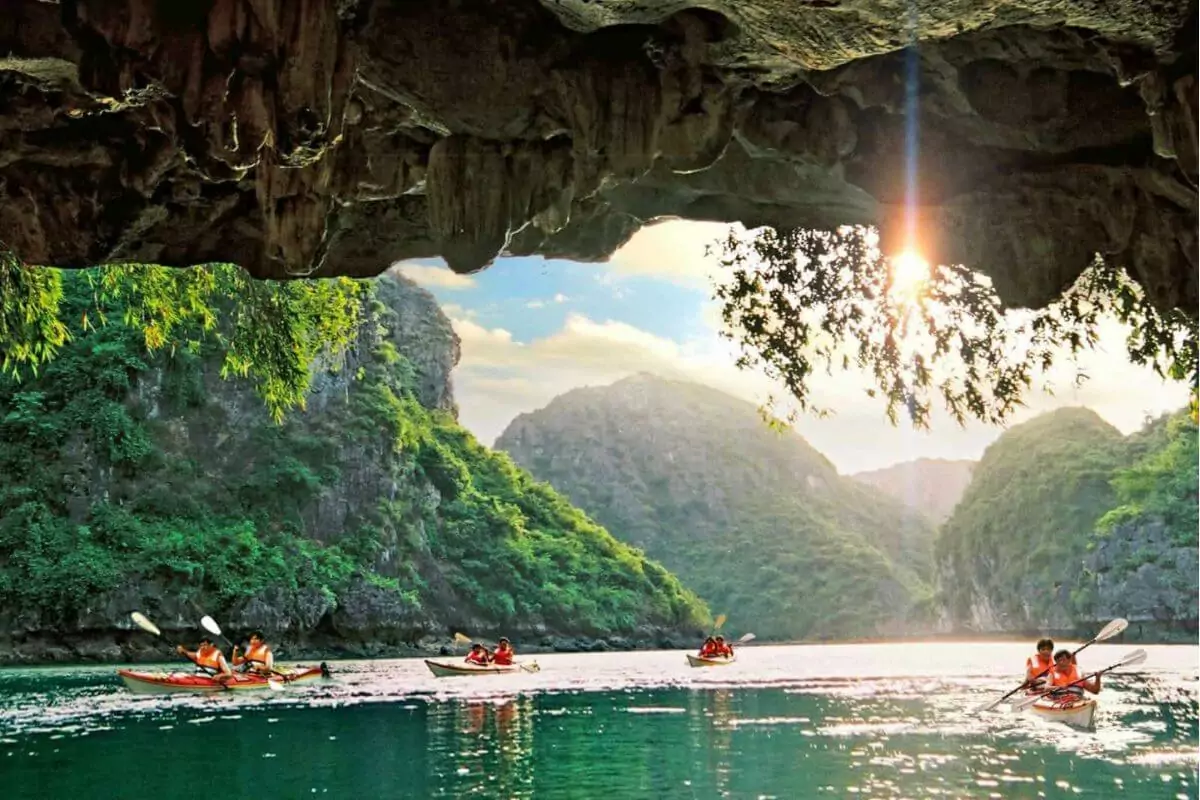 Kayaking through Dark and Bright Cave’s 100-meter dark tunnel into a sunlit hidden lagoon — Lan Ha Bay’s most celebrated and photographed attraction.
Dark and Bright Cave — Hang Sang Toi in Vietnamese, meaning “Dark and Light Cave” — is the single most celebrated attraction in Lan Ha Bay and one of the most extraordinary kayaking experiences in all of Vietnam. The cave system consists of two contrasting chambers: the Dark Cave, a long, narrow, completely dark tunnel where visitors must navigate in silence and near-total blackness; and the Bright Cave, which opens suddenly into a sunlit tropical lagoon enclosed by forested limestone cliffs — a moment of transition from darkness to light that travelers consistently describe as breathtaking.
Access is exclusively by kayak or small sampan boat — no motorized vessels can enter. The dark passage measures approximately 100 meters, requiring visitors to paddle slowly through near-zero visibility before emerging into the hidden lagoon. Monkeys are frequently seen climbing the cliff faces inside the lagoon. Squirrels inhabit the trees. The enclosed water is calm, clear, and ideal for swimming.
Important 2026 note: Kayaking regulations at Dark and Bright Cave were temporarily revised in 2024 to protect the ecosystem. Always confirm access with your cruise operator before booking.
Ba Trai Dao Islets (Three Peaches Beach) — Lan Ha Bay’s most beautiful beach stop
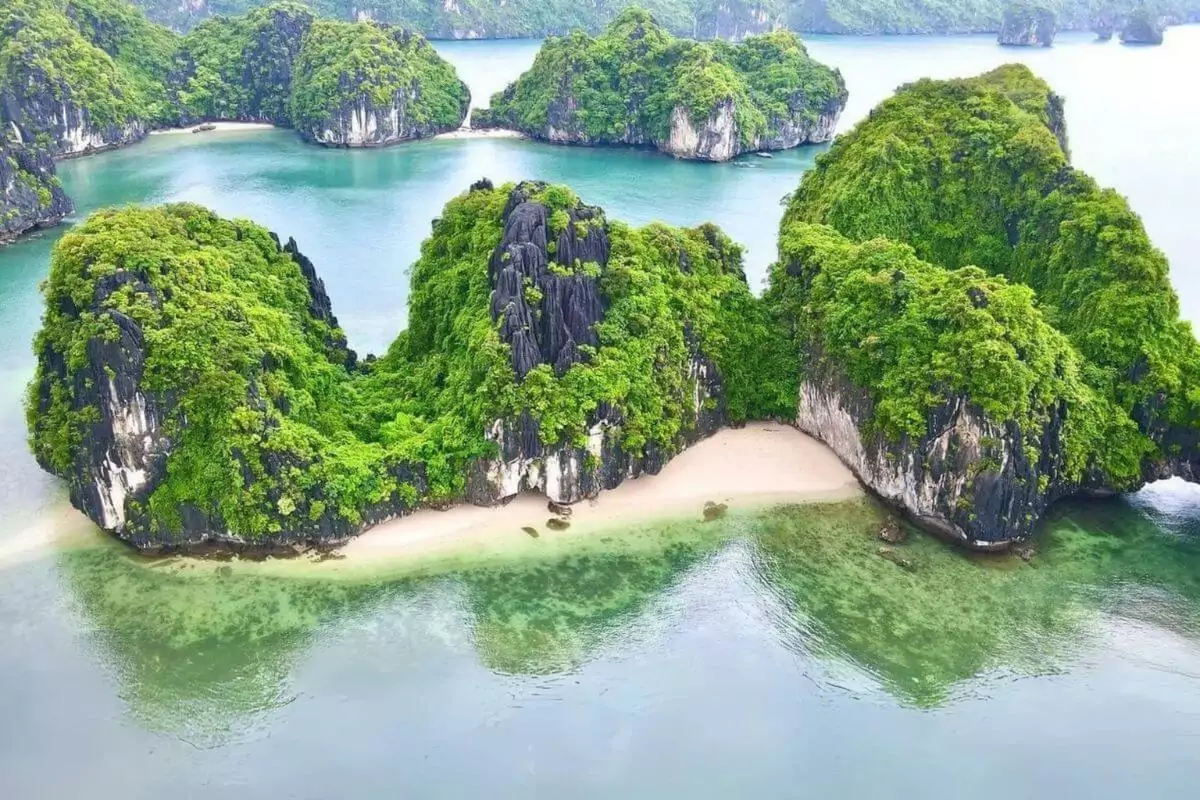 Ba Trai Dao’s three crescent-shaped white sand beaches, separated by dramatic limestone cliffs, form one of Lan Ha Bay’s most photographed swimming and snorkeling spots.
Ba Trai Dao Islets — meaning “Three Peaches Island” — is one of the most photographed and celebrated beach destinations in all of Lan Ha Bay. The name describes the bay’s defining feature: three crescent-shaped white sand beaches, each separated by dramatic rocky limestone cliffs, arranged in a curved arc that resembles three peaches on a shelf. The beaches offer pristine white sand, crystal-clear shallow water ideal for swimming and snorkeling, and a dramatic backdrop of limestone towers on all sides.
Ba Trai Dao is among the largest and most accessible beaches in Lan Ha Bay — accessible by small boat from cruise ships anchored in the surrounding waters. The calm, protected bay makes it safe for swimming year-round, though access depends on tidal conditions — some sections are only reachable at low tide, and cruise itineraries are timed accordingly. Bring snorkeling gear: the coral formations beneath the shallow water are exceptional.
Ao Ech Area (Frog Lake) — Serene floating village & mangrove ecosystem
Ao Ech Area — translating as “Frog Lake” — is one of the most serene and ecologically rich areas in Lan Ha Bay. Named for the chorus of frogs that fills the air at dusk, this sheltered cove features a traditional floating village with fish farming cages, a protected mangrove ecosystem, and calm emerald water surrounded by dense limestone formations. The area is explored by rowboat or bamboo boat — the near-silence amplified by the enclosing cliffs creates an atmosphere unlike anywhere else in the bay.
Ao Ech is a key overnight anchorage point for Lan Ha Bay cruises, where boats moor for the night in one of the most sheltered and picturesque settings in the bay. Night kayaking here — if weather permits — offers the chance to witness bioluminescent plankton, which appear as glowing blue sparks in the water when disturbed by a paddle. This phenomenon is unique to Lan Ha Bay among the three bays.
Trung Trang Cave — Cat Ba Island’s most accessible cave · Prehistoric ecosystem
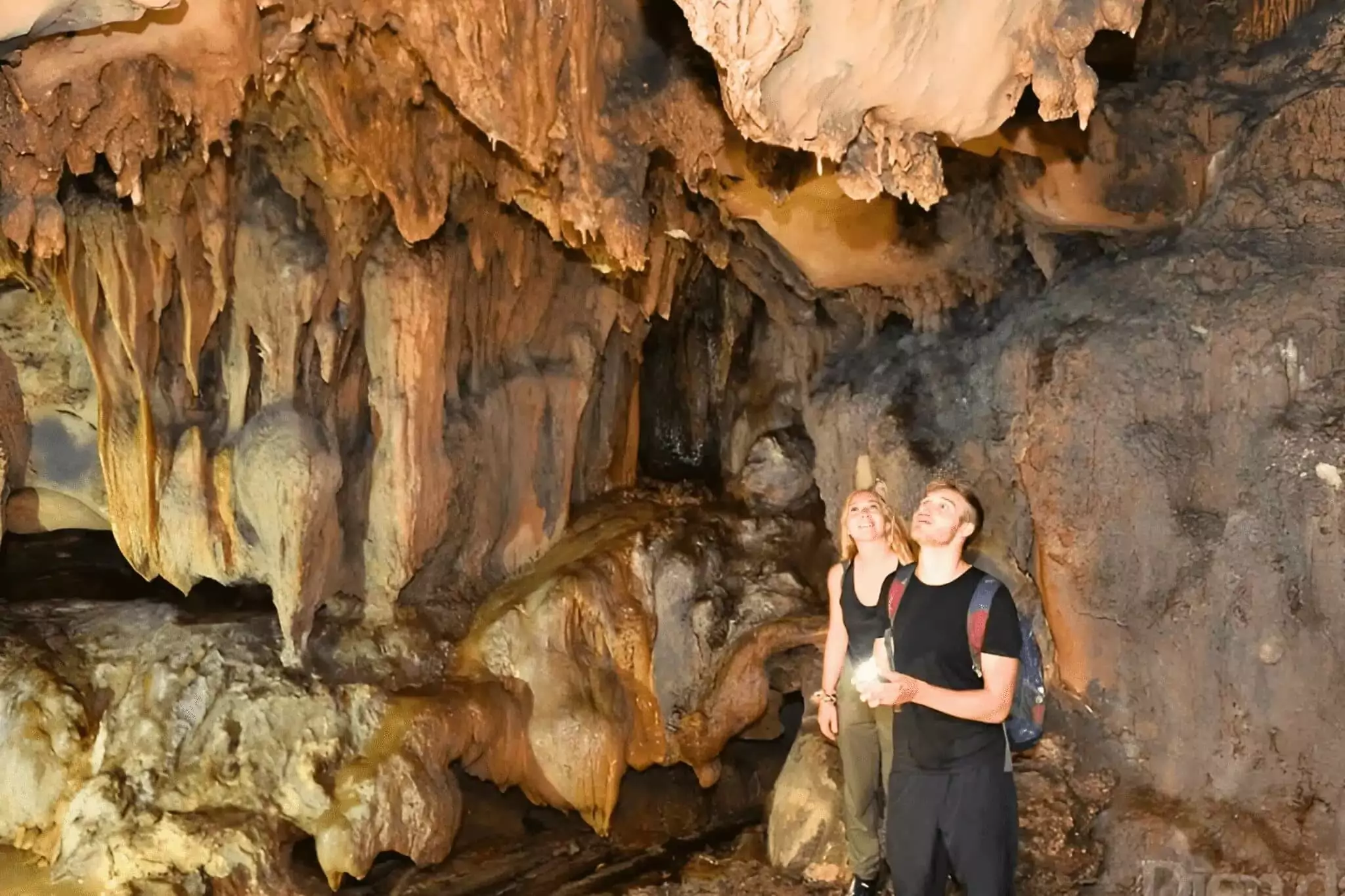 Trung Trang Cave stretches 300 meters through Cat Ba Island’s karst interior, maintaining a raw, natural atmosphere unlike the illuminated show caves of Halong Bay.
Trung Trang Cave is located inside Cat Ba National Park on Cat Ba Island — making it unique among Lan Ha Bay attractions as the only one accessible on foot from the island. The cave stretches approximately 300 meters through a valley in the karst interior of Cat Ba Island, featuring long-preserved stalactites and stalagmites and underground passages large enough to hold hundreds of visitors simultaneously.
Unlike the illuminated show caves of Halong Bay (Sung Sot, Thien Cung), Trung Trang Cave maintains a more raw, natural atmosphere. The cave connects to the broader Cat Ba National Park ecosystem, supporting a diverse community of bats, cave insects, and endemic plant species. Nearby: Quan Y Cave (Hospital Cave) — a three-storey bomb-proof military hospital used during the American War, now open to visitors as one of Cat Ba Island’s most fascinating historical sites.
Viet Hai Village — Ancient village inside Cat Ba National Park · Cycling & local life
 Viet Hai Village, hidden inside Cat Ba National Park, offers one of the most authentic cultural experiences in Lan Ha Bay — cycling through rice paddies past traditional homes.
Viet Hai Village is one of the most authentic and remote communities in Northern Vietnam — a traditional fishing and farming village hidden inside the mountains of Cat Ba National Park, accessible only by boat through narrow fjord-like channels, or by a trail through the national park. The village sits in a flat valley completely surrounded by steep limestone mountains and dense tropical forest, creating a feeling of being in a lost world entirely separate from modern Vietnam.
The village is home to approximately 40 households who have lived here for generations, growing rice, fishing, and maintaining traditional crafts. Visitors arrive by small boat from cruise ships anchored in the bay, then explore by bicycle or electric car — cycling through rice paddies, past simple wooden houses, and along quiet paths where locals go about daily life with barely a tourist in sight. Most 3-day/2-night Lan Ha Bay cruise itineraries include a half-day Viet Hai visit as their highlight cultural stop.
3. 🧗 Best for Active Travelers — Kayaking & Rock Climbing
Kayaking — The Best in All Three Bays
Lan Ha Bay is widely considered the finest kayaking destination in Northern Vietnam — and among the best in Southeast Asia. The reasons are geological and logistical: the bay’s 400 limestone islands create natural shelter from wind and waves, keeping the water exceptionally calm throughout most of the year. Hidden lagoons, enclosed caves, and narrow passages inaccessible to motorized vessels create an exploration network that rewards paddlers with discoveries impossible to reach any other way.
Key kayaking destinations include: Ba Ham Lake (an enclosed saltwater lake accessible only through a low cave tunnel at low tide), Dark and Bright Cave (the definitive kayak experience in the bay), hidden lagoons behind Ba Trai Dao Islets, and the mangrove-lined channels around Ao Ech Area. Most Lan Ha Bay cruises include 1–2 kayaking sessions in their itinerary.
Note on kayaking regulations 2026: Following a temporary suspension of kayaking at certain locations in 2024 pending new environmental regulations, most zones have reopened under updated guidelines. Confirm with your cruise operator which kayaking locations are currently accessible before booking.
Rock Climbing & Deep Water Soloing
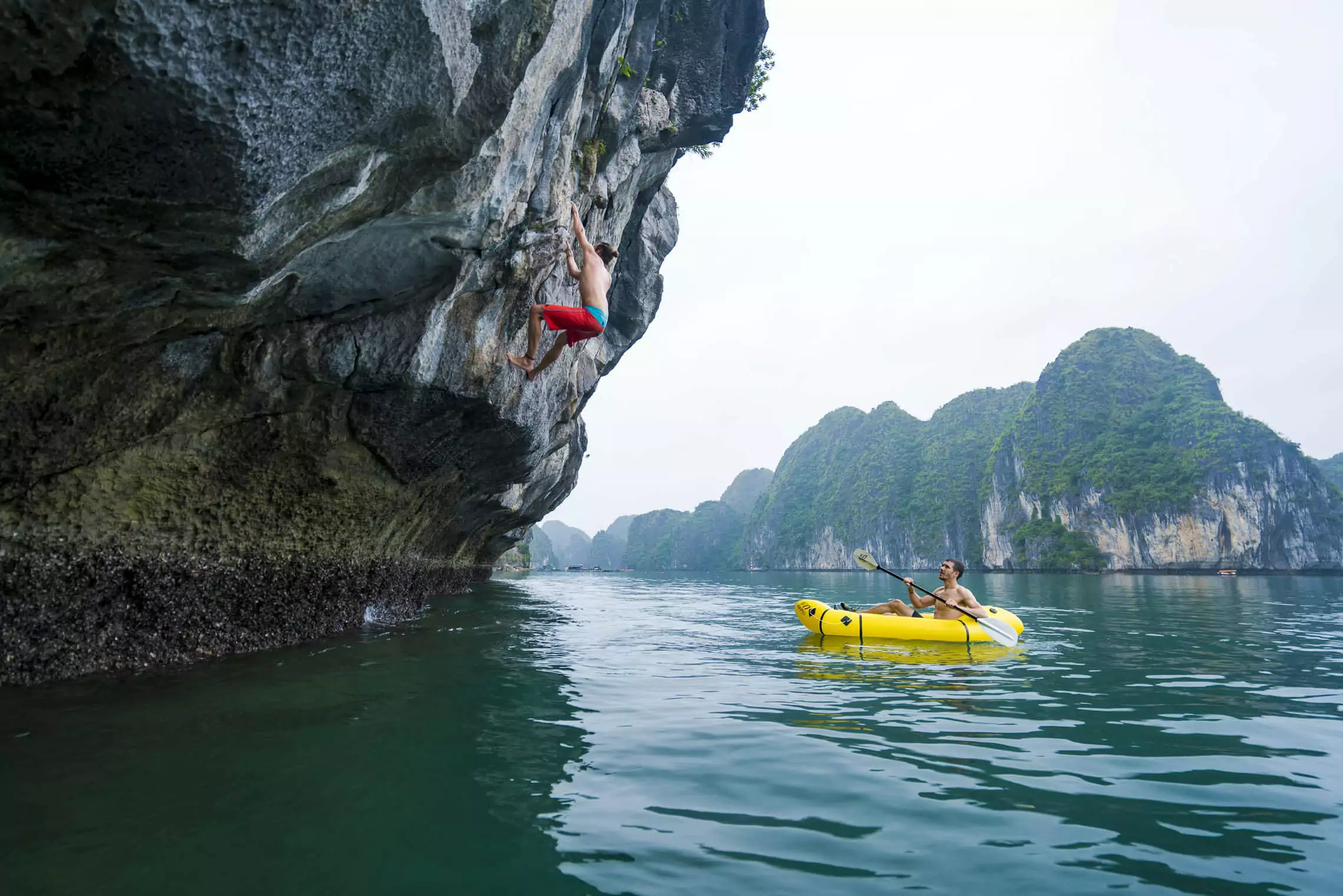 Van Boi Island’s limestone cliffs rise 20–50 meters directly from the water, making Lan Ha Bay one of the top deep water soloing destinations in Southeast Asia.
Lan Ha Bay has emerged as one of the top deep water soloing destinations in Southeast Asia. The bay’s limestone cliffs — rising 20 to 50 meters directly from the water — offer a unique form of rock climbing where no ropes are needed: climbers ascend the cliff face and fall directly into the water below if they slip. Van Boi Island is the most popular rock climbing spot, with well-established routes for all skill levels. The combination of dramatic scenery, warm water, and sheer vertical limestone makes this a truly world-class adventure experience.
Bioluminescent Plankton — Unique to Lan Ha Bay
On certain nights — particularly in summer (June–August) — the waters of Lan Ha Bay glow with bioluminescent plankton (specifically dinoflagellates), which produce a vivid blue-green light when disturbed by movement. Paddling a kayak through this phenomenon is one of the most extraordinary natural experiences in all of Vietnam. The effect is best observed on moonless nights away from boat lights — most overnight cruises offer a night kayaking session specifically to witness this. This phenomenon has not been consistently documented in Halong Bay proper, making it a genuine Lan Ha Bay exclusive.
4. 🏘️ Best for Culture & Local Life
Cai Beo Floating Village — 7,000 Years of History
Located approximately 2 km from Cat Ba Town, Cai Beo Floating Village is one of the oldest floating communities in Vietnam — archaeological evidence suggests human habitation at this location for more than 7,000 years, placing it among the earliest known maritime settlements in the region. Today, the village hosts working fish farms and floating homes, offering visitors a glimpse of a lifestyle that has adapted to the water across millennia. Access is by small boat from Cat Ba Town or as part of a cruise itinerary.
Cat Ba Island — Adventure Tourism Capital of Vietnam
Cat Ba Island (262 km²) is the largest island in the Cat Ba Archipelago and the gateway to Lan Ha Bay. The island offers a depth of experience beyond what is possible on the water alone: Cat Ba National Park covers 161 km² with trekking trails through dense jungle, viewpoints over the bay, and habitats for the critically endangered Cat Ba Langur (only 60–70 individuals remaining). Cannon Fort (177 meters) offers panoramic views. The Cat Ba cable car — at 5.4 km, among the longest sea-crossing cable cars in the world — provides a dramatic aerial approach to the island from the mainland.
5. How to Get to Lan Ha Bay from Hanoi
 A Lan Ha Bay cruise sails past limestone karsts at sunset. Overnight cruises (2D1N or 3D2N) provide the most complete experience, including Dark and Bright Cave, Ba Trai Dao, and Viet Hai Village.
Lan Ha Bay is approximately 165 km east of Hanoi — reachable in 2.5–3 hours by road, significantly faster since the opening of the 5B Expressway.
| Route |
Journey Time |
Cost (approx.) |
Notes |
| Limousine bus via Tuan Chau (recommended) |
2.5–3 hours |
~$15–20 USD / way |
Most popular; included in most cruise packages. All Lan Ha Bay overnight cruises depart from Tuan Chau Port. |
| Private car |
2–2.5 hours |
$60–100 USD |
Flexible; door-to-door from Hanoi hotel |
| Via Hai Phong + Cat Ba ferry |
3–4 hours total |
~$20–30 USD |
Hanoi → Hai Phong (2h) → ferry to Cat Ba (45 min) → Beo Port → Lan Ha Bay. Budget option, more complex. |
| Via Cat Ba cable car |
3–3.5 hours total |
Varies |
Hanoi → Hai Phong → Cat Hai Island → cable car (spectacular views) → Cat Ba → Lan Ha Bay. New route since 2024. |
| From Cat Bi Airport (Hai Phong) |
~30 min to Cat Ba |
Varies |
Nearest airport; 30 min to Cat Ba by ferry/speedboat. Domestic flights from HCMC, Da Nang. |
Important: Almost all Lan Ha Bay overnight cruises depart from Tuan Chau International Passenger Port (Halong City, Quang Ninh) — not from Cat Ba Island or Hai Phong. Cruise packages from Hanoi include round-trip limousine transfers and boarding at Tuan Chau. The cruise then sails southwest into Lan Ha Bay waters.
6. Lan Ha Bay Cruise Routes
| Route |
Duration |
Key Stops |
Best For |
| Route A — Standard |
2D / 1N |
Dark & Bright Cave · Tra Bau anchorage · Ba Trai Dao Beach · kayaking |
First-time visitors; most popular |
| Route B — Extended |
3D / 2N |
All Route A + Ao Ech Area · Viet Hai Village cycling · Trung Trang Cave · Cat Ba Island excursion |
Best comprehensive experience; culture + nature |
| Route C — Active |
2–3D |
Dark & Bright Cave · rock climbing Van Boi · Ba Ham Lake · Ba Trai Dao swimming |
Adventure travelers; kayaking + climbing focus |
| Day Cruise |
5–6 hours |
Dark & Bright Cave · Ba Trai Dao · kayaking · lunch |
Limited time; day trip from Hanoi |
Departure ports: Tuan Chau International Passenger Port (all overnight cruises) · Got Pier on Cat Hai Island (some operators) · Beo Port Cat Ba (day tours from Cat Ba Island only)
7. Best Time to Visit Lan Ha Bay 2026
| Season |
Months |
Temperature |
Conditions |
Rating |
| Spring |
Mar–May |
20–26°C |
Clear skies, mild weather, ideal for all activities; best for rock climbing and kayaking |
⭐⭐⭐⭐⭐ Best overall |
| Autumn |
Oct–Dec |
20–27°C |
Dry and sunny; excellent visibility; peak international season |
⭐⭐⭐⭐⭐ Most popular |
| Summer |
Jun–Aug |
28–34°C |
Hot; best for swimming and bioluminescent plankton; typhoon risk Jul–Aug |
⭐⭐⭐⭐ Great for beach |
| Winter |
Dec–Feb |
15–20°C |
Cool and dry; fewer crowds; excellent for Cat Ba National Park trekking |
⭐⭐⭐ Quiet season |
Rock climbing best season: October–April (dry season, limestone has best grip).
Bioluminescent plankton best season: June–August, on moonless nights.
Avoid: Vietnamese public holidays (Tết late Jan/Feb, April 30–May 1, September 2) — crowding and price surges.
8. Things to Do in Lan Ha Bay
| Activity |
Where |
Best For |
Availability |
| Kayaking through Dark & Bright Cave |
Dark and Bright Cave |
Everyone — most iconic activity |
Most Lan Ha Bay cruises |
| Swimming & snorkeling |
Ba Trai Dao Beach, Van Boi Island |
Families, beach lovers |
All overnight cruises |
| Rock climbing / deep water soloing |
Van Boi Island limestone cliffs |
Adventure travelers |
Specialist cruises; day tour from Cat Ba |
| Night bioluminescent kayaking |
Ao Ech Area & open bay |
Nature lovers; most unique experience |
Overnight cruises, Jun–Aug best |
| Village cycling / electric car |
Viet Hai Village |
Culture seekers, families |
3D/2N cruise itineraries |
| Floating village visit |
Cai Beo Floating Village |
History & culture |
Cat Ba Island excursion |
| Cave exploration |
Trung Trang Cave, Quan Y Cave |
History, geology lovers |
Cat Ba Island excursion |
| Cat Ba National Park trekking |
Cat Ba National Park trails |
Hikers, wildlife watchers |
Cat Ba Island excursion |
| Sunset & sunrise on the bay |
Cruise sundeck |
Photographers, couples |
All overnight cruises |
| Night squid fishing |
Bay anchorage |
Everyone |
Overnight cruises |
| Onboard cooking class |
Cruise kitchen |
Food lovers |
Most overnight cruises |
| Tai Chi at sunrise |
Cruise sundeck |
Wellness travelers |
Overnight cruises |
9. How to Choose a Lan Ha Bay Cruise
Lan Ha Bay cruises are generally newer and higher quality than Halong Bay — most operators launched their Lan Ha Bay fleet in 2022–2026. The result: expect better facilities, more modern cabins, and higher average standards at every price point.
| Category |
Price per Person |
Best For |
Typical Features |
| Day Cruises |
$54–$100 USD |
Limited time; day trip from Hanoi |
Dark & Bright Cave, Ba Trai Dao, kayaking, lunch; 5–6 hours |
| Budget Overnight |
$135–$160 USD |
Budget travelers, backpackers |
Standard cabins, meals, kayaking, cave visit (2D1N) |
| Mid-range / Deluxe |
$160–$300 USD |
Couples, families, comfort travelers |
En-suite cabins with bay views, quality seafood, kayaking, cooking class, some balconies |
| Luxury |
$300–$600+ USD |
Honeymooners, high-end travelers |
Private balcony suites, spa, infinity pool, gourmet dining, boutique group (10–20 guests) |
⚠️ Note on pricing: Lan Ha Bay cruise prices are typically 10–20% higher than comparable Halong Bay cruises due to the newer fleets and smaller group sizes. All prices are approximate, per person, based on double occupancy for overnight cruises, and vary by season, cabin type, and inclusions. Always confirm the full inclusions — transfers, entrance fees, kayaking, and meals — before booking.
Key factors when choosing:
- Duration: 2D/1N covers the main highlights well; 3D/2N adds Viet Hai Village, Cat Ba excursion, and a second kayaking session — well worth the extra night
- Kayaking access: Confirm Dark and Bright Cave kayaking is confirmed in the itinerary for 2026 (regulations were updated in 2024)
- Cat Ba Island access: Some 3D/2N cruises include a Cat Ba Island excursion (Viet Hai Village cycling, Trung Trang Cave) — a major highlight not to miss
- Group size: Lan Ha Bay is ideal for small-group cruises (8–20 guests) — the bay’s pristine character is best experienced with fewer people on board
→ Browse and compare all Lan Ha Bay cruises →
10. Lan Ha Bay vs Halong Bay vs Bai Tu Long Bay
All three bays share the same dramatic karst geology and are part of the broader Ha Long Bay – Cat Ba Archipelago World Heritage area. But their character, crowd levels, and specialties are distinctly different — and cruise routes do not cross between them.
| Feature |
Lan Ha Bay |
Halong Bay |
Bai Tu Long Bay |
| UNESCO Status |
World Heritage 2023 + Biosphere Reserve 2004 |
World Heritage 1994 + 2000 |
Not UNESCO-listed |
| Number of beaches |
139 beaches — most of 3 bays |
Limited (Ti Top, Soi Sim) |
Several pristine beaches |
| Crowd level |
Low–Medium (40% fewer boats than Halong Bay) |
High (most visited) |
Very low (least visited) |
| Unique activities |
Rock climbing · bioluminescent plankton · Cat Ba National Park · cycling Viet Hai |
Sung Sot Cave · Ti Top viewpoint · Luon Cave kayaking · Cua Van Village |
Cap La floating platform · pristine lagoons · deepest privacy |
| Water quality |
Excellent — fewer industrial boats, further from mainland ports |
Good |
Excellent — least visited |
| Best for |
Active travelers, second visits, families wanting beaches, UNESCO explorers |
First-time visitors, iconic landmarks, Route 2 highlights |
Luxury travelers, ultimate privacy, unspoiled nature |
| Sub-destinations |
Lan Ha Bay — 5 attractions |
Halong Bay — 8 attractions |
Bai Tu Long Bay — 4 attractions |
Which bay should I choose? For a first visit to Vietnam, Halong Bay delivers the iconic landmarks everyone recognizes. For a second visit, or if you prioritize beaches, kayaking, rock climbing, and a genuinely uncrowded experience, Lan Ha Bay is the better choice. For maximum privacy and luxury, Bai Tu Long Bay offers the most pristine and exclusive experience.
11. Practical Travel Tips & Frequently Asked Questions
Essential Tips Before You Go
- Book 4–6 weeks in advance for peak season (Oct–Apr). Lan Ha Bay has fewer cruise operators than Halong Bay, so popular cruises fill earlier.
- Confirm kayaking access: Dark and Bright Cave kayaking operates under updated 2024–2026 regulations. Always verify with your operator that this activity is confirmed in the itinerary.
- Pack for the beach: Lan Ha Bay has 139 beaches — bring swimwear, rash guard for snorkeling, and water shoes for rocky landings.
- Non-slip shoes: Essential for Trung Trang Cave and Cat Ba National Park trails — wet and uneven surfaces throughout.
- Bioluminescent plankton: If this is your priority, visit June–August and specifically request a moonless-night kayaking session from your cruise operator.
- Cat Ba Langur: Do not attempt to approach or feed if spotted on Cat Ba Island cliffs — only 60–70 individuals remain. Maintain respectful distance.
- Internet connectivity: Weak or absent on the bay — embrace the digital detox. Premium cruises offer limited satellite Wi-Fi.
Lan Ha Bay — Frequently Asked Questions
The most common questions travelers ask when planning a Lan Ha Bay visit — optimized for Google Search, AI Overviews, and Google AI Mode.
Neither bay is objectively “better” — they offer different experiences. Halong Bay has the iconic landmarks (Sung Sot Cave, Ti Top Island viewpoint, Luon Cave kayaking), the most established cruise infrastructure, and the most dramatic “first view” of a karst seascape. Lan Ha Bay has significantly fewer boats (approximately 40% lower boat density), 139 beaches versus a handful in Halong Bay, rock climbing and deep water soloing, bioluminescent plankton, and access to Cat Ba National Park and Viet Hai Village. For first-time visitors to Vietnam, Halong Bay delivers the images everyone recognizes. For return visitors or those who prioritize nature, beaches, and a quieter pace, Lan Ha Bay delivers a more rewarding experience. Both now share UNESCO World Heritage status through the 2023 joint inscription.
Yes. On 16 September 2023, at the 45th UNESCO World Heritage Committee session in Riyadh, Saudi Arabia, Ha Long Bay – Cat Ba Archipelago — which includes Lan Ha Bay — was inscribed as a UNESCO World Natural Heritage Site. This created Vietnam’s first inter-provincial World Heritage Site, unifying Halong Bay (Quang Ninh Province) and the Cat Ba Archipelago including Lan Ha Bay (Hai Phong Province). The inscribed area covers 65,650 hectares with 1,133 islands. Lan Ha Bay also forms part of the Cat Ba UNESCO Biosphere Reserve, recognized in 2004. The bay’s 7 distinct ecosystems — tropical rainforest, cave, mangrove, intertidal, coral reef, soft bottom, and saltwater lake — are what earned this dual recognition.
Last updated: June 2026 | Information verified against UNESCO official records, Wikipedia, Cat Ba National Park official data, Vietnam Tourism official sources, and multiple independent travel sources.


