1. About Thien Cung Cave — Key Facts at a Glance
| Detail |
Information |
| Vietnamese name |
Động Thiên Cung (Thien Cung Cave) |
| English name |
Heavenly Palace Cave |
| Location |
Dau Go Island, Halong Bay, Quang Ninh Province, Vietnam |
| Distance from harbor |
Approximately 4 km from Tuan Chau Harbor |
| First noted |
Some records cite an early French sighting in 1901; widely rediscovered by local fishermen in 1993 |
| Open to tourists since |
1998 |
| Total area |
Approximately 10,000 square meters |
| Altitude |
25 meters above sea level |
| Number of chambers |
3 connected chambers |
| Central pillars |
4 massive limestone pillars supporting the cave’s “roof of heaven” |
| Sacred ponds |
3 clear inner ponds in the third chamber |
| Opening hours |
08:00 – 18:00 daily (boat tour access only) |
| Accessed via |
Halong Bay Sightseeing Route 1 (4-hour cruise) |
2. Location: Where Is Thien Cung Cave?
Thien Cung Cave is located on Dau Go Island, in the southwest of Halong Bay, Quang Ninh Province, Vietnam. The cave sits approximately 4 kilometers from Tuan Chau Harbor — a short, scenic boat journey across the bay’s emerald waters, making it one of the most accessible major caves in the entire bay.
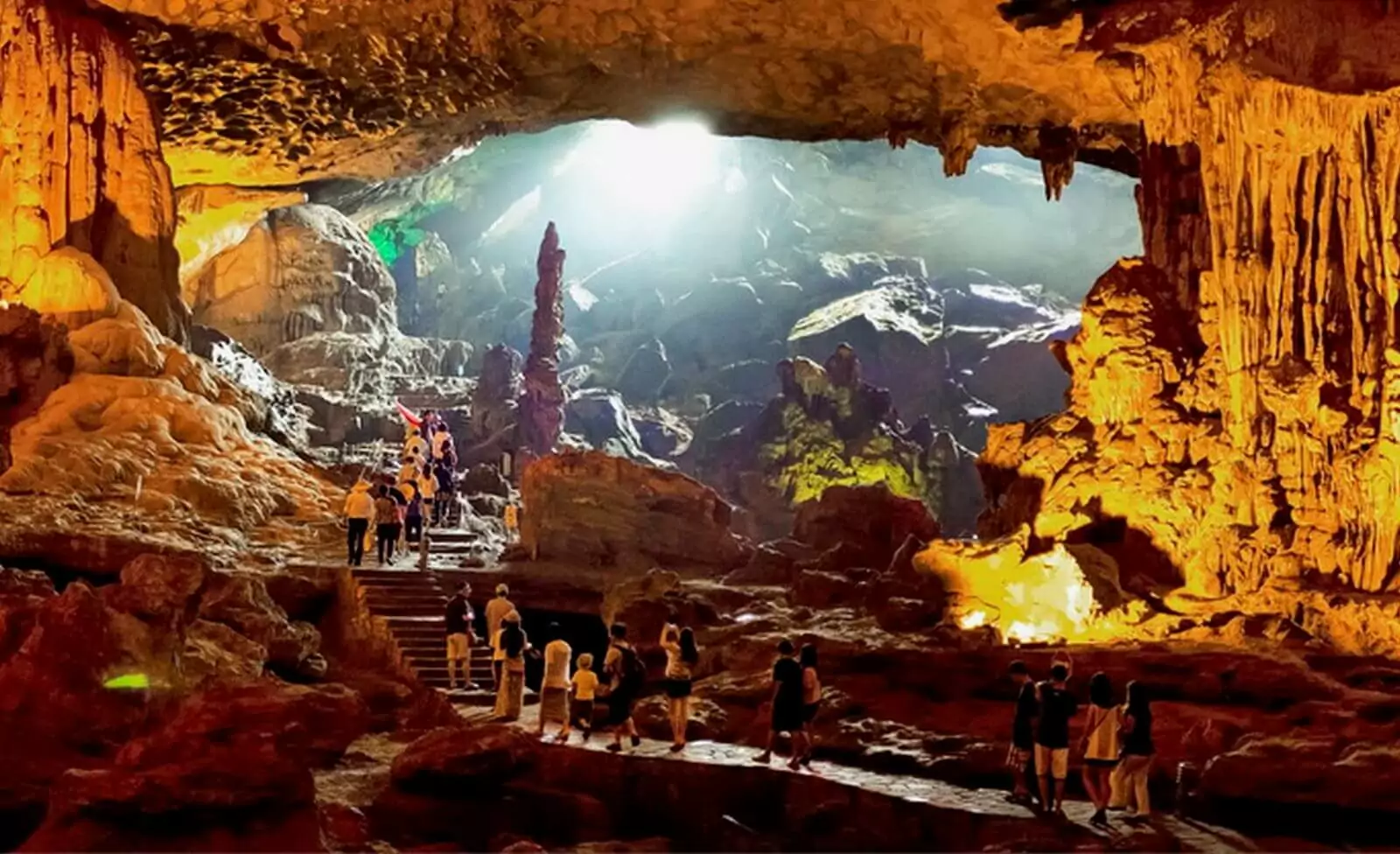 A stone stairway climbs the cliffside of Dau Go Island to Thien Cung Cave’s narrow, jungle-hidden entrance — once so well concealed it remained undiscovered until 1993.
Dau Go Island is itself a destination-rich stop: the island is also home to Dau Go Cave (Cave of Wooden Stakes), one of Halong Bay’s most historically significant caves, located just a short walk from Thien Cung. Geologists believe the two caves were once part of a single, larger cave system that has since separated through millions of years of erosion — both now sit at similar elevations of 20 to 50 meters above sea level on the northern part of the island.
Thien Cung Cave is the centerpiece of Halong Bay Sightseeing Route 1 — a 4-hour cruise itinerary that also includes Dau Go Cave, Cho Da Islet (Stone Dog Islet), Ba Hang Cave, Dinh Huong Islet (Incense Burner Islet), and Trong Mai Islet (Fighting Cock Islet). Because Route 1 is shorter and closer to the harbor than Route 2 (home to Sung Sot Cave), it is a popular choice for visitors with limited time or those joining a half-day tour from Halong City.
3. History: From Hidden Jungle Cave to Tourist Landmark
Unlike Sung Sot Cave, which was documented by a French scientist as early as 1901, Thien Cung Cave’s modern discovery story is more recent and dramatically simpler: in 1993, a group of local fishermen caught in a sudden storm scrambled up the cliffside of Dau Go Island searching for shelter — and stumbled through a narrow, jungle-obscured crack in the rock into one of the most spectacular cave interiors in all of Halong Bay.
The cave’s entrance had remained hidden for so long precisely because of its narrow, overgrown mouth — easily missed by passing boats and concealed by thick tropical vegetation climbing the cliff face. Once word of the discovery spread, local authorities moved quickly to develop the site, cutting back the jungle growth, carving a stairway up the cliffside, and installing a walkway through the cave’s chambers. Thien Cung Cave officially opened to tourists in 1998, five years after its rediscovery.
Today, Thien Cung Cave is one of the most visited attractions in Halong Bay’s UNESCO World Heritage core zone, included on the itinerary of the vast majority of half-day and full-day Halong Bay cruises operating on Sightseeing Route 1. Its proximity to Tuan Chau Harbor — far closer than the more remote caves of Route 2 — has made it one of the bay’s most accessible and frequently photographed natural wonders.
4. The Legend of the Dragon King’s Wedding
No visit to Thien Cung Cave is complete without understanding the legend that gives the “Heavenly Palace” its name.
According to Vietnamese folklore, the Dragon King ruled the seas of Halong Bay, protecting local fishermen and farmers from invaders and storms. After one such victory defending the land, the Dragon King returned to his cave palace — only to face a new crisis: a severe drought had struck the region, crops were failing, and the people were starving. Desperate, villagers set out to find the Dragon King and beg for rain, but the path to his cave was treacherous, and many who attempted the journey never returned.
Among those who succeeded was a young woman named May (sometimes told as “Cloud” in English retellings). The Dragon King, moved by her courage and beauty, fell in love with her. Their wedding was celebrated for seven days and seven nights at the heart of the cave — an extravagant ceremony attended, according to legend, by gods, genies, fairies, and dragons from across the heavens. Stone elephants danced, giant pythons coiled around ancient banyan trees, lions performed with flowing manes, and eagles soared with wings outstretched — every guest and gesture of celebration said to be preserved today in the cave’s stalactite and stalagmite formations.
The Dragon King and May went on to raise 100 children together inside the cave. When the children grew, May took half of them south to explore and settle new lands across Vietnam, while the Dragon King remained in Halong Bay with the rest, continuing to guard the bay and its people. Visitors who listen closely while walking through the cave’s chambers report hearing a faint, rhythmic drumming sound — locals say it is the echo of the Dragon King’s wedding drums, though geologists explain it as simply the wind moving through the cavern’s narrow passages.
A note on the legend: Different guides and sources tell slightly different versions of this story — some name the bride “May,” others “Cloud” or “Princess May”; some describe a 7-day wedding, others simply “a spectacular wedding.” This variation is typical of oral folklore passed down across generations, and it adds rather than detracts from the cave’s storytelling charm. Ask your local guide for their own telling — every cruise operator has a favorite version.
5. Inside the Cave: 3 Chambers Explained
Reaching Thien Cung Cave requires a short climb: a stone stairway, often damp and partially shaded by overhanging jungle, leads up the cliffside of Dau Go Island to the cave’s narrow entrance. The contrast between the modest, vine-covered mouth of the cave and the soaring chambers that open up beyond it is, for many first-time visitors, the most striking moment of the entire visit.
5.1 Chamber 1 — The Entrance Hall
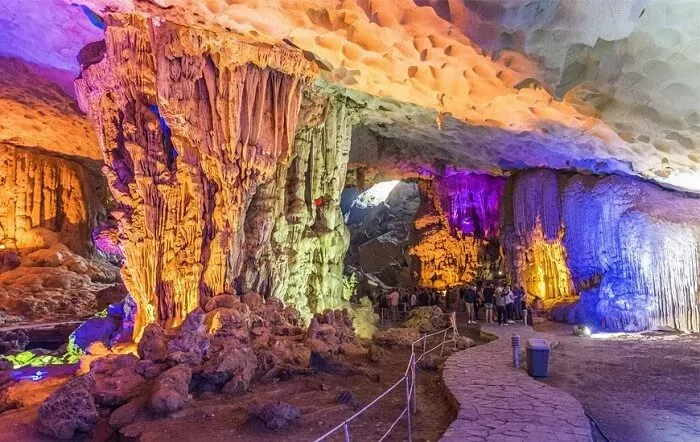 The first chamber of Thien Cung Cave features a dramatically high ceiling and stalactites resembling natural chandeliers, an immediate introduction to the cave’s heavenly palace theme.
The first chamber greets visitors with a dramatically high ceiling and a sweeping stone mural along its eastern wall, depicting mythical figures said to be guests of the Dragon King’s wedding. On the northern wall, formations resembling fairies appear to dance in celebration. Massive stalactites hang from above, lit by colorful lighting that local guides liken to natural chandeliers — an immediate and unmistakable introduction to the cave’s “heavenly palace” theme.
5.2 Chamber 2 — The Heart of the Cave
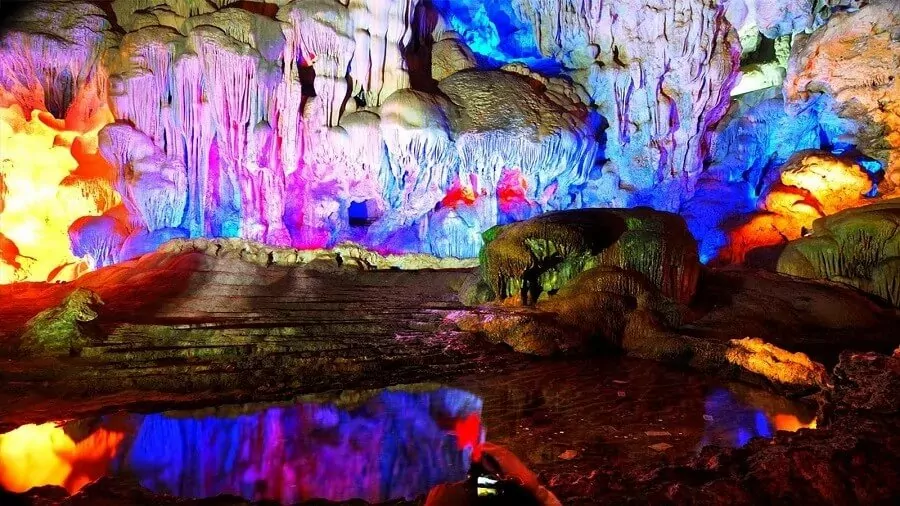 Four towering limestone pillars rise through the heart of Thien Cung Cave, naturally sculpted into shapes said to depict scenes from the Dragon King’s wedding feast.
The second chamber is the most elaborate and celebrated section of Thien Cung Cave. Four towering limestone pillars — said to hold up the cave’s “roof of heaven” — rise through the center of the space, their surfaces naturally sculpted into shapes resembling birds, fish, flowers, and scenes from daily human life. Surrounding formations are said to depict the wedding feast itself: dragons soaring through stone clouds, elephants and lions frozen mid-dance, pythons coiled around banyan trees, and eagles with wings outstretched. The chamber’s acoustics produce soft, lingering echoes that add to its otherworldly atmosphere, and it is widely considered one of the best spots in all of Halong Bay for cave photography.
5.3 Chamber 3 — The Ponds of May
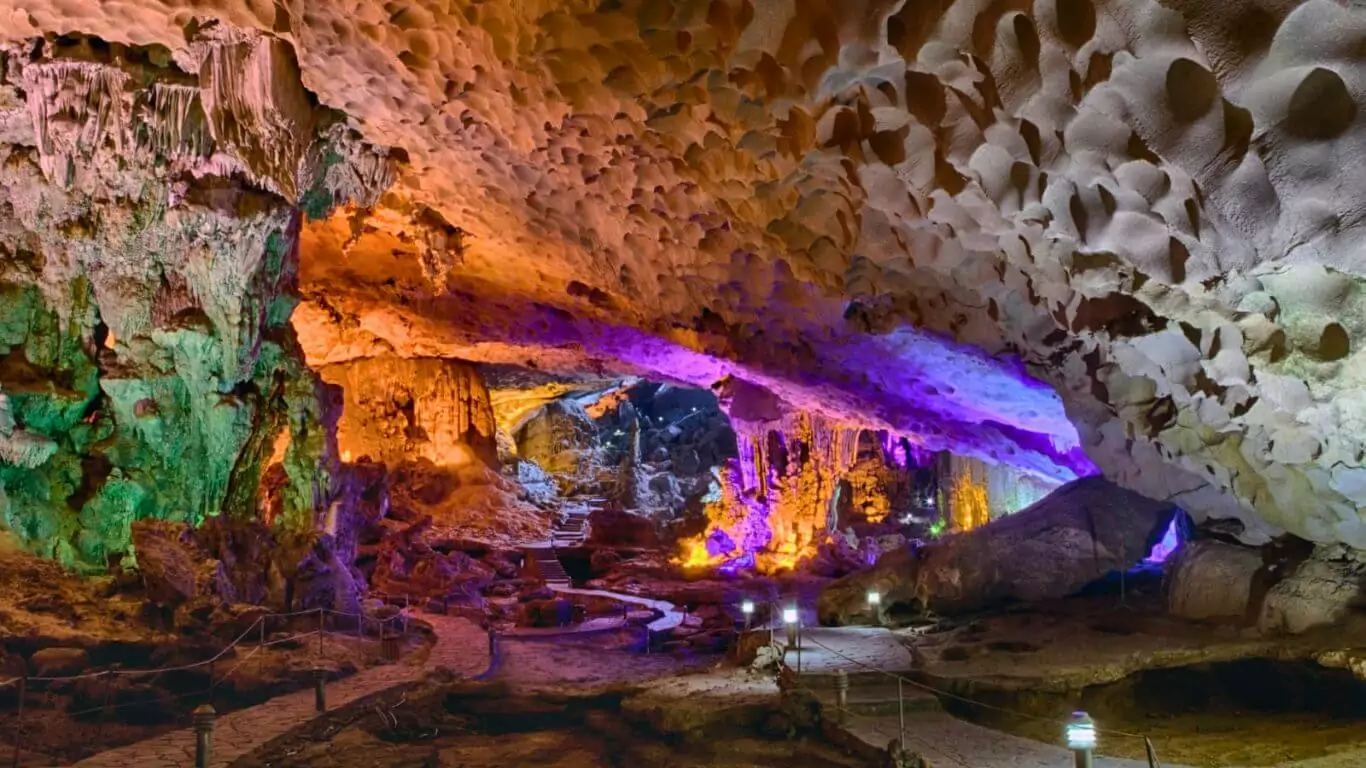 Three clear, naturally formed ponds in Thien Cung Cave’s third chamber — said in legend to be where May once bathed her hundred children.
The third and final chamber is quieter and more intimate than the first two, centered around three clear, naturally formed ponds. According to legend, these are the very ponds where May once bathed her hundred children. Multicolored lighting reflects off the still water, creating one of the cave’s most photographed and mesmerizing viewpoints. From here, a final stretch of walkway leads visitors back out toward the cave exit and the stairway down to the waiting cruise boat.
6. Ticket Prices & How to Visit Thien Cung Cave in 2026
6.1 Entrance Ticket Prices (2026)
Thien Cung Cave is visited as part of Halong Bay Sightseeing Route 1, purchased at Tuan Chau International Passenger Port or Halong International Passenger Port.
| Ticket Type |
Price (VND) |
Price (USD approx.) |
| Route 1 sightseeing ticket |
290,000 VND / person |
~$12 USD |
| Shared join-in boat |
150,000 VND / person |
~$6 USD |
| Private boat (up to 6 hours) |
1,500,000 VND / boat |
~$62 USD |
Note: These are approximate government-regulated entrance fees current as of 2026. Most cruise packages bundle the Route 1 entrance fee, boat transport, and guide into a single price — always confirm exact inclusions with your operator before booking.
6.2 Halong Bay Sightseeing Route 1
Route 1 is a 4-hour cruise itinerary departing from Tuan Chau Harbor, combining Thien Cung Cave with several of Halong Bay’s other accessible attractions:
- Thien Cung Cave (Heavenly Palace Cave) ⭐
- Dau Go Cave (Cave of Wooden Stakes)
- Cho Da Islet (Stone Dog Islet)
- Ba Hang Cave
- Dinh Huong Islet (Incense Burner Islet)
- Trong Mai Islet (Fighting Cock Islet)
Route 1 is shorter and more accessible than Route 2 (the route that includes Sung Sot Cave, Luon Cave, and Ti Top Island), making it especially popular among travelers on tight schedules, family groups with young children, or those joining a half-day excursion from Halong City rather than a full Halong Bay cruise.
6.3 How to Get There from Hanoi
- By road: Approximately 2.5–3 hours via the Hanoi–Haiphong Expressway to Halong City. Most cruise operators include round-trip transfers from Hanoi.
- By boat from port: From Tuan Chau Harbor, the boat journey to Dau Go Island takes approximately 20–30 minutes.
7. Best Time to Visit Thien Cung Cave
| Month |
Temperature |
Conditions |
Rating |
| October – April |
15–24°C |
Dry season, clear skies, comfortable for climbing the entrance stairway |
⭐⭐⭐⭐⭐ Best overall |
| March – May |
20–22°C |
Bright skies, mild temperatures, occasional light rain |
⭐⭐⭐⭐⭐ Excellent weather |
| October – November |
26–28°C |
Sunny and mild, peak international tourism season |
⭐⭐⭐⭐ Popular |
| July – September |
26–28°C |
Humid, possible typhoons; stone steps can be slippery |
⭐⭐⭐ Manageable with caution |
Pro tip: Visit on a half-day Route 1 cruise departing the harbor early in the morning to enjoy Thien Cung Cave with fewer crowds — tour groups from Halong City tend to arrive in waves through the mid-morning and early afternoon.
8. Practical Tips Before You Go
- Wear non-slip shoes. The stairway to the cave entrance and the floor inside are frequently damp — sturdy, rubber-soled footwear is essential.
- Hold the handrail on the climb up. The stone steps to the entrance can be uneven and slippery, especially after rain.
- Bring a camera for the colored lighting. The multicolored illumination inside the chambers photographs beautifully but can be tricky to expose correctly — bracket your shots if your camera allows it.
- Budget 30–45 minutes for the full cave walk through all three chambers at a relaxed pace.
- Ask your guide for their version of the legend. Local guides often have personal, slightly different tellings of the Dragon King’s wedding story — part of the charm of visiting with a knowledgeable local rather than self-guiding.
- Pair the visit with Dau Go Cave. Since both caves sit on the same island just a short walk apart, most Route 1 itineraries combine them into a single, efficient half-day stop.
- Mobility note: The stairway and uneven cave floor make this cave unsuitable for visitors with significant mobility limitations.
9. Thien Cung Cave — Frequently Asked Questions
The questions we get asked most often by travelers planning to visit Thien Cung Cave (Heavenly Palace Cave) in Halong Bay.
Last updated: June 2026 | Information verified against multiple Halong Bay tourism sources and Wikipedia. Some figures (founding accounts, exact dimensions) vary across local sources and are presented as approximate where applicable.


